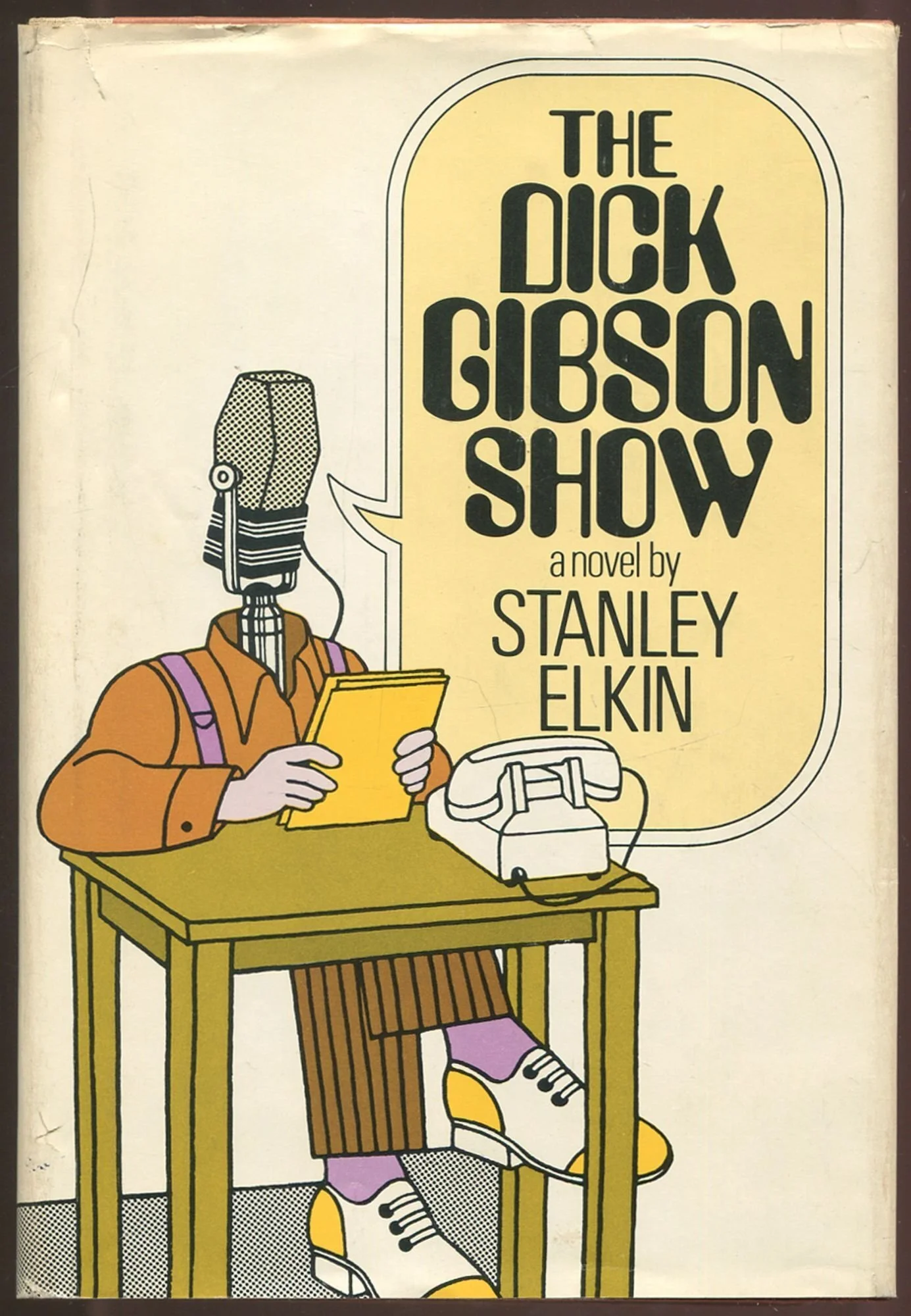
Book Review : Stanley Elkin - The Dick Gibson Show (1971)
Chuck Klosterman once said something along the lines of (I'm not sure where): "If you write a book, make sure you like it. Because in 50 years from now, you'll most likely be the only person to remember that you did". Very few people in my life know who Stanley Elkin is or why he deserves to be remembered except me and I owe this knowledge solely based on David Foster Wallace namedropping him in a random interview from years before he even wrote Infinite Jest.
Elkin passed away in 1995, almost twenty-five years after publishing The Dick Gibson Show. A novel about radio, but also about the internet and why it's unbearable.
The Dick Gibson Show tells the story of a radio anchor who may or may not be named Dick Gibson. He has other on air identities such as Ted Ellery and Marshall Maine. Before he is a person, Gibson is a voice in the night and gives one to the voiceless, the freaks of America who don’t have anything better to do than listen to the radio at night. Never the one to care about informing the people, Dick Gibson created a layer of reality only accessible in real time and it is quite the spectacle.
The White Noise of Freedom
One thing that is becomes quickly evident upon reading The Dick Gibson Show is how cacophonous it is. It's full of long monologues, not all of them matter and not all of them are from Dick. That matters because this chaos is at the heart of what Stanley Elkin is trying to express here: democratizing celebrity as an equal opportunity business is an expressway to a lack of meaning. Giving attention to untalented and unpurposeful people for entertainment's sake is devaluating talent and purpose.
If that happened, it’s because late night radio offered air time with little value that still required to sell ad space. So charlatans, niche interest experts and people in odd predicament like a 9 years old millionnaire orphant became purveyors of a different kind of spectacle. The kind of spectacle you’d only need a TikTok account to run today. Stanley Elkin had foreseen the hyperdemocratization of broadcasting of social media and the clusterfuck of communication it would create.
But Elkin doesn't just point the finger. He underlines the loneliness that connects marginal broadcasters and late night listeners. The guests on the Dick Gibson Show are social outcasts looking for connection to other social outcasts. Stanley Elkin’s novel is not a pamphlet against radio, he seems genuinely interested in why people are listening to radio late at night. Radio (as do social media) offer a utilitarian relationship where breaking silence and isolation is more important that whoever is talking to you.
The Part That’s About Demonic Possession
If you're one of the rare creatures who’s actually read The Dick Gibson Show, you know there’s a lengthy chapter about one episode where reality goes haywire. The one where Gibson received Dr. Edmond Behr-Bleibtreau, a psychologist interested in psychic phenomenon and the powers of mind over matter. Since Dick basically exists as a voice in the night, Behr-Bleibtreau steals his identity from him in order to prove a point and literally becomes Dick as a consequence.
It's a testament to the instability of language as a last rampart against oblivion. It's a volatile and slippery commodity that can mean something at one moment and mean something completely else the next. Hence the possession as a proof of concept. Once again you can find echo of this concept in contemporary times where engaging to someone online transforms your personality. It makes you possessed with a purpose that isn’t yours and turning you a puppet for an agenda you don’t control.
*
The Dick Gibson Show is a nerdy, cerebral novel about what happens when everybody is given a voice in order to keep oblivion from the doorstep. It's funny, whimsical and yet has profound insight into the consequences of silence on contemporary society. It’s a challenging novel to read, but it will build bridges in real time between the different eras of the emergence of mass media. It has staying power for the twenty-first century because it offers insight on a media that still matters.
7.7/10
* Follow me on Instagram , Bluesky and Substack to keep up with new posts *