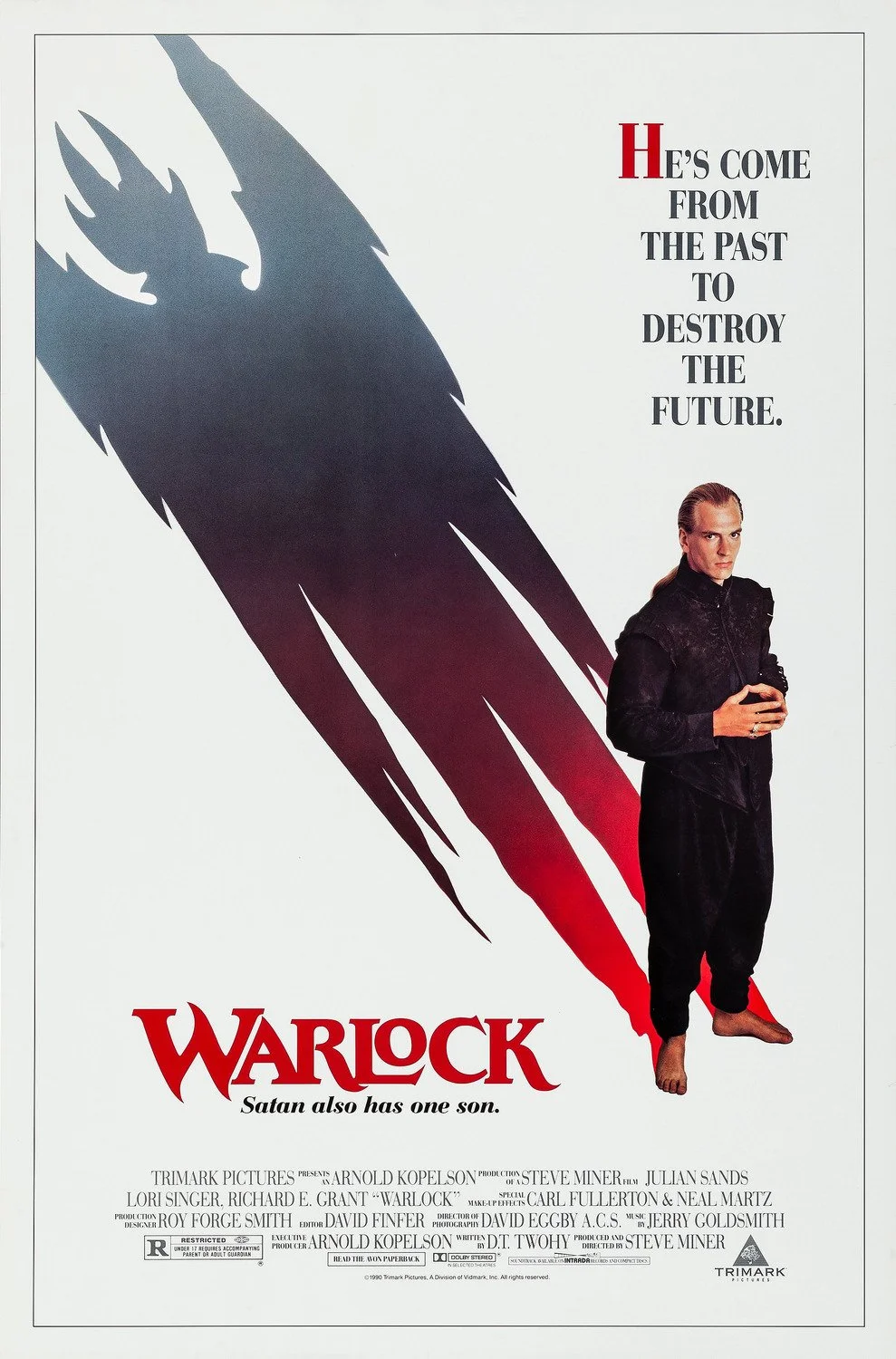
Classic Movie Review : Warlock (1989)
My only childhood memory of Warlock is walking into the living room just as the villain makes a man bleed from the eyes, and my dad (clearly done with his day) snapping at me to get out. Not "this is too scary," but just "leave'", like I’d violated some obvious boundary. It was small, stupid and it stuck. Some primitive part of me has been watching horror movies ever since like they’re back taxes I’m determined to collect.
Maybe that’s why I avoided Warlock for decades, pretending it was beneath me when really I just didn’t want to revisit the scene of the crime. But watching it now, it’s not the movie I imagined. Sure, it’s about a guy with supernatural powers and shampoo-commercial hair, but underneath the VHS chaos there’s this lingering idea that America once believed good and evil were fixed coordinates and that the slightest whiff of progress made everyone nervous.
Because Warlock, goofy as it is, treats morality like a relic: something carved in stone, then quietly eroded by the modern world while no one was paying attention.
Warlock is basically a cosmic grudge match stretched across three centuries. It starts in 1691, where witch-hunter Giles Redferne (Richard E. Grant) is about to execute the Warlock (Julian Sands), a guy powerful enough to kill Redferne’s wife and smug enough to look good doing it. But instead of accepting his sentence like a proper villain from the seventeenth century, the Warlock slips through a time portal and crash-lands in late-twentieth-century Los Angeles.
Redferne, fueled by revenge and whatever passed for justice back then goes in after him. The two of them spill into modern-day America, where the moral landscape looks simpler at first glance: freeways, diners, actual plumbing, but turns out to have its own kind of witchcraft. What follows is a cross-time cat-and-mouse chase where old-world absolutism collides with a future that’s way more ambiguous than either man expected.
The Face of Evil (Looks Awkwardly Good)
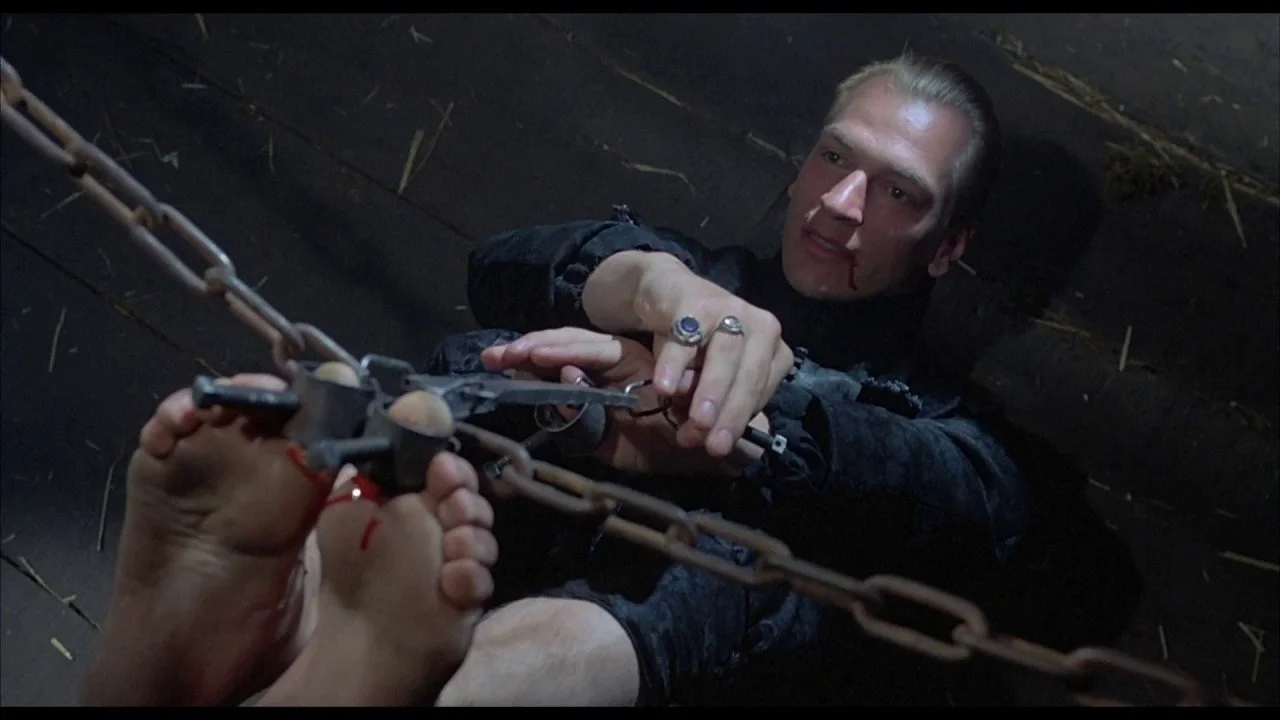
This movie is about a sexy, dead-eyed sorcerer who arrives in 20th-century America still operating under the moral code of 1691, meaning he kills LGBTQ+ folks, Mennonites, kidnaps women, and generally terrorizes anyone who isn’t Giles Redferne, sworn enemy of evil and owner of the most righteous wig in colonial history. He flies, teleports, weaponizes the evil eye (which is why that poor Mennonite farmer springs a leak) and demonstrates that you don’t need technology when you’ve got a standing contract with the guy running Hell’s mergers and acquisitions department.
What’s wild is that if Redferne had been teleported into the future without the Warlock, he’d probably condemn the same exact people for sorcery, because they all diverge from the only lifestyle he recognizes as moral. But the movie doesn’t care, because in 1989 "good" just meant "the guy chasing the bad guy". Evil was simply whatever your enemy believed in. And in that sense, the Warlock plays like an accidental prototype for Mark Zuckerberg: a supernatural disruptor using forbidden tech to consolidate power for himself alone.
He’s basically Ronald Reagan’s Ghost of Christmas Future, except hotter and significantly more honest about who he serves.
The most perceptive among you will notice that Warlock sorts good and evil using the same logic the WWE uses to distinguish faces from heels: you’re "good" if the script says you are and "evil" if someone points at you and boos. That makes the film a morality tale, which is always dangerous territory, because once you start defining virtue by decree, anything can be condemned if condemned with confidence.
What makes Warlock perversely fun is the way it accidentally undermines its own system. Redferne doesn’t realize that the last 300 years have completely redefined who counts as a threat; he just assumes difference is still criminal because it was criminal in 1691. So his holy crusade collapses into something smaller and much more human: a man chasing the guy who killed his wife and refusing to admit that’s all it is. If you want to feel truly evil in this universe, you don’t need spells or Satan, you just need to murder someone’s spouse and sprint into the future.
What does it all mean about my father and I?
It’s unclear why my father was so adamant about me leaving the room while he watched Warlock. Maybe I was being a little shit. Maybe he just wanted the living room to himself for two hours. But it’s also possible he wanted to be alone with a weird, convoluted revenge fantasy that made sense to him in ways he never articulated and my sudden appearance, terrified and needy, snapped him out of it. Movies like Warlock are a little like Linkin Park songs: they only make total sense when your emotions are running too hot for subtlety.
The oddness and specificity of using Warlock as a vessel to exorcise a bad day is what fascinates me. My dad only got that invested because it happened to be on TV that night—catharsis by programming schedule, not by choice. No one today would live vicariously through a seventeenth-century witch hunter, but back then you didn’t pick your emotional outlet; it picked you. I’d just walked in on my father in a moment so unfiltered it embarrassed both of us. I feel closer to him now that I understand that.
*
Chances are you’ll never care about Warlock as much as I do, and that’s probably appropriate. It’s not a film designed to matter. But the memory attached to it, the look on my dad’s face as he tried to lose himself in something he didn’t even choose, has followed me far longer than anything in the movie itself. Because the movie was forgettable, the moment became permanent. It fossilized into this strange, private mythology I never quite outgrew, the kind you return to when you’re trying to understand the people who raised you and the silences they lived inside.
Watching Warlock now only confirms what I already knew: it’s a movie about a flying wizard wreaking havoc because the modern world makes soft targets of us all. Not deep, not important, just a distraction that worked once, for reasons that had nothing to do with cinema. And maybe that’s why it lingers. Sometimes a silly good time becomes unforgettable simply because you needed it to be.
7.3/10
* Follow me on Instagram and Bluesky to keep up with new posts *