
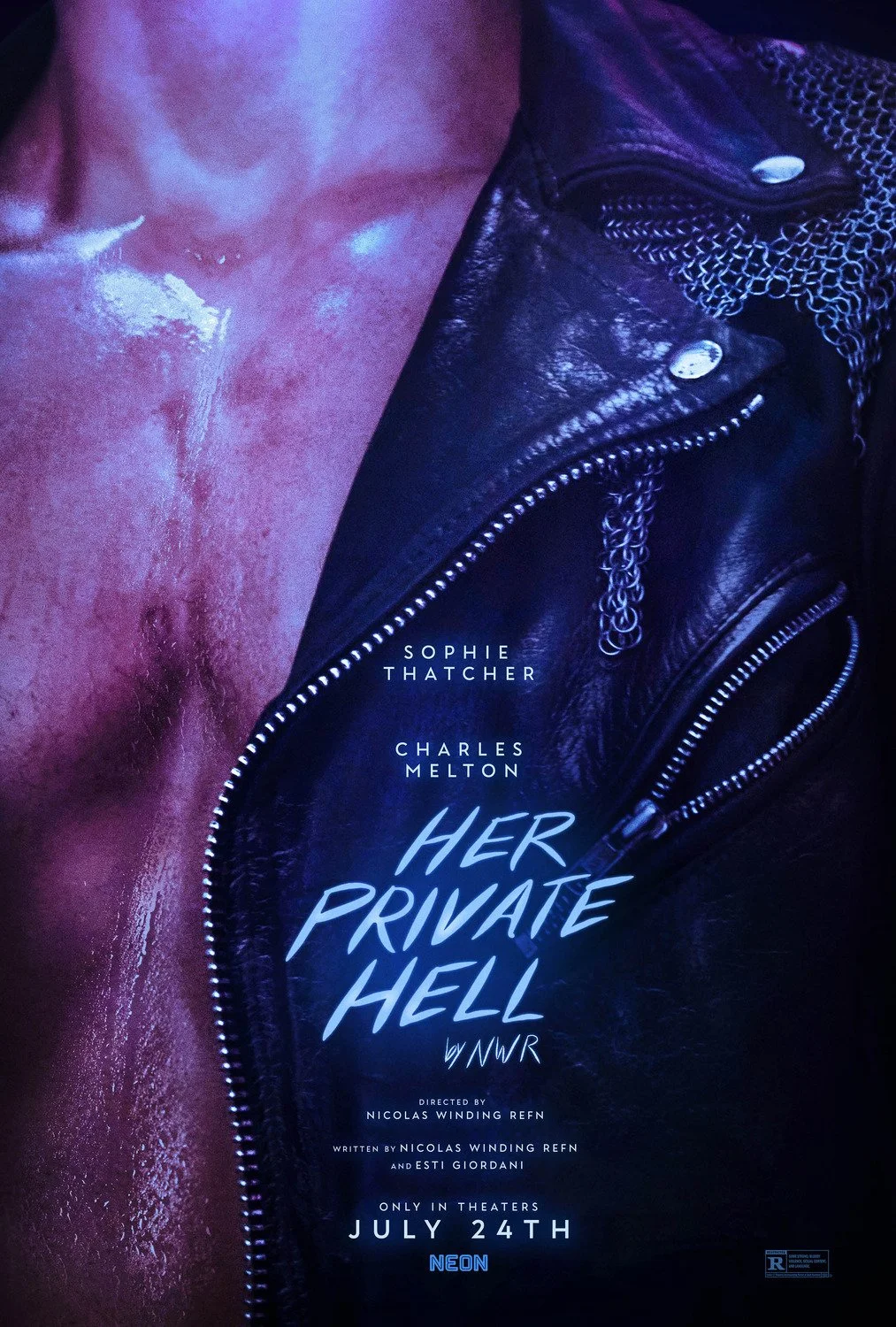
Movie Review : Her Private Hell (2026)
Over the last decade, we have quietly accepted the idea that technology companies should know what we want before we do. Every click, pause, purchase and moment of hesitation is collected, interpreted and converted into a theory about what might keep us from closing the tab. This is usually rationalized as consumer convenience: the companies understand us better, so they can provide more of the things we already like. This makes sense for stocks, but not for art.
I don’t know what the hell I want most of the time. More importantly, I don’t necessarily want to know. I want movies to occasionally behave like a stranger saying something deranged at a party and permanently changing the direction of my evening.
Nicolas Winding Refn’s Her Private Hell is crazy and unpredictable and, for better or worse, made me feel things I’m not accustomed to feeling. It has been polarizing audiences since its Cannes premiere, which is precisely what a Nicolas Winding Refn movie is supposed to do. You do not have to like Her Private Hell. But in 2026, when nearly every cultural product seems engineered to resemble something you already enjoyed, we should be grateful that movies this strange are still allowed to exist.
To make a very long and deliberately confusing story short, Her Private Hell follows Elle (Sophie Thatcher), a young actress shooting a science-fiction movie while a supernatural mist rolls into town carrying a murderous presence known as the Leather Man. Somewhere else, or perhaps somewhere emotionally adjacent, Private K (Charles Melton) is a despondent soldier preparing to rescue his daughter from hell.
What happens next is not linear, logical or especially interested in explaining itself. Elle and Private K drift through separate realities until they gradually discover that they are pursuing the same thing, even if neither of them fully understands what that thing is.
The Privilege of Dreamlike Logic
It is difficult to say whether Her Private Hell is great or terrible, partly because those words presume the movie is trying to succeed at recognizable things. What I can say with confidence is that it is disorienting, liminal and almost offensively gorgeous. Your enjoyment will depend on how willing you are to let images affect you before you understand what they mean, assuming you ever understand them at all.
This is the wager Her Private Hell makes: a movie does not always have to make sense to be gripping. Sometimes logic is not the skeleton holding the experience together. Sometimes logic is the security guard preventing anything strange or interesting from entering the building.
David Lynch spent three decades fighting this same battle and was eventually granted the retrospective privilege of being the dream-logic guy, as though everyone had understood what he was doing the entire time. They had not. Culture simply became comfortable with his confusion after he had repeated it often enough to make confusion look like a genre.
Her Private Hell is at its best whenever it feels least like a Nicolas Winding Refn movie. Whenever it abandons the familiar mythology of neon streets, beautiful sociopaths and bone-crunching violence and becomes something stranger: a space-age vaporwave giallo transmitted from a deserted hotel in another dimension.
My main problem is that Refn does not fully commit to the originality of this vision. Every time the movie becomes exquisitely alien, it retreats toward something recognizable. Private K wanders back into the neon-soaked streets. Men begin punching each other with ceremonial seriousness. Refn starts repeating the images that made him famous, perhaps because even Nicolas Winding Refn occasionally needs the reassurance of Nicolas Winding Refn.
The movie did not need any of this. It had already found something better.

The Art of Cinema History
Another thing I loved about Her Private Hell is how thoroughly it is haunted by film history. Nicolas Winding Refn has never been shy about wearing his influences on his sleeve, although at this point the sleeve has become some kind of ceremonial cape. The bright colors and operatic murders evoke Dario Argento. The rigid compositions, empty spaces and unnerving stillness suggest Antonioni. There are traces of Brian De Palma in the voyeurism and visual gamesmanship, along with one scene that appears to wander directly out of David Lynch’s Blue Velvet.
Without spoiling anything, these cinematic quotations quietly calibrate the emotional weather system you are about to enter. They are more than Easter eggs for people who own too many Blu-rays. They are implicit agreements between a director and his audience: Oh, you like beautiful, unhinged movies? So do I. Let’s go somewhere irresponsible together.
The references Refn chooses are remarkably coherent. Argento, Antonioni, De Palma and Lynch all explored the boundaries of filmmaking, but they were also interested in the less respectable question of taste. How beautiful can violence become before enjoying it starts to feel suspicious? How artificial can an emotion become before it somehow feels more sincere? At what precise moment does good taste mutate into bad taste?
More importantly, is that mutation something an artist can control? Or does every sincere attempt to create something beautiful eventually reveal the specific kind of ugliness its creator finds irresistible?
*
I liked Her Private Hell more than most of Nicolas Winding Refn’s recent work. It is appropriately corrosive, visually intoxicating and almost completely uninterested in behaving like a normal movie. In an era when audiences dissect plot holes as though movies were defective household appliances, I’m grateful someone still has the nerve to work intuitively, follow dream logic and treat realism as an entirely optional feature.
I only wish Refn had pushed the experiment further. Whenever Her Private Hell becomes truly strange, he seems to panic and retreat into the neon streets and ritualized violence he already knows how to make beautiful. The movie keeps opening a door into something exquisitely alien, then returning to make sure Nicolas Winding Refn is still standing behind it.
So yes, I had a good time. I just wish Her Private Hell had been a little more private.
7.3/10
* Follow me on Instagram , Bluesky and Substack to keep up with new posts *