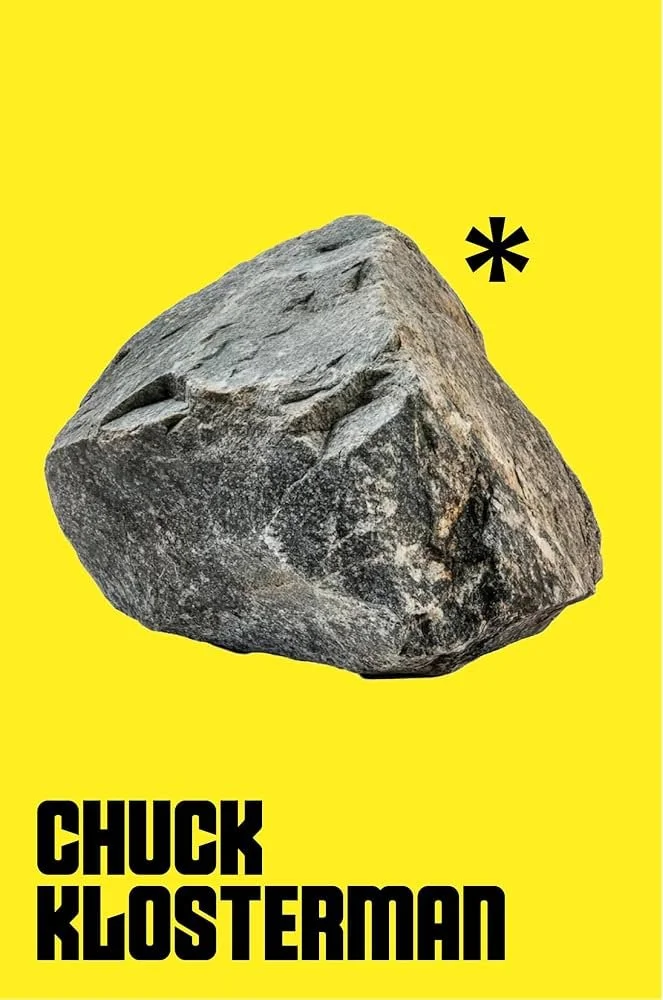
Book Review : Chuck Klosterman - Rock : A Mainstream Alternative History of Alternative Mainstream Music (2026)
When superstar producer Rick Rubin told Anderson Cooper he's been paid obscene amount of money for all his adult life for basically "the confidence I have in my taste and my ability to express whatI feel", almost everybody thought he either lost it or that Rubin secretly was the greatest con artist in modern history. They keyword here being almost. Every paid music critic around the world nodded accordingly and said to no one in particular "oh well, I guess this is also what I do".
There are very little qualifications to become a music critic outside of loving music, listening to a lot of it, being curious enough not to keep listening to the same bands (this is much harder than it sounds) and knowing how to voice your opinion in a compelling manner. This is why critical acclaim and commercial popularity is often completely asynchronous. This is why Nickelback has almost thirty million monthly listeners on Spotify and Wilco only have 2.4.
Music critics are weirdos for whom music in the abstract is way more important than for average people. Someone can have a special relationship to the music of Linkin Park because it reminds him of high school, while a critic could make love to concept of indie rock. But what if it wasn’t the case? What if difficult and emotionally challenging music was what everyone wanted?
I’ve never asked myself this question ever, but it’s what patron saint of this site Chuck Klosterman asked himself in his second book of this year Rock : A Mainstream Alternative History of Alternative Mainstream Music and what happens is not exactly Freaky Friday 2 with awkward cousins at a family reunion instead of a mother and daughter. It's not simple at all.
Rock isn't an essay, but it’s not a novel either. It's a thought experiment akin to his HYPERtheticals and SUPERtheticals card sets, except it goes on for over three hundred pages. Klosterman's often been doing hypotheticals of the sort on sliding door moments in sports history on Bill Simmons' podcast, but this is by far the most extensive version of this exercise that I know of. The starting point : what is The Velvet Underground became the world's most important rock band instead of The Beatles?
For Better Or Worse
Unlike what you might think, replacing the cultural impact of The Beatles by the cultural impact of The Velvet Underground doesn't create a music nerd utopia where Eliane Radigue plays in massive concert halls and becomes the most sought-after film score composer in Hollywood. Sanguisugabogg and Taylor Swift don't swap playing venues. Several thing happens because of this reversal of fortunes, but one of the most important is that nothing is taken at face value anymore. Even when it should be.
Because the essence of criticism lies in deconstructing an aesthetic proposition, but sometimes there is nothing to deconstruct. As The Velvet Underground & Nico explode in Chuck Klosterman's theoretical universe, the accessibility and wholesomeness of The Beatles becomes immediately suspicious. It can't mean what it pretends to mean. In a world where criticism reigns king, you cannot straightforwardly offer people a good time with heartfelt songs set to groundbreaking melodies.
This intellectual headlock will haunt rock history throughout the book. Sometimes it will discredit a band. Sometimes it will legitimize them because critics will have found (or just create) a meaning to their music that may or may not belong, with Duran Duran being given as a case study. The appeal of a band becomes completely divorced from any spontaneous reaction. Spontaneousness becomes distrusted and the crazy thing is that music doesn't get necessarily better for it.
To me, what was the best (and most culturally intelligible) point Chuck Klosterman is making is by turning the grunge revolution on its head, making Lenny Kravitz into a type of underwhelming Kurt Cobain figure built by the villainous National Association of Rock Critics (NARC) as this savior figure for a culture that questions everything except its own taste. Nothing against Lenny Kravitz, but if being properly rated was an Olympic sport, he'd be in the conversation for gold medal every four years.
What We All Learned About Criticism and Commerce
Now, why has Chuck Klosterman's thought experiment turned the way it turned? The easy answer would be that NARC ruined everything because of their intellectual greed. After all, they’re the bad guys and The Velvet Underground allowed them to kidnap something that should have no master. NARC are definitely a catalyst for the failed utopia of hypermeaningful music Klosterman presents in Rock, but it's not because of something they did. It's because of something they prevented from happening.
By making countercultural feelings and ideas mainstream by default, NARC has handicapped the mechanisms that allow counterculture to emerge in the first place. I'm going to give the example of Lenny Kravitz again because it's the one I understand the best, but there was no grunge movement because there was no hypercommercialism of the eighties to rebel against in Chuck Klosterman's alternative history. If everything is intellectually curated, there is no space left for emotional explosions.
If criticism and commerce are fundamentally divorced, it's a good thing. At least, most of the time. Smart and groundbreaking music can be commercially successful to an extent (hello Radiohead), but if the impetus for making smart and groundbreaking music is that it’s supposed to be what everybody wants, it's not going to be groundbreaking anymore. Hence NARC starting to manufacture meaning for random bands in order to maintain dominion over popular taste. It becomes quite the mindfuck.
Rock is Chuck Klosterman's most unassuming and accessible non-fiction book, but it’s paradoxically his most demanding. It has been compared online to Danny Boyle's Yesterday where The Beatles never existed and the comparison is not wrong although it's a hundred percent on the money. Every band still exist more or less in the form we know in Klosterman's alternative universe, it's us who are different and it influences the music and cultural history in ways that are slightly disappointing.
Paradoxically again, I find that it is the only satisfying outcome possible. Anything else would've been gimmicky.
*
For the first time since reading The Visible Man, I spent most of a Chuck Klosterman book asking myself whether or not I'm actually enjoying it. One of its weirdest quirks is that he doesn't sound like himself. He writes in the style of a very depressed (and oddly sober) Lester Bangs and does a great job at it. But once I've understood what exactly Klosterman was going for in Rock, I was all-in. This is a great book and the greatest thing about it is that it's not written by the Chuck Klosterman we know.
8.7/10
* Follow me on Instagram , Bluesky and Substack to keep up with new posts *