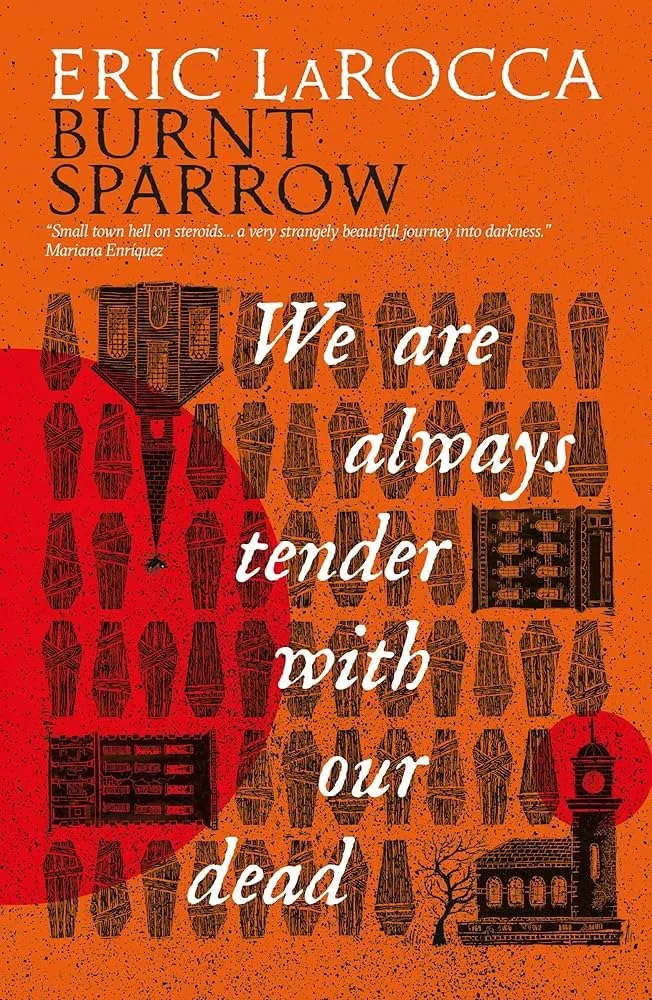
Book Review : Eric LaRocca - We Are Always Tender With Our Dead (2025)
The best novels almost always have middling reviews. A wise man once told me "once your ideas start to circulate, disagreement becomes inevitable. People who disagree with what you're doing can't ignore you anymore". Strong work doesn’t repel people on purpose, but it does wander into emotional rooms most of us prefer to keep locked and it refuses to apologize for looking around once it’s inside.
That’s why Eric LaRocca’s We Are Always Tender With Our Dead, the first Burnt Sparrow novel, currently sits at a modest 3.41 on Goodreads, buoyed by 976 readers who couldn’t quite agree on what they’d just experienced. This is not a failure of execution. It’s a record of discomfort.
The novel takes place in the small, isolated town of Burnt Sparrow, where an act of unspeakable violence against the community has been perpetrated by a faceless family. Rupert Cromwell, a thoughtful and already wary teenager, follows his father as the town attempts to metabolize what has happened. The deeper Rupert goes, the more the familiar becomes suspect.
Longstanding distrust curdles into something sharper, especially around figures like the unsettling Mr. Esherwood, who volunteers to imprison the guilty family himself, promising to teach them the true meaning of suffering, as if that phrase has ever led anywhere humane.
The main thing is that the main thing is never the main thing
Here’s where Eric LaRocca quietly separates good horror from great fiction. We Are Always Tender With Our Dead is not a novel debating whether torture is right or wrong. That decision has already been made, by the townsfolk, by the narrative, and implicitly by the reader before they ever open the book. What’s actually at stake is something far more intimate and uncomfortable: the question of how a young person decides what their own suffering is for.
That’s the real unease of the novel. Not the violence itself, but the dawning realization that pain doesn’t automatically make you better or worse. It just asks you to choose who you’re willing to become once it’s done with you.
And this is the part that likely grinds the wrong gears for certain readers. Because suffering is not a metaphor here; it’s a given. You’ve suffered. I’ve suffered. Those experiences reshaped us into the people we are now. But Rupert Cromwell is not an avatar for righteous indignation or moral clarity. You cannot project yourself into him comfortably. He is not a corrector of wrongs. He’s fragile, observant, and deeply interior,a teenager who won’t even entertain the idea of enacting justice himself.
This isn’t a story about the town, or even about the faceless family. It’s about Rupert. And that distinction makes all the difference.
And that’s where the novel performs its most effective gut check. If you pick up a small-town horror story about answering senseless violence with more senseless violence, your expectations matter. Do you believe violence inevitably multiplies? Do you believe escape is a moral failure? Do you believe certainty is strength? We Are Always Tender With Our Dead refuses to tell you what Rupert should want or where he should go and that uncertainty is the point. The discomfort comes from being forced to look alongside him, without the relief of an answer. That shared unease is what made this novel linger for me long after I closed the book.
The Quiet Charms of Burnt Sparrow
This is my third Eric LaRocca novel, and by a considerable margin, it’s his most controlled and the one that feels most distanced from the Clive Barker influence. The atmosphere lands somewhere between seventies folk horror and those indie video games coded by a single person, where the tension comes from choices, puzzles, silencesand unresolved paths rather than combat.
The near-absence of physical confrontation involving Rupert doesn’t deflate the dread, it amplifies it. Violence always feels imminent, always just offscreen, like a jump scare that never quite arrives. Which, fittingly, is exactly how the town of Burnt Sparrow operates: quiet, watchful, and permanently braced for something terrible it has already decided how to justify.
Maybe this is just a wiring issue on my end, but the opening chapter — where genuine urgency crashes into Rupert’s self-preserving teenage apathy — reminded me of the first sequence ofThe Last of Us. From there, I never quite escaped the indie horror game logic of it all. Even the dinner scene at End House didn’t play out like prose so much as a series of dialogue options hovering over slightly distorted faces, every polite exchange vibrating with the possibility of something going wrong.
That’s the quiet trick of Eric LaRocca’s writing: its almost old-fashioned courtesy, its refusal to hit expected genre beats. The restraint becomes the horror. And that deliberate disinterest in doing what horror novels are "supposed" to do feels like one of the more genuinely exciting developments the genre has had in some time.
*
I completely understand why We Are Always Tender With Our Dead upsets people, and I’d argue that every negative reaction only proves what the novel is doing. This isn’t a book designed to entertain you in the conventional sense; it’s designed to gauge you. It asks what you’re willing to look at, and what you instinctively turn away from when nobody is forcing you to stay.
The horror isn’t just what happens on the page, but what those events quietly activate inside the reader. LaRocca makes the reading itself feel like a moral act. The novel is deceptively easy to read, but strangely difficult to process, and that imbalance is exactly why it lingers. It’s why it will continue to polarize readers and be talked about. It’s what great art is meant to do. Starting 2026 with a bang.
8.7/10
* Follow me on Instagram and Bluesky to keep up with new posts *