Book Review : Logan Berry - Doom is The House Without A Door (2025)
The late, great David Lynch was one of the only artists I’ve ever known who became celebrated for not being understood. He was a tiresome exception that never became a rule about anything. Lynch influenced countless artists over his lifetime, but he was too peculiar and unpredictable to ever be copied. I thought of Eraserhead, Blue Velvet and even Lost Highway while reading Logan Berry's novel Doom is the House Without a Door, but only the way you think about a nightmare you can’t describe the morning after.
It doesn't feel anything like a David Lynch movie at all, but it’s undeniably a narrative meant to be felt rather than understood the way most of novels are and we all know who democratized these.
It’s not immediately clear what Doom is the House Without a Door is about and that’s both a strength and a liability. On the surface, it follows a husband and young father whose grip on himself is slowly disintegrating. Page by page, his mind drifts to visions of violence and death that never quite announce where they’re coming from. There’s no real twist, no hidden redemption. You’re not watching someone solve their problems, you’re watching someone dissolve into them.
It’s less a story than a slow-motion crash, and you, the reader, are trapped in the passenger seat, unable to look away.
The Perils of Aporia
I’m sorry, but I’m gonna have to put my lit nerd suit on. Don’t blame me, blame Logan Berry.
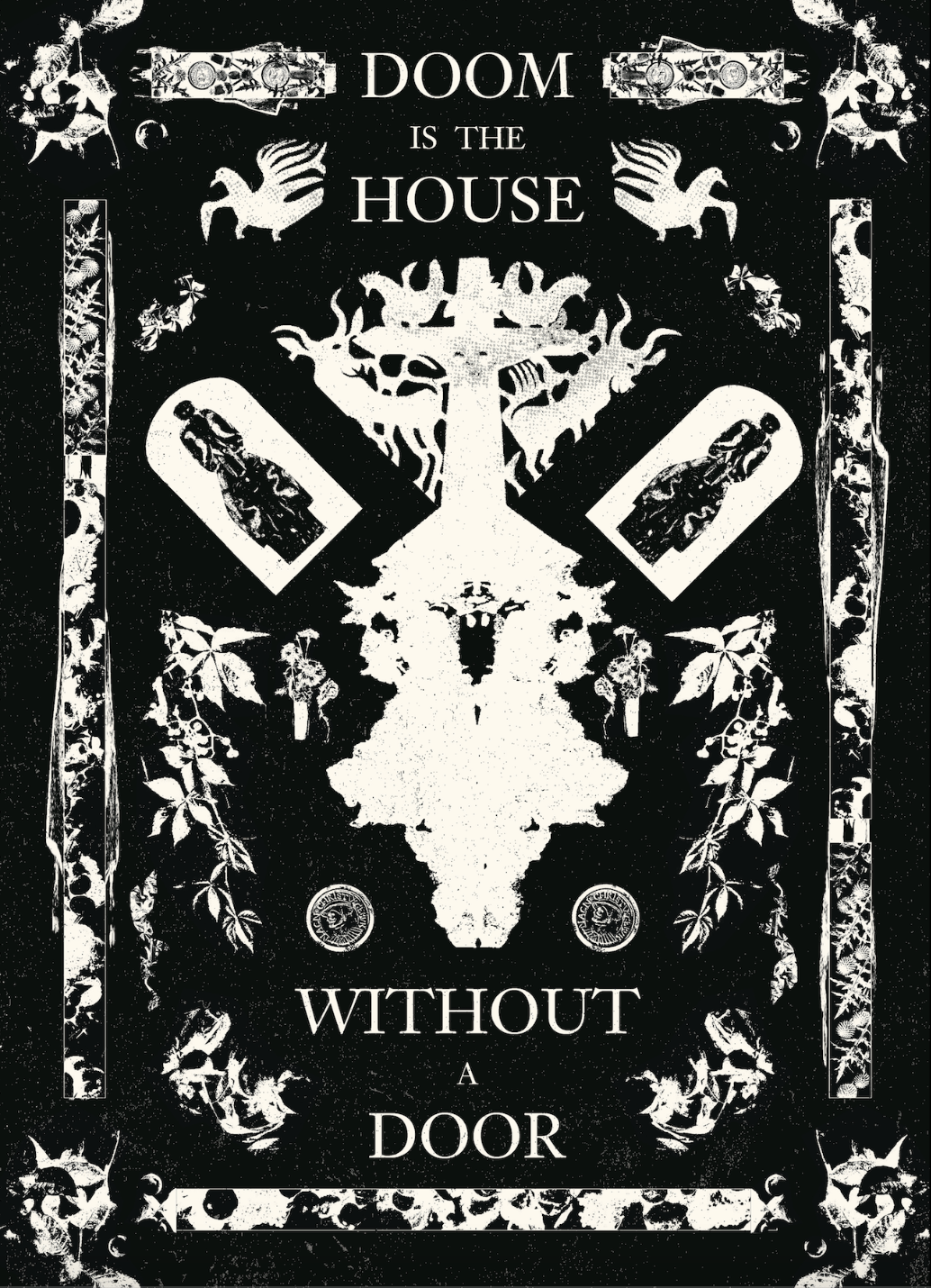
It goes without saying, Doom is the House Without a Door is not a conventional novel. It’s not even conventional in its presentation as the artwork is also a part of the storytelling. The first thing it reminded me of was the writing of Blake Butler, an author who I really love. Logan Berry’s odd, shamanistic use of language challenges its sacred duty of representation with raw and intuitive imagery.
You get images like corpses swimming in fire crashing against something as ordinary as a family trip to the zoo. It doesn’t line up neatly, but that’s the point. It’s not coherence Berry is after. It’s pain, raw and intuitive, smuggled straight into your bloodstream. And it works up to a certain degree. I don’t mean to say you need to be a dude to understand this novel, but as a man, I understand the surges of agression when you feel trapped in a situation you’re not meant to be in. It’s illogical and unhealty, but it’s there.
Where Doom is the House Without a Door stumbles is when it confronts the violence consuming its protagonist. The source of that violence is never clear: is it his own suppressed rage, a mental collapse, or some half-glimpsed supernatural force? The novel meanders in that uneasy in-between. Jacques Derrida had a word for this: aporia. Ugh, feel like I need a shower just for bringing him up. It’s the condition of pure bewilderment, where no path forward is possible because no answers exist.
That’s where Berry leaves his character, and by extension, his reader. Which is interesting on a theoretical level, but dramatically it feels like a shrug. What happens to the protagonist simply… happens, and I can’t help but feel cheated by that. We’re talking about the protagonist committing supreme horror here. It’s not something that just happens to you.
The Right Way To Talk About Violence
The main difference between Logan Berry and Blake Butler is intent. With Butler, it doesn’t matter if the prose collapses into unreadable static halfway through, you still know what he’s talking about. 300,000,000 was a middle finger to the concept of death itself. Alice Knott staged a metaphysical trial between living art and dead art. There’s always a target in his chaos, a clear idea smuggled through the noise. With Berry, that center never quite materializes.
In Doom is the House Without a Door, violence is everywhere: seeping, muttering, bleeding through the margins, but it never crystallizes into a statement. It’s less rebellion than observation, and that vagueness keeps the novel suspended between haunting and hollow. The protagonist gives in to it and eventually lets himself be consumed by the chaos. I would accept this if the novel was about the protagonist disappearing or even taking his own life, but I need to know why he murders his family. I can’t just happen.
To give credit where it’s due, the illustrated sections of Doom is the House Without a Door (designed by Mike Corrao) push things closer to an answer. The pages are scattered with commercial imagery, insane bills, doodles, graffiti, like the inside of a brain that can’t stop picking up junk signals. You get the sense of a man drowning in the noise of ordinary life and fantasizing about just pulling the plug. It gestures toward a mind that’s racing too fast, burning out its own wiring.
But here’s the problem: that doesn’t automatically make him interesting, or even sympathetic. Most people are overwhelmed. Most people find ways to cope. What Berry gives us is collapse without resistance, which is honest but also strangely inert.
*
Doom is the House Without a Door is an intriguing experiment that never quite stares its own horror in the face. There are moments of impact (the scene where the protagonist deals with his father-in-law), but they drift in and out like static, never building toward a perspective on violence beyond the bleak shrug of “it happens, and there’s nothing you can do.” That’s chilling, yes, but it’s also unfinished.
Fiction, even when it wants to terrify, has a responsibility to push past inevitability : into meaning, misdirection, even madness (like Butler does). Berry gestures at all of these, but never commits. The result is a novel that feels like watching a nightmare through a window: unsettling, but ultimately happening to someone else. We’re far from Lynch here. I don’t know how to feel. We’re far from Butler, because I don’t know what Logan Berry wants to say, but I do feel like he’s in the right direction.
6.1/10
* Follow me on Instagram and Bluesky to keep up with new posts *