Book Review : Steven L. Peck - A Short Stay in Hell (2009)
No one eat at McDonald's because it's delicious. You eat junk food because it’s easy, it satisfies a crave and more important, you know exactly what it's going to taste like. Not every meal can be a gourmet experience or even a healthy one. It's a matter of balance. This logic is also why not everyone has read Dostoevsky or watched Fellini's filmography. Some art is popular because it's exquisite, other because it delivers thrills and ideas in ways that are vivid and accessible.
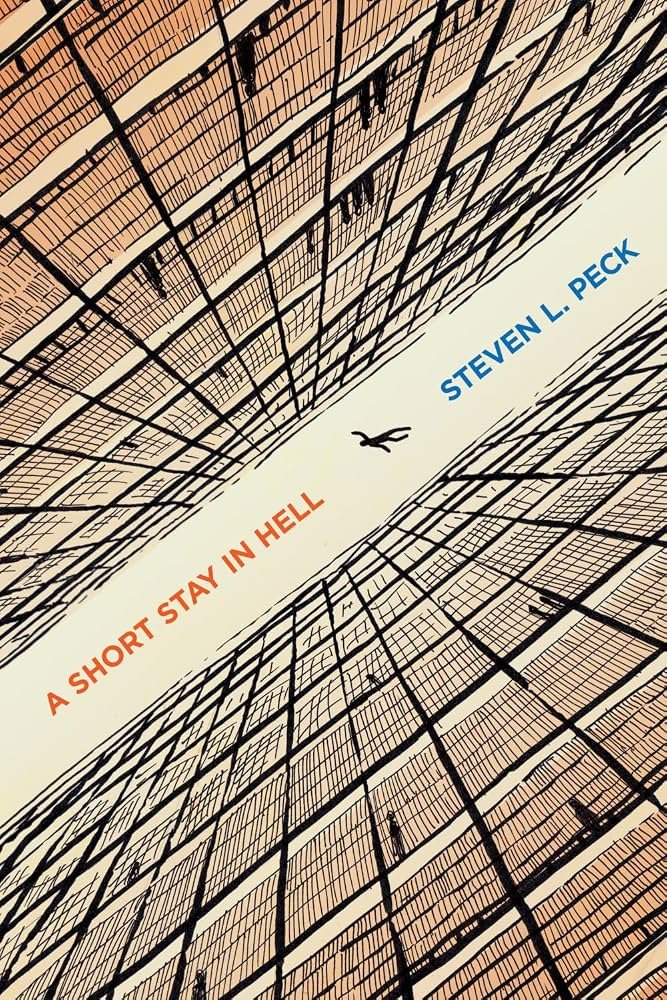
Steven L. Peck’s 2009 novella A Short Stay in Hell didn't blow up on TikTok because it's especially profound, but because it was profound enough and not too obnoxiously cerebral. It’s existentialism masquerading as liminal horror and it's satisfying in the same way a Big Mac is at 11PM.
A Short Stay in Hell tells the story of a faithful mormon named Soren Johansson who dies at a young age from cancer, only to find out he's been sent to hell. Wrong beliefs, man. But hell isn't as bad as it's been portrayed to be and it's not even forever. It's a monolithic library where the books that tells the story of your life is hidden someone. Your only task in order to access the pearly gates is to find it. The damned are cared for like they're at a hotel. What can possibly go wrong, huh?
Death and Purpose
Now, the charm of A Short Stay in Hell lies in its format. It's barely over a hundred pages long and over before it even starts. Steven L. Peck only has the time to make his point : death gives purpose to life. Do anything long enough, the weight of the present will eventually crush it and drain the meaning from it. Looking for a book is only fun if you can find it. Living is only fun if the moment is fleeting. Turn existence into an endless corridor and purpose will always be at the other end. It's a design feature.
This rather simple idea is efficiently illustrated by Soren getting to know people, forming relationship (some considerably lengthier than those he had while alive) and losing them for one reason or another along the way. And that loss gets Soren adrift because he holds on to purpose lost rather than meaning-to-be. The circumstances are pretty complex and dire for him in particular because purpose is always bound to become purpose lost. Everything breaks at some point except him now.
Once you understand that A Short Stay in Hell is about losing connection with people, it doesn't have much else to offer. But guess what? Steven L. Peck wraps up and takes his ball home after that. The book swiftly makes its case for dying being a rather useful part of life that you have to understand as you're alive and ends exactly where it should. It less of a profound experience because you don't go on a journey with the character, but it's a quite respectful thing to do for an author, knowing when to stop.
Was There Any Wasted Pontential Here?
Another charm of A Short Stay in Hell (that I kind of ruin here) is to figure out exactly what the hell it is. Written by a philosophy (of biology) professor, it looks like an existential cipher and it’s kind of what it is, really. But could it have been anything else? I was interested with the idea of a book telling the story of your life. Because how can it possibly exist if you cannot compellingly tell it yourself first? Owning your narrative, your strengths and weaknesses was another avenue it could've ventured it.
Now, it didn't for an obvious reason. Writing a book about hell where hell is a monster you can defeat (or at least ascend from) would be a self-defeating venture, so Steven L. Peck understandably squeezed the ol’ Judeo-Christian logic out of his narrative like pus from a button. Even though it feels like an appetizer rather than an entrée, there was a million ways A Short Stay in Hell could've veered in gimmicky Christian storytelling and it didn't. Self-restraint was crucial to making this book successful.
*
Is A Short Stay in Hell as creepy and liminal as the TikTok people want you to think? Not quite, but it's not a bad read by any means. It's not quite fulfilling, but it’s also not a book that delves into empty promises about what it might be. In that sense, it’s more of an order of Jalapeño poppers that hit the spot than a full meal and it’s fine the way it is. You can read it in a single setting, nod, feel like you've understood everything there is to be understood and go on your merry way. Good books can do that too.
7.4/10
* Follow me on Instagram , Bluesky and Substack to keep up with new posts *