
Movie Review : Friendship (2025)
There’s something deeply satisfying about watching men hate each other on screen. It feels cosimically correct, like gravity or taxes. The sight of two fictional arch enemies duking it out helps you redraw your own moral boundaries in real time. You start thinking: If I’m the good guy of my own story, then whoever stands against me must be the villain, right? That’s how it works in movies. And the only proper way to deal with evil, as established by Bruce Willis in Die Hard, is to throw it off a skyscraper.
But you know what’s actually uncomfortable? Watching two white men love each other without irony, without a punchline, without someone yelling "no homo". Andrew DeYoung’s debut feature Friendship lives entirely in that discomfort. It’s less a movie about male friendship than it is an autopsy of the rules men have inherited for performing it. The result is an oddly punishing, oddly tender film that lingers like the aftermath of an argument you didn’t win or maybe didn’t need to have.
In Friendship, Craig (Tim Robinson who's basically playing himself) is an awkward, middle-aged suburban dad quietly drifting away from his marriage, like so many middle-aged suburban dads before him. His wife (Rooney Mara’s sister Kate) tries to interrupt the entropy by introducing him to their charismatic new neighbor (Paul Rudd). The men do what polite men do: they make small talk, swap weekend anecdotes, and try not to reveal how lonely they actually are. But something happens.
Each man recognizes a quality in the other that feels essential to his own survival, something he wants but isn’t sure he deserves. That exchange becomes the movie’s quiet engine: two men, circling an emotional connection they can’t admit they need, pretending that all of this is just good manners.
A Film About Men And Patriarchy
Here’s the thing about Craig and Austin: they’re not really friends. They’re performing the idea of friendship the same way people perform enthusiasm at a baby shower. Their connection is built on need, not affection. Craig looks at Austin and sees a version of himself that might’ve been: spontaneous, magnetic, apparently free even if he never had any idea who he was in the first place. He starts mirroring Austin’s habits like he’s trying on a new personality in the dressing room of his own life.
Austin, meanwhile, just enjoys being admired. He radiates the soft arrogance of a guy who peaked in high school and somehow made that his entire adult personality. His dorky neighbor’s doe-eyed worship feels right to him at first.
You'll excuse me the feminist theory detour here, buuuut… in her seminal book The Will to Change, bell hooks calls the forces shaping the relationship between Craig and Austin the patriarchy. There’s always a dominant “father” figure with life-and-death authority over everyone beneath him. Swap in "boss," "coach" or "president, and the hierarchy still holds. Once you recognize the structure, you start seeing it everywhere, even in a cul-de-sac barbecue.
From the start, it’s obvious who plays the father in Craig and Austin’s dynamic. But as their friendship evolves, that power balance starts to warp. The movie quietly asks whether dominance and submission are built into male connection itself, or if we’ve just been trained to mistake control for intimacy. There’s a scene in Austin’s garage that distills everything about their relationship into one sloppy, beautiful moment.
Two bozos, half-drunk and half-aware of what they’re really fighting about, start boxing for fun. But it’s not fun. For Craig, taking a beating from Austin would mean admitting that the life he wants (the confidence, the charisma) can only exist in someone else’s body. Austin punching him in the nose confirms that he's real and he's someone else. Someone inaccessible. So Craig does what desperate men do when faced with the truth: he sucker punches it.
Craig and Austin were never friends. They could not just take joy in one another without one becoming a support cast in the other’s life.
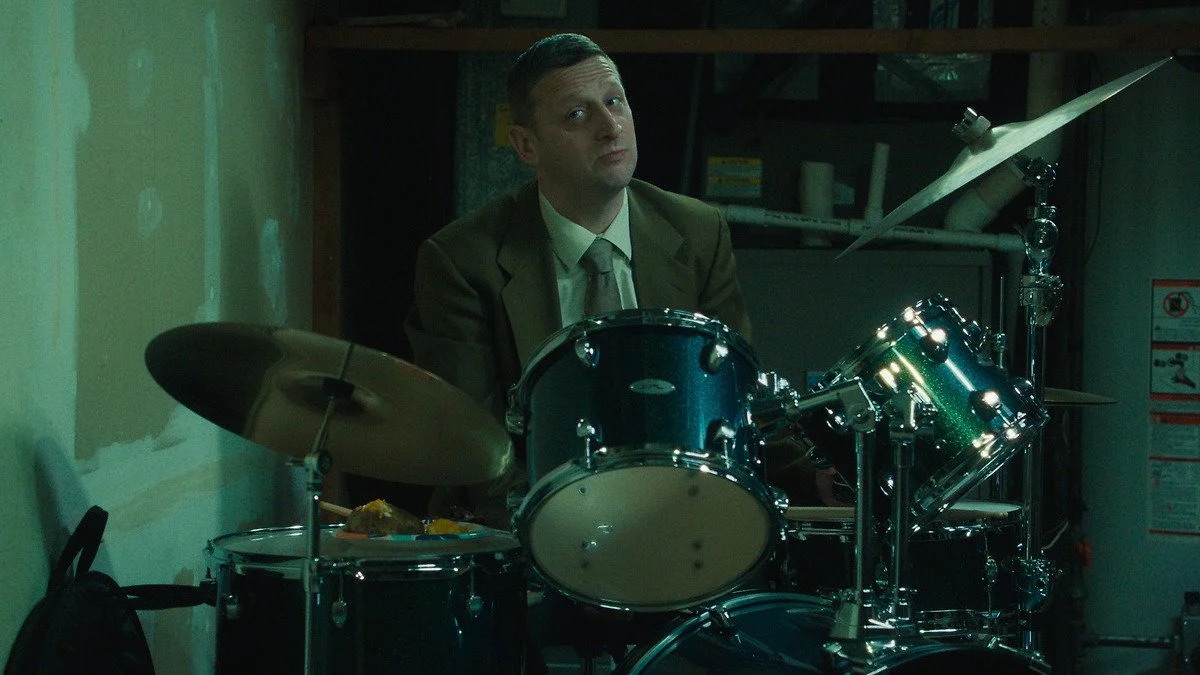
So, who's the bad guy here?
That’s the real question at the center of Friendship: does there even need to be a good guy and a bad guy? A predator and a victim? The simple answer is Craig, obviously he’s a socially awkward lunatic chasing a toothpaste commercial version of himself through his hollow neighbor. But the more you sit with it, the less that answer works. As Craig ramps up the idea of integrating Austin's qualities into his own personality, it becomes obvious that his friend doesn't really care about him.
Austin isn’t innocent. He’s just more functional. There’s a quiet, rotten despair in him that feeds on being idealized. He needs Craig to see him as larger than life because that’s the only proof he has left that he still is. Their dynamic becomes a kind of mutual delusion, one man chasing significance, the other running from obscurity, both trapped inside the same patriarchal fantasy of what being a man is supposed to feel like. They only end up causing chaos and destruction in the other's life.
But maybe that’s the whole point of Friendship: to show that this binary way of seeing relationships : good guy versus bad guy, winner versus loser, is completely fucking stupid. The second you assign moral roles, you’re already trapped inside the same patriarchal logic you’re trying to escape. Someone has to dominate; someone has to submit. Craig looks like the loser here, sure: he loses his stability, his dignity, maybe even his family. But was any of that worth keeping if it kept him miserable?
Maybe losing everything was the closest thing he’s ever had to being free. Am I accidentally arguing for a sequel to Friendship? Andrew DeYoung, I’m looking at you.
*
I finished Friendship thinking it was slightly better than mid. But I haven’t stopped thinking about it since, which is usually the first sign that a movie’s better than you’re willing to admit. It’s often hilarious, even if my review doesn’t make it sound that way (you just need a high tolerance for cringe). Beneath the absurdity, though, is something deeply unsettling: men seem almost biologically programmed for conflict, even with the people they actually like.
Friendship takes place in a perfectly normal suburb, but that’s the trick: being normal stopped being enough a long time ago. Normal won't take you anywhere anymore.
8.1/10
* Follow me on Instagram and Bluesky to keep up with new posts *