Movie Review : Pillion (2026)
There’s a specific arrogance to your early twenties. You think you’ve located your identity because you’ve located your taste. You know what music you like, what politics you post about, who you swipe right on. It feels like self-knowledge. It’s mostly branding. The problem with being 22 isn’t ignorance, it’s premature certainty. You haven’t been tested yet. You haven’t discovered which parts of yourself are negotiable and which parts are welded to your spine. The decade ahead will separate the two, and it will do so without asking permission.
I can only imagine how much more unstable that process becomes when your sexuality exists outside the cultural default, when the thing you want is already marginal before you even understand it yourself.
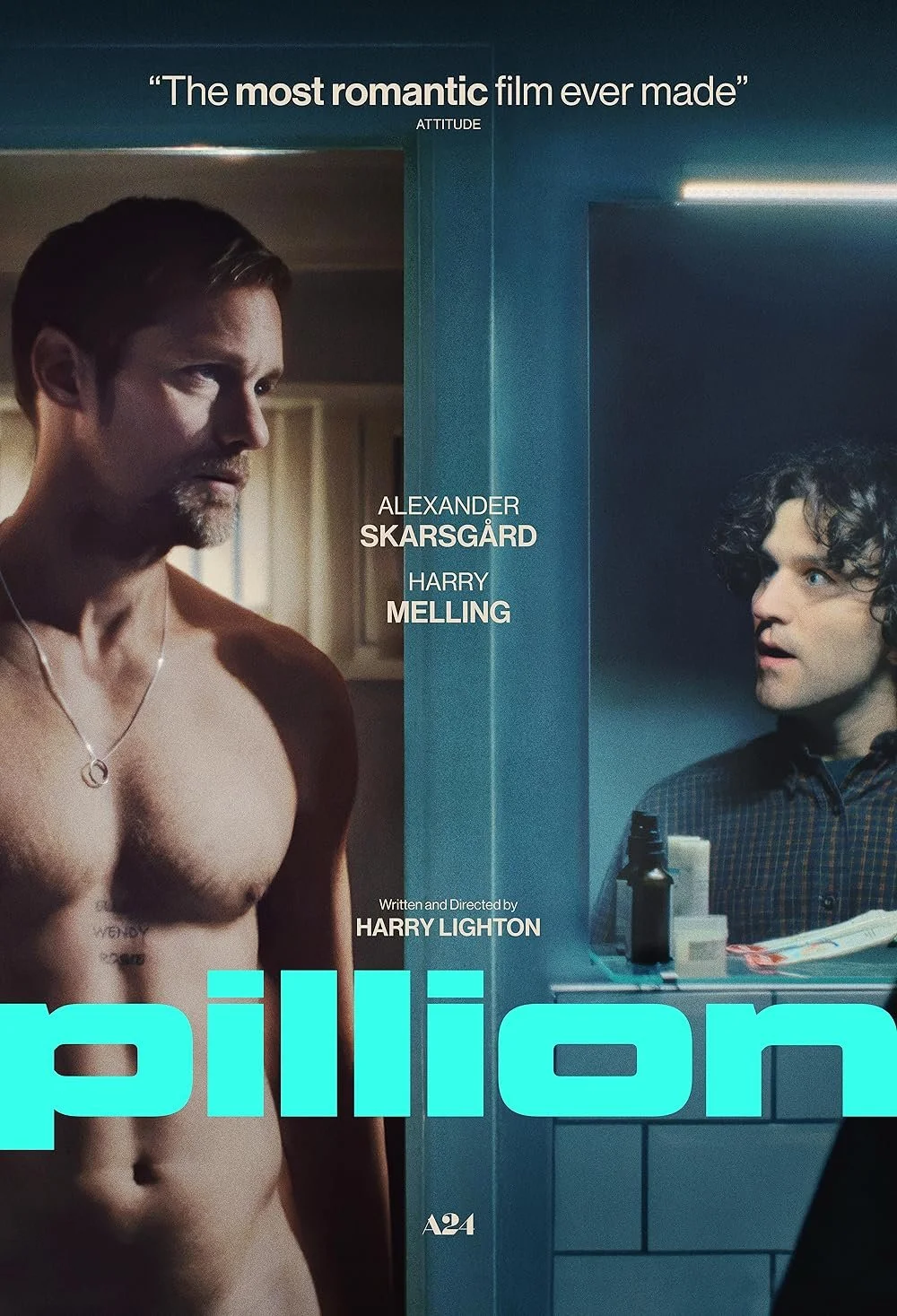
In his debut feature Pillion, Harry Lighton takes that instability and narrows it to a pressure point. A young queer man begins to understand the depth and the extremity of his desire after meeting a handsome, sexually dominant biker. On paper, it sounds exquisitely niche. In practice, it’s uncomfortably universal. Not everyone wants the same things. But everyone has wanted something they didn’t yet know how to name.
Pillion follows Collin (Harry Melling), a young man living at home with parents who are perfectly comfortable with the idea that their son is gay but visibly unsure what that actually entails. Collin drifts through existence without fire or passion until the day he meets Ray (Alexander Skarsgård), a sexy, mysterious biker who sees in him what he calls "an aptitude for devotion". This is the beginning of an unlikely BDSM relationship that will turn Collin from a boy into a man in his own terms.
The Difference Between Desire and Sex
There are two explicit BDSM sex scenes in Pillion, and they are narratively indispensable. They are not there to titillate. They are there to clarify. They also function as a kind of audience stress test. If you can’t watch these sequences without retreating into irony, discomfort, or voyeuristic detachment, the film quietly exposes that distance.
But what makes these scenes matter isn’t their explicitness. It’s what they reveal about Collin’s desires. He doesn’t want orgasmic transcendence. He wants recognition. What he seeks from Ray isn’t physical satisfaction, it’s emotional commitment. He wants to feel chosen. Necessary. Seen. Submission, for Collin, becomes a way to feel like he exists. If Ray desires him for who he is (not just what he does), even in a structured hierarchy, then Colline has a function. Devotion gives him a narrative.
The real question is whether that narrative belongs to him or to Ray.
It’s crucial to Pillion that Collin is played by Harry Melling because he’s not conentionally attractive. His power isn’t charisma. It’s fragility. He carries himself like someone apologizing for occupying space. His best asset is that wounded, fawn-like gaze that suggests he’s perpetually waiting to be told who he is. That mirrors something to Ray that he can’t quite explain.
What makes the dynamic unsettling is that Collin’s vulnerability — something that has likely made him feel small or peripheral his entire life — suddenly becomes valuable. In Ray’s world, softness isn’t a liability; it’s currency. Collin’s instinct to defer, to observe, to devote, it all has a place. But that place comes with a condition: meaning must be assigned. Collin cannot survive as a submissive without a story explaining why he matters. If he's interchangeable, his entire structure for meaning collapses.
That’s the quiet tension at the center of the film. Vulnerability, once a source of shame, becomes his greatest asset. But when your defining trait is your openness to being shaped by someone else, you’re left with a terrifying question: who’s doing the shaping? That’s what Collin wants access to. Not always, but some of the time. It starts with mutual satisfaction, but Collin’s journey is mostly psychological and existential.

Domination And Submission As Performance
Another line Pillion navigates with unnerving precision is the one between domination and abuse. The screenplay by Harry Lighton and Adam Mars-Jones deliberately flirts with the visual language of coercion —power imbalance, asymmetry, emotional withholding — without ever crossing into non-consent. Ray’s authority is real, but it isn’t imposed. It’s offered. What makes the dynamic compelling is the negative space. Ray leaves pauses. He tests the perimeter. He waits. Inside those silences, Collin chooses.
The power exchange only exists because Collin steps into it.
That breathing room is what separates performance from violation. BDSM, as depicted here, is ritual. It’s choreography. Ray provides structure and direction; Collin provides devotion and awe. One wants to worship. The other wants to be worshipped. Each supplies the other’s mythology. It’s intensely sexual and strangely metaphysical at the same time. The acts themselves matter less than the roles they clarify. Together, they construct a private cosmos in which their respective insecurities feel ordained rather than accidental.
And that’s where the romance lives. Not in tenderness, necessarily, but in mutual recognition. Ray fills a clear gap in Collin and by virtue of staying, you figure Collin must do the same for him.
*
You don’t need a working knowledge of LGBTQ+ discourse to connect with Pillion. What you need is memory. Specifically, the memory of wanting something you couldn’t fully articulate—even to yourself. That experience belongs to everyone.
Yes, this is an unapologetically queer film. Its erotic language, its power structures, its emotional codes are rooted in gay subculture. And that specificity is not incidental, it’s essential. The story works because desire here already exists outside the mainstream. It carries friction by default. But what Pillion ultimately interrogates isn’t queerness. It’s longing. It’s the terror of wanting something that feels socially illegible, even to your own brain. It’s the relief that comes when someone else names it for you.
For people who’ve never felt marginal in their desire, that kind of yearning might seem abstract or theatrical. For people who have, it’s oxygen. That’s why the film hits as hard as it does. The queerness isn’t a barrier to universality, it’s the mechanism that makes the universality visible.
8.1/10
* Follow me on Instagram , Bluesky and Substack to keep up with new posts *