Movie Review : Vivarium (2019)
No one ever plans to become normal. Nobody is twelve years old imagining a future of steady employment, polite neighbors, two children and infinite mortgage payments. Normalcy is not a dream. It is what happens after school ends, after freedom becomes scheduling, after society starts asking you to justify your own existence with paperwork, income and the ability to discuss interest rates without laughing.
This is the quiet horror at the heart of Lorcan Finnegan’s Vivarium. Although it is pugnaciously on-the-nose, it asks a question most people avoid because the answer would ruin dinner: are you living the life you wanted or the one that was assigned to you by default?
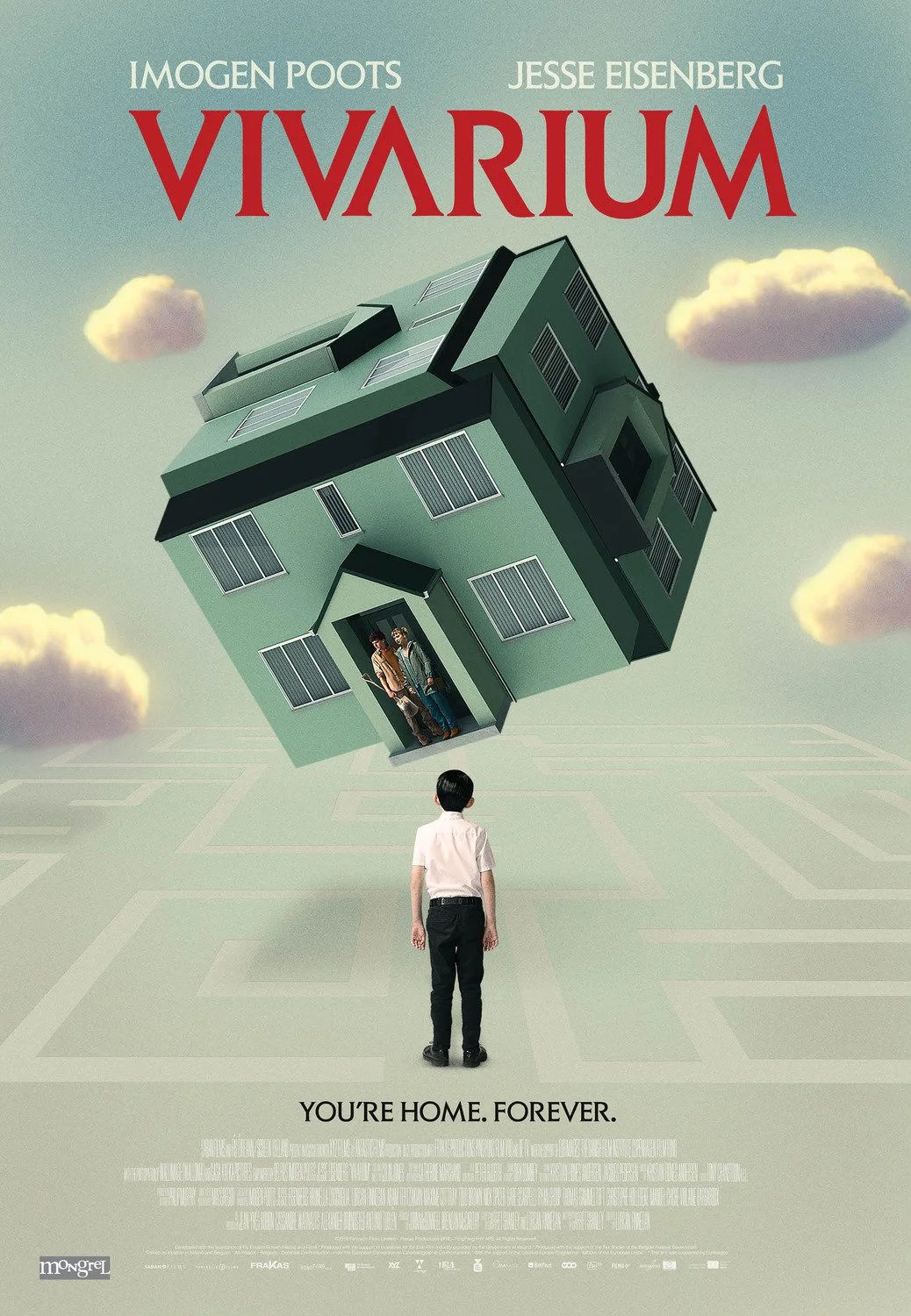
Vivarium tells the story of Tom (Jesse Eisenberg) and Gemma (Imogen Poots), a young couple who make the mistake of doing one of the most dangerous things any young couple can do: look for a house. After following Martin (Jonathan Aris), a profoundly upsetting real estate agent, they find themselves trapped in Yonder. An endless suburban development where every house looks identical, every street leads nowhere and the idea of escaping seems to violate the laws of physics.
A baby is delivered to them in a box with a simple instruction: raise the child and be released.
The Slow Cancellation of the Future
Co-writer and director Lorcan Finnegan does not seem especially interested in telling a compelling story in the traditional sense. Vivarium is less a narrative than a 97-minute allegorical enclosure, a brightly colored terrarium where modern life is reduced to its cruelest socio-biological instructions: pair off, move into a pod, raise a child who will eventually want nothing to do with you in order to preserve the system and die.
This is not exactly subtle, but subtlety is not really the point. Vivarium is atmospheric, immaculate and deeply unpleasant in a way that feels intentional. It is not trying to surprise you with where it goes, because where it goes is the whole joke. It is trying to make you feel the existential dread of adulthood as if you were bathing in it. The movie does not argue that modern domestic life is alienating, but locks its character into an alternate universe where this alienation is the only thing there is.
Eventually, Gemma stops trying to escape and begins making something like an honest attempt at raising the child, while Tom redirects all of his remaining energy toward digging a hole in the backyard. This is where Vivarium becomes almost comically blunt, though not ineffective. Gemma disappears into motherhood. Tom disappears into work, obsession and depression, digging what is obviously his own grave while refusing to understand it as anything except a project.
The allegory could not be much clearer if the house came with a pamphlet. Domestic life has split them into roles neither of them chose but both of them somehow obey. She feeds the thing. He digs. She tries to create meaning from obligation. He tries to escape obligation by committing himself to an even more pointless one. It is efficient. Obvious, but efficient.
That is also why the mysterious setting of Vivarium is slightly misleading. Yonder looks like a puzzle, but there is no real mystery to solve. The movie is not built around hidden answers. It is built around symbols that become more oppressive the longer you stare at them. The horror is not figuring out what Yonder means. The horror is realizing that you understood it almost immediately and it still did not help. There is nothing else to it, nothing to look forward to and this is your life now.
Rethinking Liminality
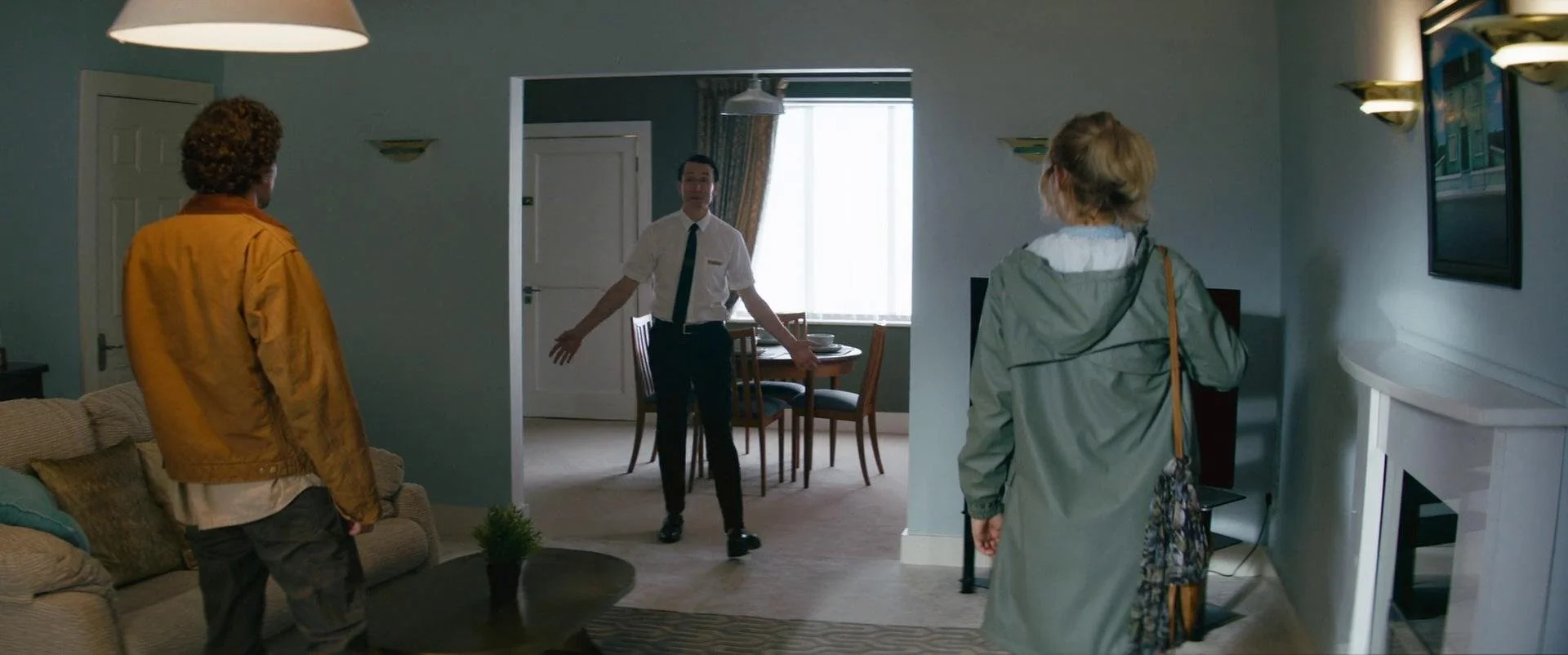
With that said, Vivarium is a fun movie to watch in 2026 because it embraces liminality in original ways. It does not rely on secret rooms, impossible hallways or byzantine architecture. Its liminal space is a home, which makes it more insulting. Tom and Gemma are not trapped in some ancient maze or haunted institution. They are trapped inside the thing they were supposed to want.
By moving them into a lifeless, prefabricated, prefurnished house that seems to have been designed by someone who has studied human domesticity in outer space, Lorcan Finnegan grants them their wish in the abstract. Here is the house. Here is the child. Here is the neighborhood. Here is the shape of a life.
The horror comes from the absence of everything that should make those things meaningful. There is no history in Yonder, no personality, no mess, no evidence that anyone has ever lived there before or could ever truly live there again. It is domesticity stripped of memory and choice. Finnegan quietly turns the suburban dream into a philosophical trap: is this the life you chose or simply the life that was waiting for you once you stopped resisting? Is this what you want, or only what you were trained to recognize as wanting?
Once again, the literal loneliness of Tom and Gemma is meant to represent something larger and uglier: the existential loneliness of people who did everything in the correct order and still ended up trapped inside a life with no pulse. They are together, but not connected. They are parents, but not fulfilled. They have a house, but not a home. Yonder is not empty because no one lives there. It is empty because nothing human can take root there.
*
Vivarium is a strange cat to rate because it does not play the same game as most movies. It functions more like a nightmare than a story, creating an alarming dreamscape out of problems people spend their entire lives trying not to think about. It is very good at what it is doing. The problem is that what it is doing is also somewhat limited.
Once Vivarium announces its direction, it mostly walks in a straight line toward the oblivion it promised from the beginning. There is power in that. There is also a ceiling. It is not terribly difficult to maintain dread when the movie never meaningfully complicates its own metaphor. Finnegan’s vision is sharp, memorable and upsetting, but it is not especially expansive. For a movie about something as sprawling as domestic expectation, parenthood, capitalism and the quiet death of individual desire, it sometimes feels content to keep pressing the same bruise.
I enjoyed Vivarium. I will remember Vivarium. I also do not feel any particular need to ever watch Vivarium again, which might be the most honest compliment I can give it. Some nightmares reveal something about you. Others just show you the room you were already afraid of entering.
7.4/10
* Follow me on Instagram , Bluesky and Substack to keep up with new posts *