Movie Review : Silence (2016)
Religion has been making a comeback. I suppose this shouldn't be surprising given that conservative politicians have been weaponizing new technologies to worm their way inside youth culture for almost twenty years now. Unlike religion, Martin Scorsese's movie Silence was never popular. It's almost three hours long, features renowned actors pretending to be forsaken Portugese priests and it came out on Christmas, competing against notably Rogue One: A Star Wars Story.
It was never going to work. Scorsese does that once every ten years or so: he directs a passionate, but difficult movie about something he only seems to care about. Silence counterintuitively made it on streaming ten years after flopping in theatres and I’ve never considered that the two occurrences were conceptually linked. Religion is not making a comeback, it just put on its comfortable clothes again.
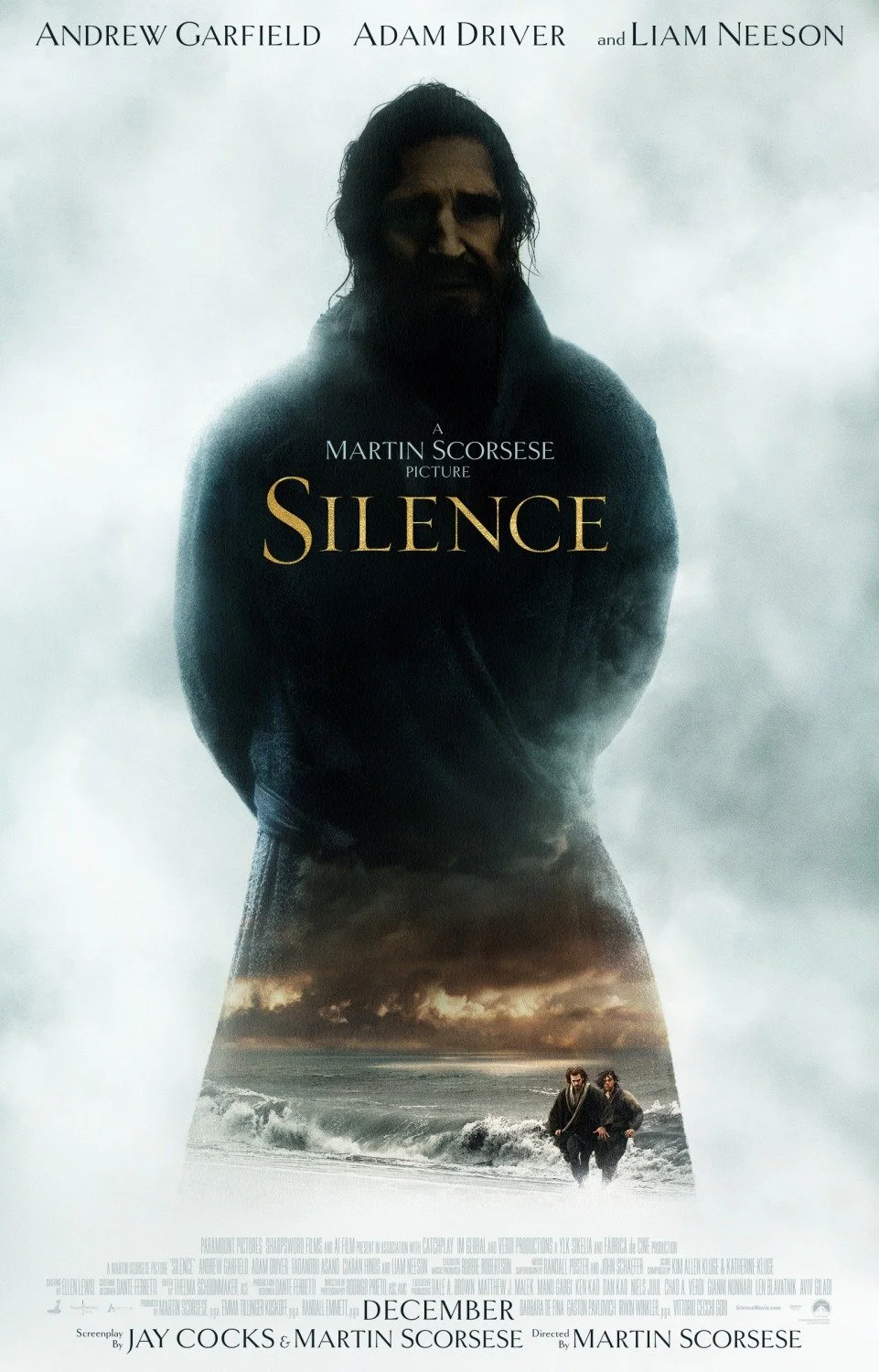
Silence tells the story of Sebastião Rodrigues (Andrew Garfield) and Francisco Garupe (Adam Driver) two Jesuit priests looking for Cristóvão Ferreira (Liam Neeson), another Jesuit priest who disappeared while teaching Gospel in medieval Japan. Upon arrival, they discover a level of Christian persecution beyond what they could even imagine, but they choose to see it as the ultimate test of their fate as priests are bound to do and, of course, is not how they should've chosen to see it at all.
Meaning As A Form of Validation
This is a great movie for Satanists to watch because it features a lot of priests being tortured in cruel and unusual ways. They get crucified, scalded with boiling water, exposed to rising tides until they drown (or not), hung upside down with their head buried into the ground, Japanese people are historically creative when it's time to inflict suffering upon unprepared folks. What makes Silence quietly fascinating is that the Jesuit priests get off on it. Not in a BSDM way. It's even more perverse than that.
Silence is a film about faith more than it is a film about religion. The normal reaction to being forced to witness naked priest being doused with boiling hot spring water would be to haul ass out dodge like "fuck this place, we're clearly not welcome here", but none of the Jesuits do that. On the contrary, they perceive Japanese hostility as the ultimate test to their faith. They'll either die as martyrs or live to evangelize the entire country. But there's a fate worse than death for them and it's something the Japanese clearly understand.
The Japanese don't kill local Christians. Death is incidental to their relentless pursuits of making them renounce their faith. The real questions tormenting Liam Neeson and Andrew Garfield is: are you going to renounce your identity to save the lives of others? I suspect that it's the question Martin Scorsese was interested in also. The fate worse than death for Jesuits is to accept (at least on surface level) that their lives have no meaning whatsoever and that's about the only relatable thing about them.
Faith As A Team Sport
The parallel between the failed evangelization of medieval Japan and the political landscape that fostered the ongoing return of religion is depressingly easy to make. To paraphrase theologian Walter Wink: the worshipping instinct has never disappeared, it just secularized or as modern day philosopher Bret Michaels once said — folks just need something to believe in. Whether it's a god or all-powerful men who walk the Earth with quasi-divine self-assurance, what we choose to believe in becomes our identity.
I'm aware that it's a pretty easy conclusion to draw from a three hours movie that romanticizes physical and existential suffering, but it doesn't mean that it's wrong. None of our identities are self-contained. Although the world has evolved, our brains have been mostly the same for 200 000 years and we're all hard-wired to belong to a group and religion is (or at least was) a fantastic group to belong to. It's organized, political and you can’t ever really prove that it’s bullshit.
That's why the priest suffer in Silence and that's why TikTokers are finding God.
*
I've enjoyed Silence even if its philosophical conclusions felt wildly depressing. I'm glad that Martin Scorsese feels entitled to taking a massive financial loss (we're talking about twenty to thirty million dollars net) in order to do whatever the hell he wants. Silence is quite meditative and doesn't necessarily address the most alluring topics but it's a film that provides what we all claim to desire: the space to slow down and be alone with our thoughts. But what we claim to desire and what we do desire are almost never the same.
7.5/10
* Follow me on Instagram , Bluesky and Substack to keep up with new posts *