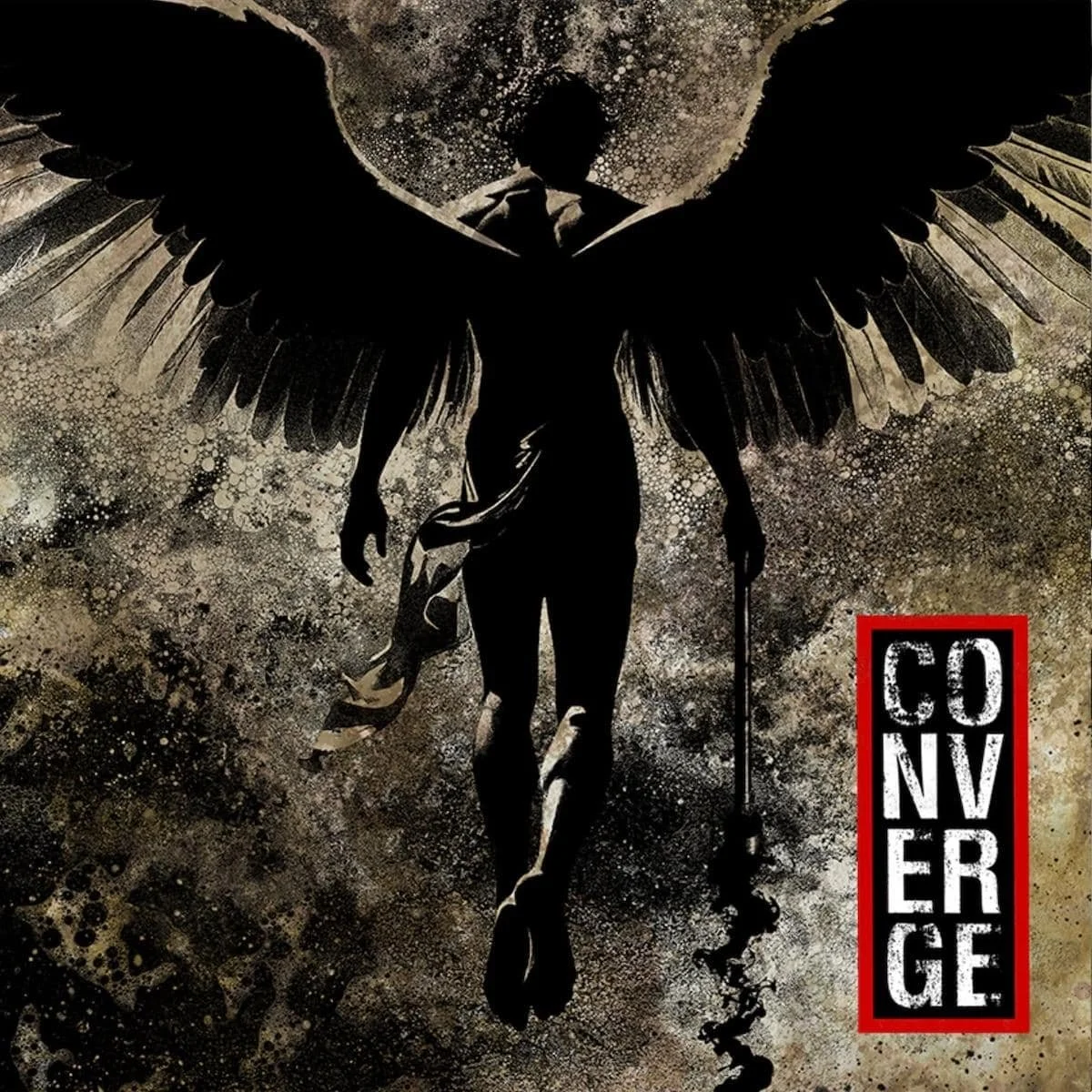
Album Review : Converge - Love Is Not Enough (2026)
There’s an underdiscussed checkpoint in adulthood that has nothing to do with mortgages or marriage or optimizing your sleep cycle. It's the moment where you begin to understand who you are as person. You learn your bandwidth. You learn what you’re good at. You learn what will destroy you. And ideally, you adjust. A majority of artists eventually narrow. They refine. They settle into an emotionally sustainable equation.
Then there’s Converge, who somehow have been everything to everyone for over three decades. They’ve never picked a lane because they built the highway. Metalcore, mathcore, noise, sludge, post-everything, the brand of apocalyptic heartbreak that made them so universally beloved was always too volatile to crystallize. Their sound is a mutating virus that attacks your feelings. You can hear the virus on their new record Love Is Not Enough but once again, you can't fight it.
Before you know what hit you, you'll be spin kicking and shrieking your heart out in front of your bewildered spouse in your living room. I don't know how they do it, but Converge had kept its life-affirming furor alive once more.
Love Is Not Enough clocks in at a lean thirty-one minutes. Ten songs, no ornamental drift, no prog detours, no ambient apology. It’s arguably the most sraightforward thing they’ve done since When Forever Comes Crashing, which is a sentence that would have sounded impossible fifteen years ago. The violence is still there. The emotional combustion is intact. Jacob Bannon still sounds like he’s trying to cough up something lodged between memory and regret. But the real evolution comes from Kurt Ballou.
The riffs are tighter. More compact. Power-chord heavy. The fretboard acrobatics that once made Converge feel like a band sprinting down collapsing stairs have been replaced with something sturdier. He’s not trying to dazzle you with asymmetry. He’s trying to hit you in the sternum. And that’s interesting. Because technicality often reads as youth. Complexity can be a flex. But simplifying? That's confidence. It feels like a band that knows which notes hurt the most and sees no reason to decorate around them.
This is not simplification as compromise. It’s simplification as focus. If Converge's discography has one consistent variable, it's that the band always delivers for maximum impact.
Now, I’ve been pitching Love Is Not Enough as this stripped-down, almost ascetic version of Converge. While that’s technically true, this record is a smorgasbord of extremes operating under a "less is more" principle. A song like Distract an Divide channels grindcore aggression and velocity as Gilded Cage sinks into a sullen, atmospheric crawl, leaning into sludge and post-metal textures that stretch the emotional bandwidth without overstaying its welcome. And yet, they both totally make sense on the same record.
This kind of orchestrated chaos is what makes Converge so special. Plenty of bands can be loud. Plenty can be technical. Very few can sound like they’re will ten contradictory impulses into coherence. Bad Faith is both a thunderous love letter to Entombed and a rallying cry against ideological disconnect. The riff feels prehistoric. The sentiment feels painful and immediate. Force Meets Presence is a hardcore punk missile prophesying an inevitable and cataclysmic collision.
There's even a foreboding instrumental interlude called Beyond Repair that fractures the record cleanly in half. It’s not filler. It's part of the architecture and ratchets up the feeling of dread. It resets the emotional temperature before the second act ignites. And the thing is, I’ve merely addressed the scaffolding by now. The connective tissue. The structural beams of Love Is Not Enough. We haven’t even reached the heat-seeking bombs yet and this record is anything but short on nuclear arsenal.
My favorite song on Love Is Not Enough is the self-combusting and tragic Make Me Forget You. It’s structurally familiar territory for Converge: the tempo shifts, the emotional crescendo, the sense that the song might disintegrate under its own velocity, but it hits with a supercharged emotional intensity that stands shoulder to shoulder with anything on All We Love We Leave Behind. It's an absolute gem that Jacob Bannon interprets with a breakneck abandon that only he seems capable of.
As a forty-something myself, I more than relate to his wounded feelings about missed chances and the hauntings of the past.
The bombastic We Were Never The Same is one of the most memorable closers I’ve heard in recent years. Ben Koller's commanding drum performance and Kurt Ballou's cinematic, but abrasive riffs create a vivid backdrop for vibrant performance by Jacob Bannon, who sounds cornered. There’s a reckless urgency in his delivery that makes the title feel like an accusation. We Were Never the Same isn’t about transformation. It’s about the realization that whatever you thought you were returning to never actually existed.
As a one-two punch with Make Me Forget You, it's a knockout combo if I've ever heard one. The title song is also an anthemic scorcher that interrogates the tenets of morality. It features some of the catchiest and leanest riffs, almost confrontational in their simplicity. What really makes it crush, though, is the rhythm section. Nate Newton and Ben Koller don’t posture on this track. They disappear into the machinery of it. And that’s the point. Their assault is unified, almost self-erasing, which paradoxically makes it feel heavier. It’s not showy. It’s structural. You don’t notice them because they’ve become load-bearing.
They each have flashier moments elsewhere on the record, but Converge truly lock in when ego dissolves and velocity aligns, that’s when the band transcends individual brilliance.
*
In my view, Converge have one of the most unimpeachable discographies in modern music. Not heavy music. Music. Full stop. I’ve got at least four of their records sitting at a nine or higher without hesitation: Jane Doe, You Fail Me, Axe to Fall, and All We Love We Leave Behind (my personal favorite).
Love Is Not Enough lives one tier below those monuments. It hits the same emotional frequencies — the desperation, the confrontation, the bruised clarity — but it doesn’t hover in that altitude quite as long. It burns hot and lean. Thirty-one minutes. No indulgence. No myth-building. It’s less of a cathedral, more like a flare gun. But a flare gun matters when you’re lost. This record doesn’t rewrite their legacy. It reinforces it. It reminds you that Converge are not coasting on historical capital. They are still actively metabolizing anxiety, regret, political fractur and midlife reckoning into something highly dangerous.
8.5/10
* Follow me on Instagram , Bluesky and Substack to keep up with new posts *