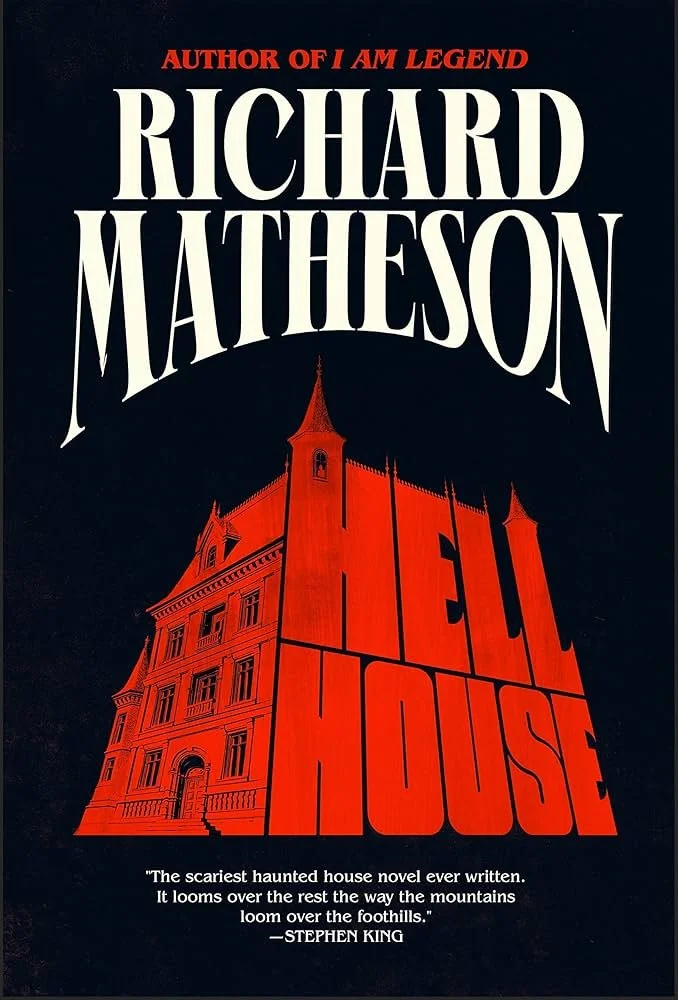
Book Review : Richard Matheson - Hell House (1971)
The fear of malevolent spirits might be the most persistent superstition in human history. It’s older than organized religion and arguably more believable. The ghost story rejects the moral clarity of Judeo-Christian logic: the idea that when you die, you get dealt with. You’re rewarded if you’re good, punished if you’re bad, and the books are closed. Ghosts refute that contract. They hang around. They linger. They feed on the only thing they no longer have: life.
They terrify us not because they’re evil, but because they imply that the universe has no interest in closure. Everything will not be OK in the end, and maybe it never was.
Richard Matheson’s Hell House endures because it understands that ghosts don’t really matter unless someone is there to be afraid of them. The horror isn’t the haunting , it’s the observation. The novel is less about evil spirits than about the way human beings create their own hauntings for malevolent spirits to play with.
Hell House follows Dr. Lionel Barrett, a scientist recruited to investigate the most haunted building in England a mansion so spiritually toxic it once devoured an entire team of researchers. Barrett doesn’t get to choose his company: the wealthy patron funding the project insists he bring two psychics, Florence Tanner and Benjamin Fischer, along for "balance". His wife Edith tags along out of loyalty (and insecurity), which turns out to be a terrible reason to enter the titular Hell House.
Inside, the house behaves like an intelligent predator, scanning for weakness, exploiting doubt, and reinventing cruelty in real time. Everyone’s there for their own reasons, but the house is the only one that doesn’t have to explain itself.
Florence Is In The Machine
The star of Hell House, at least to me, is Florence Tanner. She’s both the most terrified and the most terrifying person in the book, which feels appropriate for someone who believes in nothing but love and light. Tanner’s new age spirituality is an open wound she bleeds out from. She’s convinced that whatever haunts Belasco House is just confused or suffering and that her job is to help it "cross over", like she's a cosmic therapist for the damned. It’s not logic guiding her; it’s conviction masquerading as intuition.
Her compassion makes her brave, but it also makes her a perfect target. The house doesn’t need to defeat her. It just has to let her keep believing in order to fuck with her and fuck with her, it does.
Florence eventually unearths what might be the deepest secret of Belasco House: the existence of Emeric Belasco’s invisible son, Daniel, a ghost who behaves toward her like he’s just discovered both a mother and a savior. It’s the most tender and disturbing part of the novel, because Tanner’s empathy becomes a liability the instant it finds a purpose. She’s not just a counterpoint to Lionel Barrett’s scientific rigidity; she’s the emotional inversion of it.
Where Barrett treats the house like a problem to be solved, Tanner treats it like a lost child to be consoled. There’s something heartbreakingly human about that, the way people project their need to heal something external when what they really want is to be healed themselves. Florence wants love to be enough, but Hell House is built on the arguably more realistic premise that it isn’t. That is can also be used against you in the court of the damned.
Haunted House, Haunted Self
The other figure that makes Hell House genuinely unsettling is Lionel’s wife, Edith, a woman who walks into the Belasco mansion not out of courage or curiosity, but out of fear. You read that right. She’s so terrified of being left behind that she’d rather risk demonic torment than an empty house. Years earlier, Lionel’s trip to Europe almost destroyed her; the loneliness cracked something fundamental inside her, and she’s been trying to seal it shut ever since.
In that light, her decision to join him on this expedition isn’t love, it’s damage control. Edith isn’t haunted by ghosts yet; she’s haunted by the possibility of silence. And if that sounds crazy, well, the ghosts of Belasco House couldn’t agree more. They’ve been waiting for someone exactly like her.
There are cold rooms, flying objects, and all the obligatory haunted house theatrics in Hell House, but none of that is what makes it terrifying. What makes it endure is how recognizably human the fear is. The book doesn’t frighten you by inventing new horrors, it frightens you by identifying the ones you already have. It links you to the most wounded people in the room and forces you to recognize yourself in their weakness. Matheson understands that ghosts can’t hurt anyone unless they find emotional leverage.
They start with the haunted, the Florence Tanners and Edith Barretts, and work their way outward, rooting themselves in pain that already exists. The supernatural is just a delivery system for mean dead people. Don’t want to get haunted? Go to therapy.
*
Hell House has withstood the test of time for a reason. It’s quite the conventional haunted house novel, But Matheson knew exactly what he was doing. He understood that the real horror wasn’t the ghosts themselves, but the people who give them space to exist. The metaphorical and the literal collapse into each other here: the unresolved griefs inside our heads and the dead things we pretend to have buried in the real world.
Hell House endures because it’s not really about haunting, it’s about how hard it is to let anything go. And that, my friends, never gets old.
7.6/10
* Follow me on Instagram and Bluesky to keep up with new posts *