Book Review : Thomas Pynchon - Inherent Vice (2009)
By now, Thomas Pynchon is less a novelist than an urban legend that occasionally files taxes. His reputation precedes him like a fog machine left running too long: dense, brilliant, and slightly toxic if inhaled directly. Generations have tried to decode Gravity’s Rainbow and The Crying of Lot 49 the way mystics decode tea leaves or serial killers decode messages from God. Even when he started writing more accessible books, the myth metastasized.
You don’t just read Pynchon. You enter a hall of mirrors built by a man who refuses to show his face.
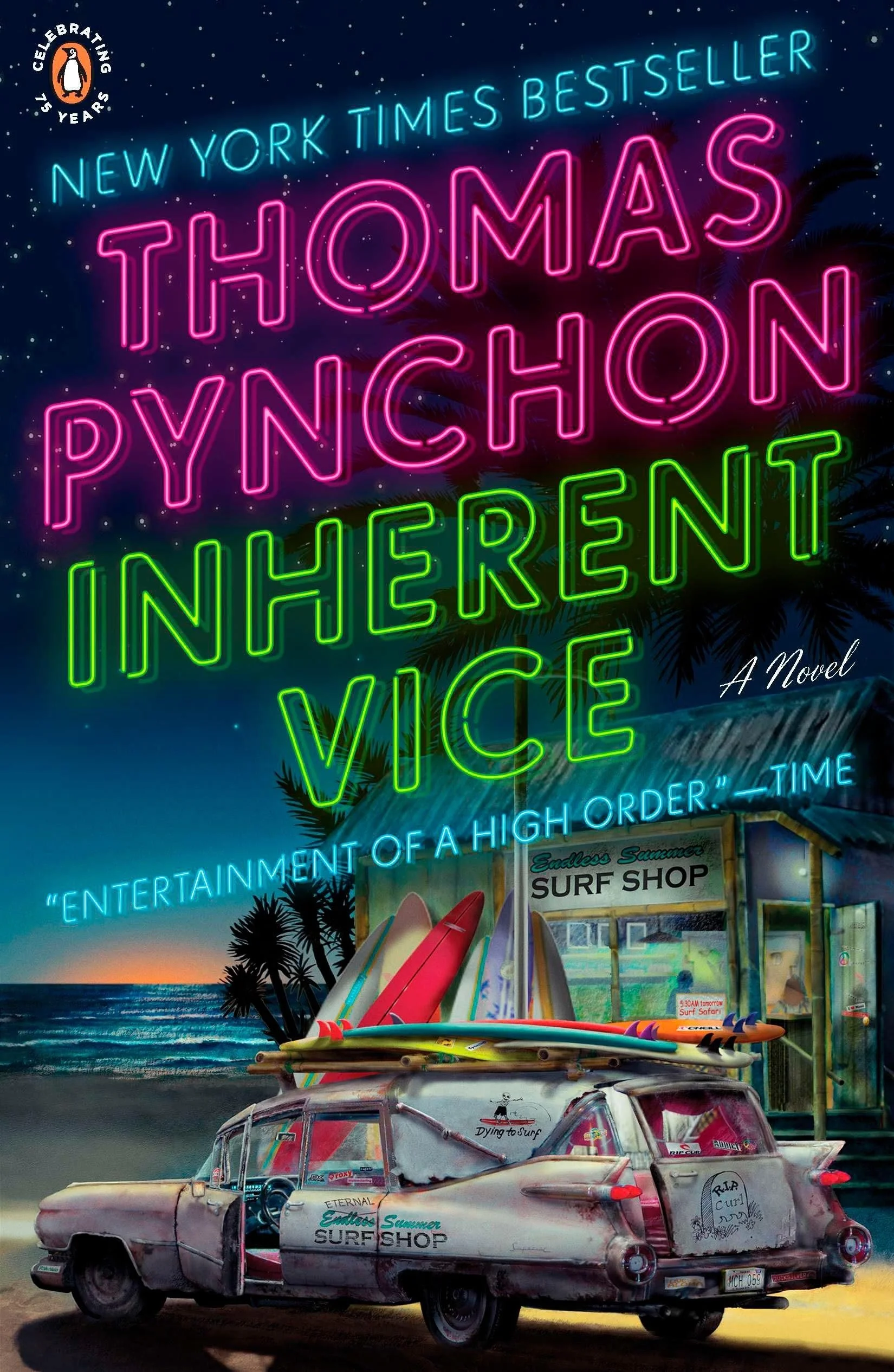
His 2009 novel Inherent Vice is supposed to be the easy one, the "gateway drug" for people who think Ulysses might be fun someday. But even here, the air hums with low-grade paranoia, the kind that makes you suspect every sentence is a code and you’ve been cast as the patsy. Reading Pynchon always feels like standing too close to genius and worrying you won’t get the joke , but that’s the point. You’re not supposed to get it; you’re supposed to feel the static. At least, I think.
Inherent Vice follows Doc Sportello, a perpetually stoned private eye who looks like he solves crimes for free LSD instead of money. One night, his ex-girlfriend shows up with a new problem and a new boyfriend: a real-estate mogul named Mickey Wolfmann who’s vanished under circumstances that sound like bad gossip from a Malibu spa. Supposedly, his wife and her lover had him committed. Or maybe he just disappeared into the fog because that’s what people in Pynchon novels do.
From there, Doc keeps getting hired by increasingly unlikely people: a man named Tariq Khalil looking for one of Wolfmann’s associates, a woman named Hope Harlingen who thinks her dead husband might not be so dead. It’s never clear if these cases are connected or if they just share the same cosmic Wi-Fi. Everyone seems to be orbiting the same weird gravitational field : corruption, paranoia, and the fading dream of 1960s California.
The only person who might help Doc make sense of it all is his nemesis, Detective Bigfoot Bjornsen : a violent, hyper-masculine cop who somehow feels like the only grown-up in a cartoon.
The Sad Taste of Disappointment Pie
The question that haunted me through both of my readings of Inherent Vice was deceptively simple: are all these cases actually connected, or are these people just existing within the same doomed ecosystem?Namely, 1970s California, where everything once colorful was slowly turning beige? Because I don’t think this book is really about a missing real-estate mogul, dead neo-Nazis, ex-junkies reinvented as government operatives, or even heroin. Those are just the fumes leaking out of a much bigger engine.
Inherent Vice is about the slow-motion collapse of the postwar American dream. Tthat once-bright hallucination where freedom and prosperity were supposed to be compatible, where utopia could be achieved through surfboards and good weed. Pynchon’s California is the ugly, neon-soaked hangover that followed that dream. The acid wore off, the beach got privatized, and everyone started working for the people they were rebelling against five years earlier.
The relationship between Doc Sportello and Bigfoot Bjornsen is the closest thing Inherent Vice has to a moral compass, even if it spins in circles. On paper, they’re natural enemies: the cop and the hippie, the authoritarian and the anarchist, the guy who enforces the system and the guy who pretends it doesn’t exist. But their hatred feels strangely theoretical, like they’re just playing out inherited roles from a culture that no longer remembers why it divided people that way.
In practice, Doc and Bigfoot operate less like rivals and more like two exhausted men waiting for the same bus. They don’t like each other, but they share a kind of existential common ground: both can feel the center collapsing. The old binaries, law and chaos, idealism and greed, flower power and fascism, have become aesthetic choices instead of moral ones. By the time they realize they’re fighting the same encroaching darkness, it’s already swallowed the coastline.
The Ills of Modern Man
There’s also something undeniably mythical about Inherent Vice, and not because of anything overtly supernatural. It’s simply because it takes place in California, a place that turns everything, eventually, into myth. The sunshine is mythic. The failure is mythic. Even the traffic has a mythic rhythm if you stare at it long enough.
In Pynchon’s version of California, people don’t just represent themselves; they’ve become avatars of whatever idea broke them. Mickey Wolfmann and Adrian Prussia are the ghosts of greed wearing human faces. Bigfoot is power, unironically personified: brute, confused, performative. Coy Harlingen is disillusionment in a leather jacket. And Doc Sportello, sweet, shambling Doc, is nostalgia itself: a man who still believes the sixties might come back if everyone would just chill out for five minutes. California, in this telling, isn’t a place where people live, it’s a collective hallucination where everyone becomes a metaphor for their own undoing.
So yeah, I believe Inherent Vice is really about a failing utopia. On the surface, it’s an investigation into a missing real-estate mogul, but underneath, it’s an investigation into how people vanish into desires that were never truly theirs. How a dream can die while the machinery that produced it keeps running, like a treadmill still spinning after its runner collapsed. The vision fades, but the lifestyle persists. We just become the ghost in a carnivorous machine.
Maybe I’m reading too much into it. I’m not in Thomas Pynchon’s head, and I suspect that even if I were, I wouldn’t be able to find the light switch. But I don’t think I’m wrong, either. Because while Inherent Vice borrows the trench coat and magnifying glass of a private detective story, it’s really performing a cultural autopsy (which I think is the only thing Pynchon’s ever written about). The case Doc is trying to solve is America itself and the most unnerving thing is that nobody ever officially reported it missing.
*
Inherent Vice is fun, confusing and a little exhausting, the literary equivalent of trekking through the Hollywood Hills on MDMA while trying to remember where you parked. And I mean that in the most respectful, complimentary way possible. Very few writers remain so totally unmoored from conventional living (or even conventional thinking) as Thomas Pynchon. He exists in that rare air where eccentricity and genius are basically the same thing, and the rest of us are just trying to read fast enough to keep up.
He’s already been canonized in his own weird way, adapted not once, but twice by Paul Thomas Anderson, arguably the only director both reckless and reverent enough to try translating that psychic noise into images. But rather than treating those films as the final word, they should make you want to go back to the source. To get lost in Pynchon’s headspace. To feel that specific kind of confusion that’s indistinguishable from revelation.
7.9/10
* Follow me on Instagram and Bluesky to keep up with new posts *