
Movie Review : Kinds of Kindness (2024)
The pleasure of watching a Yorgos Lanthimos movie is a lot like hanging out with that one cousin who always starts normal but ends the night howling at a karaoke bar about Nietzsche and dental hygiene. You know the chaos is coming. You just don’t know when. That’s the thrill. Lanthimos has this unnerving ability to operate as both a legitimate filmmaker and an experimental saboteur within the same story. A guy who builds the house and then gleefully sets fire to the wiring because, somehow, that’s also part of the design.
So, Kinds of Kindness feels like the purest form of that impulse. The uncut Lanthimos. It’s the cinematic equivalent of taking every pill in the medicine cabinet just to see which one actually works. It’s fascinating, grotesque, and a little exhausting. The movie dares you to find the pulse of humanity inside its strange, clinical cruelty. And while it sometimes feels too much like a Yorgos Lanthimos movie to be enjoyed in a normal human way, there’s still something undeniably compelling about watching him lose his mind on his own terms.
Kinds of Kindness plays like a cinematic short story collection performed by the same deeply committed weirdos: Jesse Plemons, Emma Stone, Willem Dafoe, Hong Chau, Margaret Qualley, and Joe Alwyn. It’s divided into three tales that feel like they were all dreamed up by the same anxious deity and interpreted through slightly different levels of hysteria. It’s a lot, I know.
The first, The Death of R.M.F., is a psychosexual power trip between a man and his boss : think corporate servitude reimagined as a form of religious devotion. R.M.F. is Flying follows a woman who returns home after being lost at sea, only for her husband to suspect she’s someone else. A story that feels halfway between domestic paranoia and existential body-snatching. And R.M.F. Eats a Sandwich (yes, that’s really the title) dives into a cult searching for a woman who can raise the dead.
Each piece exists in the same off-kilter moral universe, where emotions are flattened, desires are clinical, and everyone talks like they’ve been hypnotized by a self-help guru with brain damage. It’s unsettling, occasionally hilarious, and kind of beautiful in its devotion to the absurd.
Songs About Fucking
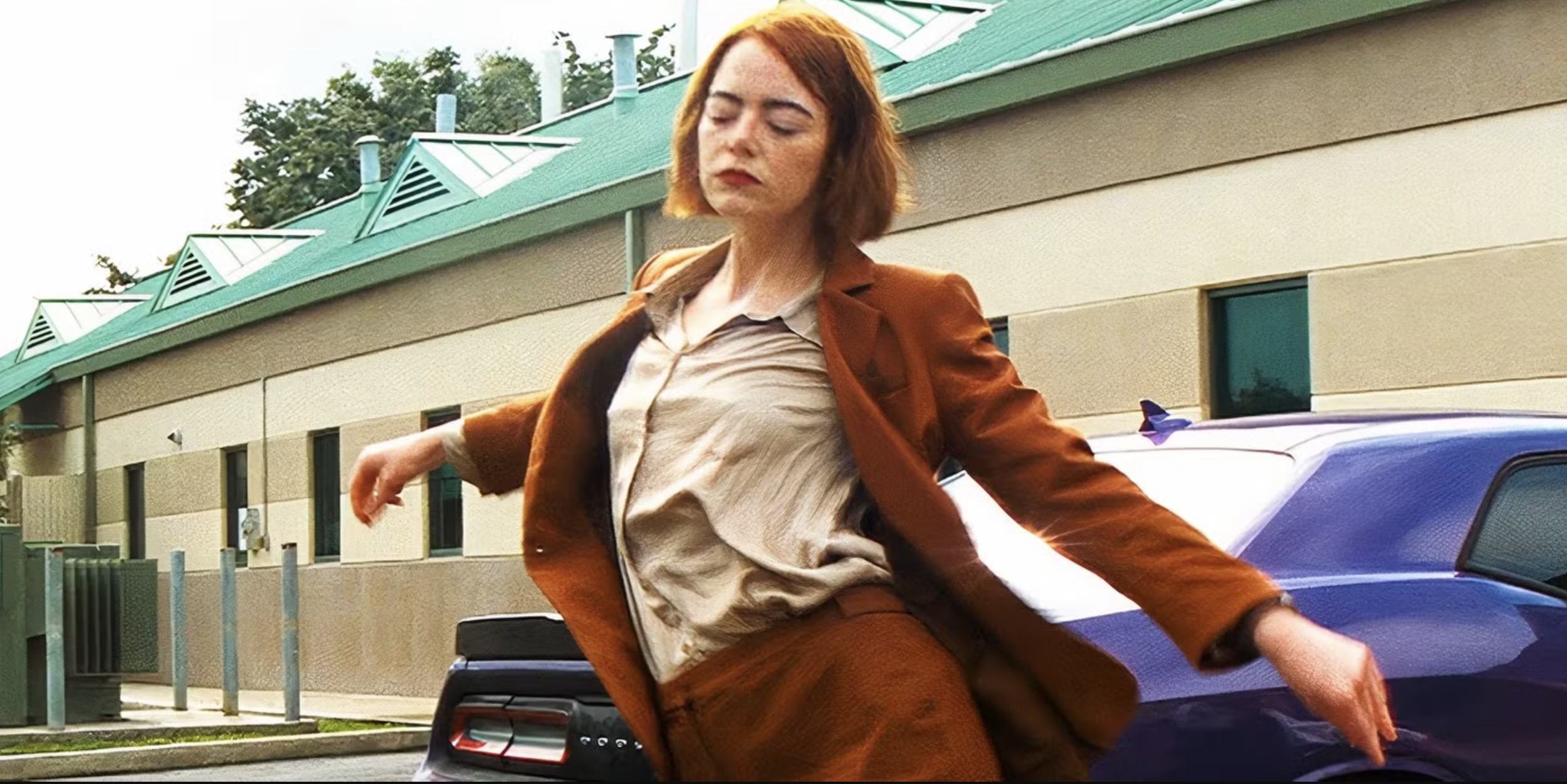
This is a movie about many things, but one of the strong recurring themes is desire. Physical, but also metaphysical desire. Primal and philosophical. Longings for what you definitely can have, but also for what you can't. In R.M.F is Flying, Daniel (Jesse Plemons) yearns for a pre-trauma version of his wife, Liz (Emma Stone), as if she were a different person entirely. Maybe she is. Maybe she isn’t. The short film never quite says and that’s the trick. The point isn’t the mystery, it’s the ache.
It’s how simultaneous longings for what was and what might be fracture reality into parallel emotional timelines, each one lonelier than the last.
This paradox gets sharper in The Death of R.M.F., where Robert (Jesse Plemons again, now playing a different kind of lost soul) has essentially outsourced his desire to Raymond (Willem Dafoe) . Not out of submission, but out of faith. He’s traded autonomy for abstract satisfaction, like a monk worshipping the erotic potential of obedience. The one moment his selfhood resurfaces, he immediately starts to sink. He can’t process the idea of wanting something that isn’t sexual, because Raymond has eroticized every corner of his existence. The world only makes sense to him through that filter. Step outside it, and the whole structure collapses, like a spiritual boundary dissolving under its own perversion.
I don’t know why Yorgos Lanthimos decided he needed to dissect the anatomy of wanting through three different stories played by the same people. Maybe there’s no reason. Maybe he just thought it would be weird in a cool way , which, honestly, it is. R.M.F. Eats a Sandwich is the apex of that weirdness, the most surreal and overtly sexual of the bunch. It’s about the desire to transcend the final limit (death) but filtered through Lanthimos’s particular obsession with ritual and submission.
It plays like a séance conducted by sex addicts. Beneath the absurdity, though, there’s something almost spiritual at work. The story hums with the idea that devotion (whether erotic, religious, or delusional) can actually bend the laws of the physical world. It’s simple, yes, but it vibrates with that unmistakable Lanthimos frequency: the energy of someone trying to love their way out of the body.
But why three stories, am I right?
The form of Kinds of Kindness is as fascinating as what it’s trying to say. I love that it feels unfinished. Not in a lazy way, but in the way a sketchbook is unfinished. It’s a series of cinematic studies, ideas that aren’t fully resolved but somehow make sense together, like fragments of a dream that almost connect. There’s something liberating about that.
It reminds me of Phyllomedusa, the frog-obsessed gorenoise artist who seemingly releases every sound he’s ever made. Because of him, I’ve heard textures and emotional registers I didn’t even know existed. Lanthimos does something similar here: he opens every door, even the ones that go nowhere, because the wandering itself produces meaning. Kinds of Kindness moves with that same gleeful curiosity. A willingness to draw outside the lines just to see if a new kind of feeling can emerge from the mess.
It’s a long movie, and it feels long. Not in a punishing way, but in the way that listening to a guy literally croak into a microphone for two hours eventually starts to feel like transcendence disguised as fatigue. The exhaustion is part of the tension. Desire works the same way: it wears you down until you start mistaking depletion for enlightenment.
Lanthimos seems acutely aware of this, because in Kinds of Kindness he weaponizes his own reputation, leaning into his quirks, his tonal sadism, his refusal to give anyone the emotional release they think they’ve earned. You can’t track the beats the way you can in a normal film, because there are no beats. Just ruptures. It’s what happens when a filmmaker intentionally strays off the path and keeps walking into the woods, just to see what animals start following him.
*
I thoroughly enjoyed Kinds of Kindness, but I’m probably predisposed to enjoy movies that want to see what I’m made of. I like art that tests its audience, that leans so far into its own discomfort it becomes a mirror. No quirk is too strange if it’s in service of truth. No shock is too much if it’s not gratuitous. Lanthimos and I seem to share a fascination with the invisible levers that push people off course , the intangible instincts that turn ordinary lives into moral hallucinations.
In Kinds of Kindness, he finally exposes his own. They’re beautiful. They’re broken. And, like everything worth feeling deeply, they hurt in all the right and the wrong ways.
7.7/10
* Follow me on Instagram and Bluesky to keep up with new posts *