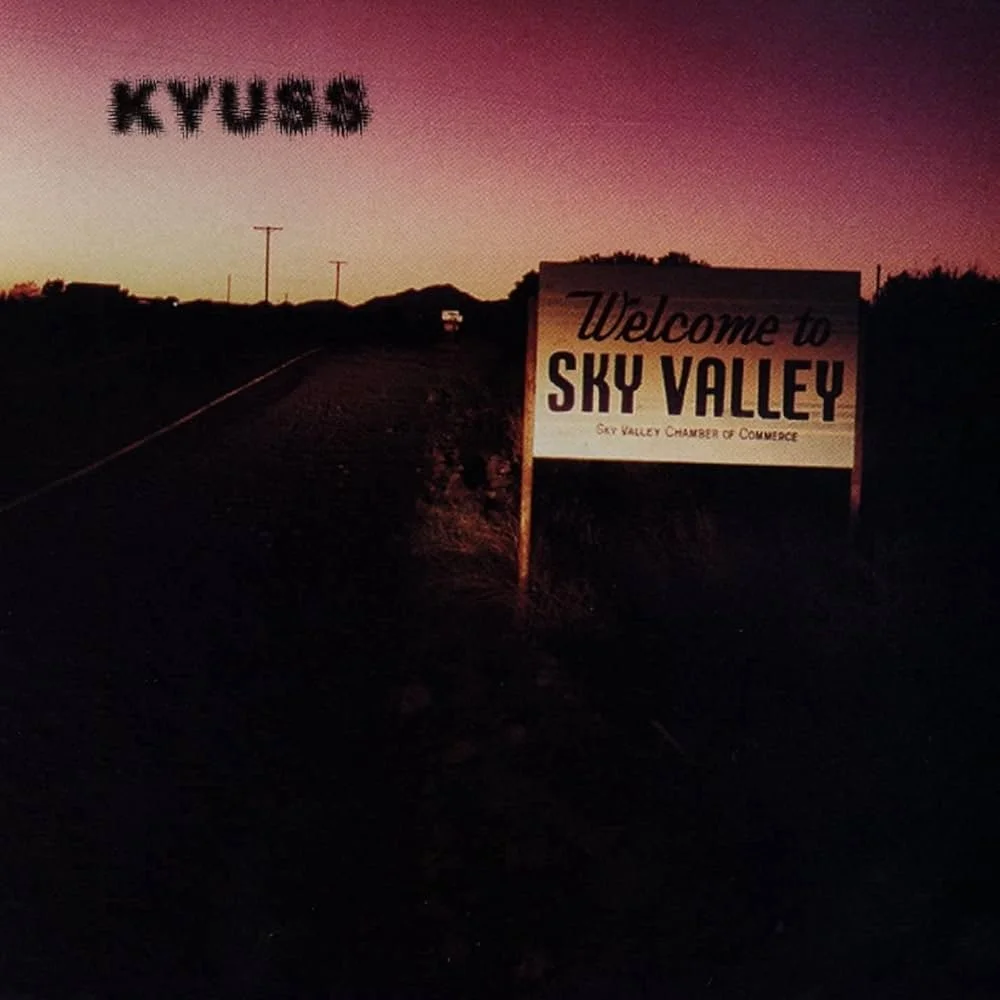
Classic Album Review : Kyuss - Welcome To Sky Valley (1994)
I’ve never been a lyrics guy, which is not the same thing as saying lyrics don’t matter. It’s more that I don’t need them to grant me permission to feel something. I respond to music the way people used to respond to rock ’n’ roll in the 1950s: as a physical suggestion rather than an intellectual argument. Back then, the music wasn’t trying to explain your problems or diagnose your sadness; it was trying to get you to move your body long enough to forget you had them. Any deeper emotional investment was optional and, crucially, self-directed.
Somewhere along the way, rock music became a medium that wanted to live in your head. It wanted to be decoded, interpreted, and taken seriously in ways that felt increasingly academic. That impulse never fully disappeared, but it migrated, first into indie culture, then into think-piece fodder, and eventually into genres that treated self-analysis like a competitive sport. Meanwhile, the original function of rock ’n’ roll: release, motion and obliteration quietly relocated to electronic music.
And yet, every once in a while, a band shows up that feels like a glitch in the matrix. Kyuss' Welcome to Sky Valley is one of those occurrences. It’s an artifact from a parallel timeline where rock never forgot that its primary job was to get you out of your head and into your body.
Welcome to Sky Valley features ten songs — eleven if you count the hidden track tucked away like a private joke at the end, back when 90s rock was still fun — and stretches across fifty-one minutes of blues-soaked, sunburnt, psychedelic rock that feels inseparable from the California desert that inspired it. This record doesn’t just reference its geography; it makes you feel it. Long stretches. Repetition. Heat. The sense that time has slowed down enough for you to notice your own pulse and it’s fucking amazing.
Now let’s address the elephant in the room: Welcome to Sky Valley opens with Gardenia, which is not just one of the best songs on the album, but one of the best opening statements ever recorded. At nearly seven minutes long, it revs the record up. This thing breathes. It lurches forward on a groove so filthy it feels almost impolite, like you’ve walked in on something private.
Written by drummer Brant Bjork, Gardenia lives and dies by rhythm. From behind the kit, Bjork locks into a ferocious, intoxicating tempo that owes more to old-school jazz drumming than to metal orthodoxy. This isn’t a beat meant to dominate; it’s meant to seduce. The song doesn’t rush, doesn’t climax on cue, doesn’t care if you’re ready. It just keeps moving, confident that you’ll fall into step eventually because you will.
Lyrically, it’s about riding motorcycles through the desert, being high, and feeling a vaguely erotic attachment to a machine — an experience that is, for most people, completely impossible to relate to. But that’s the point. When John Garcia bellows those words with such passion and abandon, it becomes obvious they’re not meant to be decoded or empathized with. They exist to carry heat and rhythm, to give physical shape to the groove. Meaning is secondary to motion.
Gardenia doesn’t ask you to understand it. It asks you to submit. I love this song irrationally and permanently, and it has never failed to make my body move before my brain has time to object.
But let’s not kid ourselves: the gravitational center of Gardenia and of Welcome to Sky Valley as a whole, is Josh Homme. His guitar playing is so loose, bluesy and soulful it functions like a second lead vocal, arguably the primary one. This is underscored by the mix itself, where John Garcia’s voice often sits lower than Homme’s guitar, as if the album is quietly suggesting where your attention should go.
On the explosive Asteroid and across long stretches of the record, it’s the riffs that do the singing. They bend, swagger, hesitate, and repeat with a logic that feels emotional rather than technical. Homme isn’t shredding or posturing; he’s conversing. The guitar becomes a delivery system for feeling, not virtuosity, which gives Welcome to Sky Valley its jangly, slightly surreal, and fundamentally unpredictable character.
There’s something almost disarming about how unprofessional it all sounds — not sloppy, but human. Like music drifting out of a half-open garage somewhere in your neighborhood, played by people who aren’t trying to impress you, because they’re too busy enjoying themselves. That casual confidence is what makes Homme feel less like a frontman and more like an author: not commanding the record from above, but shaping its mood from the inside, one groove at a time.
The album’s other single Demon Cleaner shifts the focus back toward the collective. Where Gardenia overwhelms through brute groove, this track is smooth, sultry, more openly hallucinatory, built on a bombastic yet controlled rhythm section and looping guitar figures that feel less like riffs than recurring thoughts you can’t quite shake.
Everyone pulls in the same direction here. The band locks into a trance and John Garcia steps into a shamanistic role, repeating the word "yeah" like a mantra until it stops functioning as language at all. The repetition isn’t lazy or filler, it’s ritualistic. The song isn’t trying to say something; it’s trying to do something.
On paper, Demon Cleaner is about self-exorcism. In practice, it’s about surrender: embracing the strange and the unknowable without demanding clarity or resolution. It’s another form of abandon to cosmic forces, one that trades aggression for hypnosis. Moments like this are what make Welcome to Sky Valley feel less like a collection of songs and more like a shared state of mind you briefly get to inhabit. This set the standard for modern stoner metal bands.
There isn’t a weak track on Welcome to Sky Valley (everything here ranges from good to iconic) but a few songs feel especially revelatory. Odyssey roars forward like a sonic motorcycle tearing down an empty highway at sunset, all momentum and fading light, the kind of song that makes distance feel purposeful. The inexplicably titled Supa Scoopa and Mighty Scoop is even more inevitable, with Josh Homme descending on the track like a tidal force, patient and unstoppable, letting the groove do the damage instead of the volume.
Then there’s Space Cadet, bluesy and disjointed, which sounds less like a composition than the greatest improvised jam session you’ve somehow been invited to overhear. It wobbles, drifts and corrects itself in real time, capturing that rare feeling of musicians listening to one another rather than performing at you. Taken together, these songs feel like different faces of the same landscape. Each one catches a distinct layer of the desert — speed, heat, vastness, hallucination — until the album starts to feel less like a sequence of tracks and more like a terrain you move through at your own pace.
One of the reasons Welcome to Sky Valley feels so singular is that it quietly disrupts your sense of time. It isn’t as tight or overtly purposeful as Blues for the Red Sun, but that looseness is intentional. This is an album that moves according to its own internal clock, prioritizing atmosphere and hallucination over momentum.
The record oscillates between the collective and the private experience of the desert. At times it imposes images — heat shimmering off asphalt, engines idling in the distance — and at others it waits patiently, allowing your own visions to surface. The music stretches and contracts, repeating grooves until they stop feeling repetitive and start feeling like the cosmos talking to you.
What makes this approach work is that Welcome to Sky Valley never sacrifices groove or soul in pursuit of strangeness. It’s undeniably weird, but never alienating. The album understands that the quickest way to make something feel transcendent isn’t abstraction, it’s rhythm. And by grounding its weirdness in feel, Kyuss create a listening experience that feels both disorienting and deeply human.
*
Welcome to Sky Valley has not aged a day since June 28, 1994. It didn’t just help invent a subgenre of rock; it modernized another without ever sounding self-conscious about either achievement. This is a historically important record for guitar music, but its endurance has nothing to do with history. Anyone can "get it" in 2026 because it operates on a primal rock ’n’ roll frequency that predates context.
The album summons vivid images without enforcing a rigid meaning. It doesn’t tell you what to think or feel, it pulls you out of your head and drops you back into your body, where groove takes precedence over interpretation. These songs don’t age because they were never trying to be timely. They were trying to move. Kyuss may eventually be reduced to a footnote, a name people argue about on message boards. But play Welcome to Sky Valley anywhere, at any time, and the result will be the same: people will start dancing, often before they realize why.
9.1/10
* Follow me on Instagram , Bluesky and Substack to keep up with new posts *