Taylor Swift's Last Frontier
Taylor Swift has developed a system for making the entire planet revolve around her.
It’s not magic, and it’s not even mysterious. Every year or so, she releases an album to seismic anticipation and proceeds to do two things: 1) start milquetoast beefs with other celebrities (preferably men she dated who turned to be various levels of mediocre) 2) stay perfectly calibrated between what her fans expect and what the moment demands. She perfected algorithmic intimacy. Swift has built a billion-dollar brand out of being exactly who she appears to be, which is also exactly what she’s not. Bear with me.
The popularity of Taylor Swift, stratospheric, omnipresent, and somehow still expanding, rests on a principle she no longer seems to understand or care about: what she doesn’t say matters infinitely more than what she does.
Her career was once engineered around negative spaces: the pauses, the subtext, TikTok conspiracy theory, the plausible deniability of being misunderstood. Between 2020 and 2022, that dynamic reached its apex. Folklore, Evermore, and Midnights were marketed as her grown-up era, a rebranding of emotional restraint as sophistication. But since then, the returns have quietly diminished. It’s not that her popularity has dropped (it hasn’t) or that the music has worsened (it’s still just fine). It’s that the illusion has evaporated.
The last two records, The Tortured Poets Department and The Life of a Showgirl, are still immensely popular and discussed, but they feel smaller, the way watching someone perform a magic trick after she explained it away is.
The one thing Taylor Swift needs to do to secure her legacy is the one thing she seems constitutionally incapable of doing: getting out of her own way. She could disappear for a few years, enjoy her era of bliss with Travis Kelce, and let the world miss her. But she won’t. She can’t. Instead, she’s doubled down on oversharing, enforcing songs about how great her boyfriend’s penis is as if the world might forget she’s happy unless she annotates it in verse.
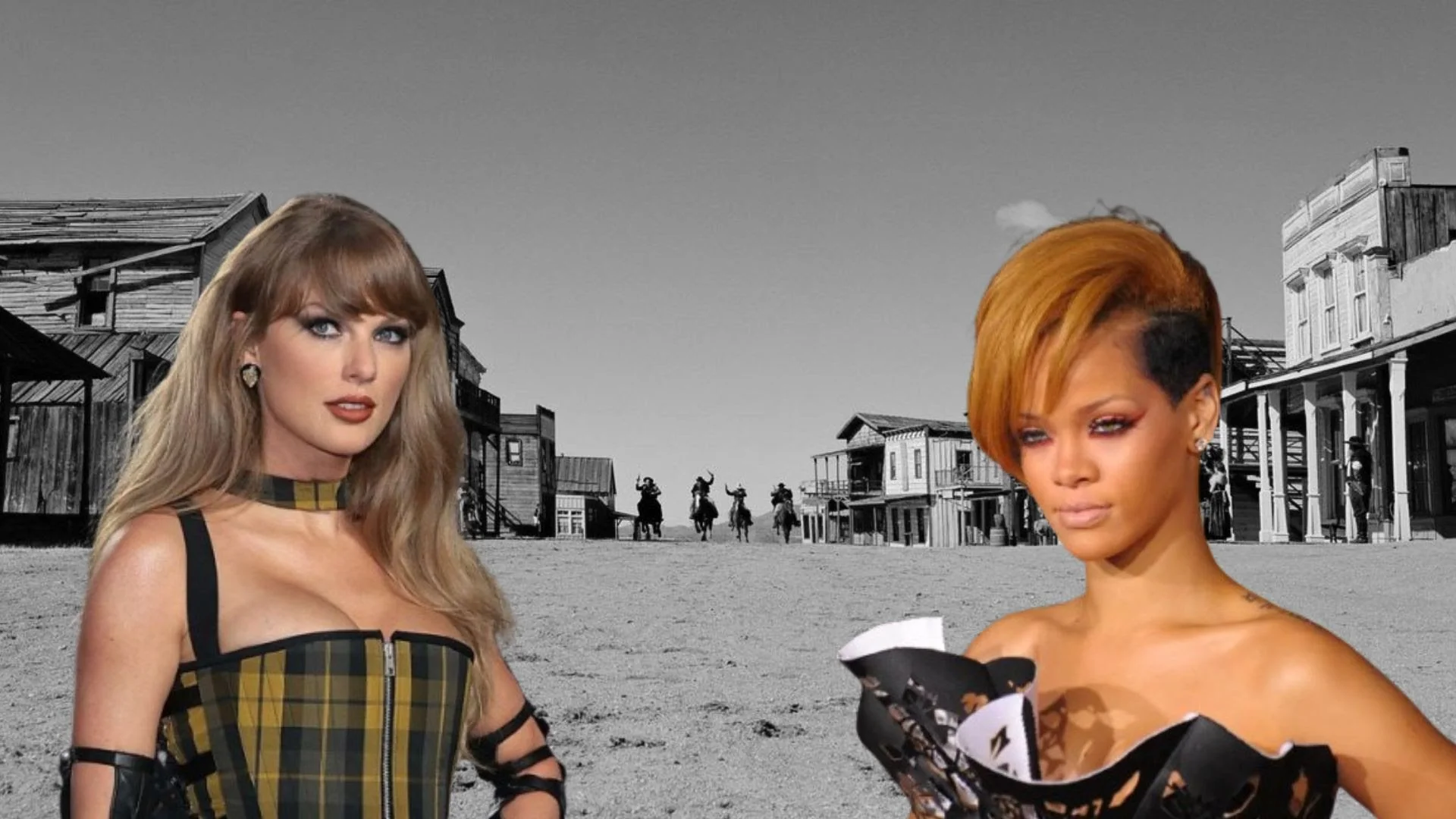
For anyone else, retreating from the spotlight would be career suicide. For Taylor Swift, it would be the smartest possible move. Myths work best when they remain myths. You’re only sacred as long as you’re partly unknowable. Just ask J.K. Rowling what happens when you keep explaining everything to people who were happier not knowing. You know who understands this perfectly? Rihanna. She hasn’t released an album in nine years, and somehow not a soul one stopped caring.
ANTI or The Art of Working Backwards
So why is Rihanna the ANTIthesis of Taylor Swift?
I take for granted you already know who she is. Everyone does. She’s responsible for some of the most unavoidable pop songs of the twenty-first century: We Found Love, Don’t Stop the Music, Diamonds, Work, the generational Umbrella, and Bitch Better Have My Money. But she hasn’t made new music in almost a decade. Instead, she launched Fenty Beauty in 2017 and Savage X Fenty in 2019, and then simply let those empires talk for her. Or sing, depending on how you interpret capitalism as performance art.
In diversifying, Rihanna did something counterintuitive: she made singing optional. She turned the act of not recording music into a creative statement. Every year she doesn’t release an album, her legend grows a little larger, as if the silence itself were proof of genius.
By not releasing new albums, Rihanna managed to accomplish three remarkable things. First, she made the world want a new Rihanna record more than ever, an impressive feat considering the public’s attention span now resets every minute or so. Second, she secured a level of reverence we usually reserve for dead artists. People talk about Anti the way classic rock fans talk about Rumours or Purple Rain as if it represents some eternal cultural equilibrium. And third, she future-proofed herself.
By walking away while she was still at her peak, Rihanna made every subsequent move, whether it’s lingerie, makeup, or a hypothetical space program, seem inherently credible. No one actually knows if she’s qualified to run a multibillion-dollar brand, but everyone assumes she is, because she treated pop stardom like an elective course she’d already aced.
Rihanna never really disappeared. She still shows up at basketball games, drifts through the Met Gala, and occasionally brings her partner A$AP Rocky along like a cool accessory who also happens to be the father of her children. She even performed at the Super Bowl halftime show while visibly pregnant, a detail that made the entire planet lose its collective mind for about a week. But these days, Rihanna doesn’t make songs; she makes bras and blush. And because those things don’t come with lyrics, people project meaning onto her instead.
Her Super Bowl performance was instantly mythologized as an act of radical self-acceptance, proof that Rihanna had transcended the need to care about anyone’s expectations. Maybe that’s true. Or maybe she was just pregnant and told the NFL, “It’s either this or nothing.” The beauty of being Rihanna is that both interpretations work. When you stop explaining yourself, the world starts explaining you and that’s where real power lives.
She learned that the hard way. Back in the cursed Chris Brown years, Rihanna tried being transparent. She tried showing her audience who she really was. There was even a half-forgotten Oprah special where she attempted to make sense of her own trauma in real time. It didn’t work. We don’t actually want that kind of honesty. We love ideas, not people. We want romance, not reality. And Rihanna, ever the pragmatist, decided she’d rather be a myth than a memoir.
Engineering Your Self
Here’s the thing: Taylor Swift understands the game too. She just happens to be addicted to it.
Ever since Kanye West interrupted her at the MTV Video Music Awards in 2009 (an incident whose sincerity will probably be debated until the heat death of the universe) Swift has understood something crucial about modern fame: music is no longer the main variable. The song itself is secondary. What matters is the narrative orbiting around it.
Drake hasn’t released a culturally meaningful track since Hotline Bling almost a decade ago, yet he remains unavoidable. That’s because people don’t just consume music anymore, they consume the continuity of an artist’s life. We listen when we feel personally invested in the story being told, but especially in the story happening outside the songs.
Rappers have always understood the importance of public beefs, but their audiences understand it too. It’s performance art with a beat, closer to WWE than to war. Everyone plays their part, and everybody wins, even the guy who technically loses (ask Drake, who’s somehow survived multiple lyrical assassinations and still ends up trending every time).
Taylor Swift rebranded the concept for unsuspecting white girls. Over the last fifteen years, she’s had far too many rivalries for them all to be organic: Kanye West, Katy Perry, Scooter Braun (whom she awesomely obliterated), she grilled Jake Gyllenhaal for ten full minutes like a steak of regret, Joe Alwyn and now Charli XCX. Every album cycle produces a new antagonist. It’s a narrative requirement, like a Marvel villain or a pro wrestling heel. The enemy doesn’t matter; the structure does. The conflict is the fuel, and Taylor never lets the tank go empty.
This strategy produced the exact result you want when you’re in the business of mythmaking: Swifties became her personal army, and before long, they started writing their own apocrypha. What emerged was less a fandom than a parallel reality, a kind of Twilight Zone fueled by algorithmic devotion. TikTok turned into an incubator for Swiftian urban legends, essentially a QAnon for white liberal women.
There were the Gaylors, who insisted Taylor was secretly gay and communicating through coded messages and color palettes. That shit made it into The New York Times, I kid you not. Then there were deeper cuts, like the mythical lost album Karma, which supposedly went nuclear on everyone as if she wasn’t already. None of this was real, of course, but that wasn’t the point. The point was that Taylor Swift had achieved the purest form of fame imaginable, she no longer had to tell her own story because millions of people were already doing it for her. The world (or popular culture) was her oyster.
As counterintuitive as it sounds, this is where she should’ve stopped. At least for a while. Let the story breathe. But obscene success has a strange side effect: it makes you forget that you don’t belong to yourself anymore. There’s a point where continuing to do what made you great doesn’t preserve your legacy, it erodes it.
Eventually, Swift did release Karma and the big reveal was that it wasn’t a secret album at all, just the weakest track on Midnights. The myth is collapsing under its own weight. The Gaylors were equally stunned when she announced her engagement to Travis Kelce, as if the world’s most carefully managed celebrity narrative couldn’t possibly end with her falling for a Midwestern football player. But that’s apparently what happened. By staying in the game, Swift is doing the one thing her myth was built to avoid: she’s explaining herself. And nothing kills a legend faster than being right there to confirm it.
Taylor Swift’s final frontier is to reinvent herself in a way that makes singing optional, the way Rihanna did when she went Supernova and dissolved into pure myth. I’m not sure she has that in her. I’m not even sure she wants it. Swift seems genuinely satisfied keeping it up and satisfaction is the death of desire, as hardcore philosopher Jamey Jasta once said. But if she ever plans to transcend her own legend, this is the moment. The window’s still open, but only barely.
If she walks away now, she’ll never go out of style. She could return whenever she wants, as a comet and not a calendar event. But if she keeps going, she risks proving what pop culture secretly believes about everyone: that even its most gifted avatars are disposable once we’ve decoded the illusion. The glass is full, and we’re ready to pour someone else a drink.
* Follow me on Instagram and Bluesky to keep up with new posts *