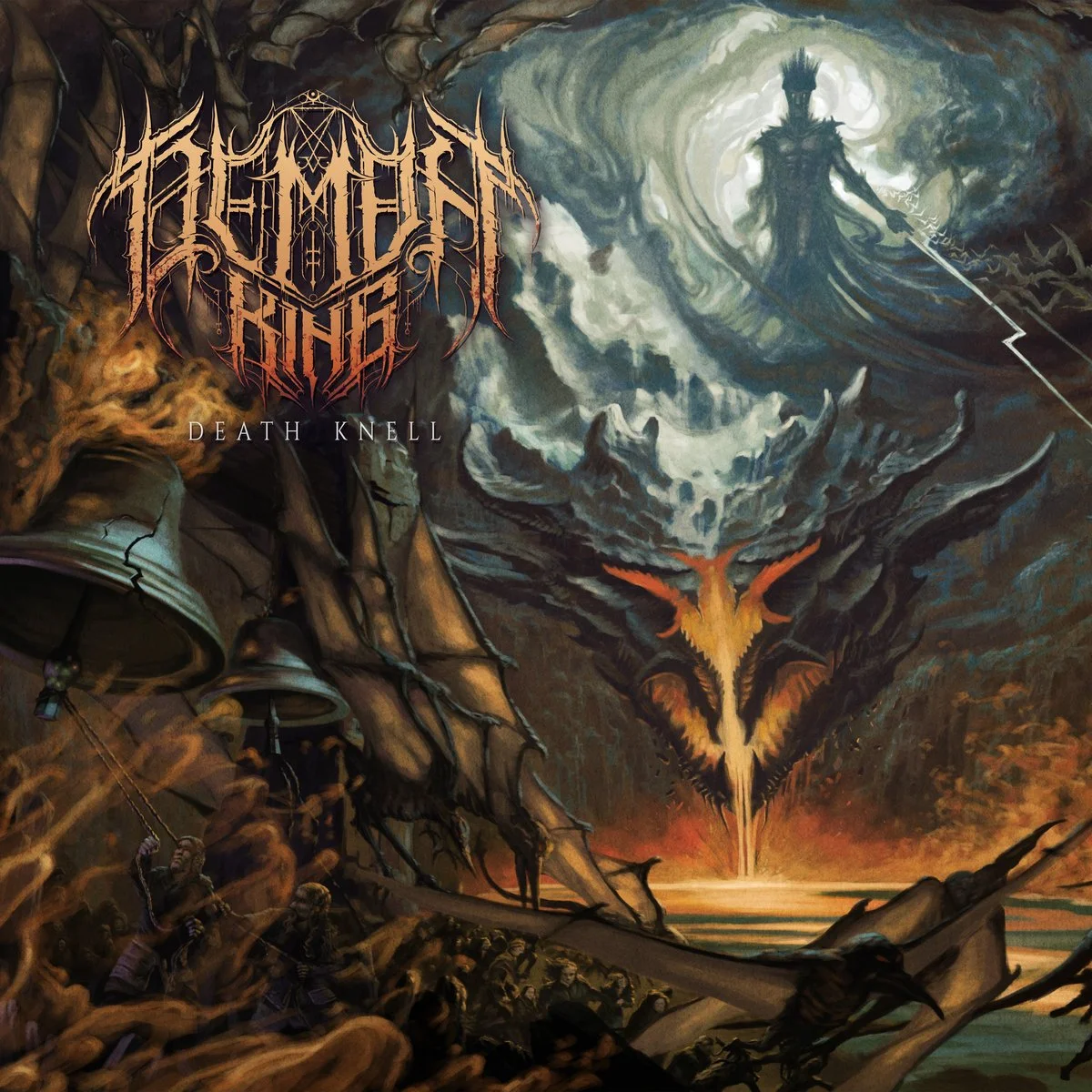
Album Review : Demon King - Death Knell (2025)
I’m the biggest technical death metal hater I know. As a non-musician, I have two major issues with the genre: a) it requires too much focus to be played with any sort of meaningful energy, and b) there are way too many riffs crammed into a single song for anything emotionally coherent to survive. These are broad complaints, sure, but they’re also patterns: recurring behaviors, like the instinctive migration routes of a species that evolves for complexity instead of survival.
But Nasvhille’s own Demon King’s first full length album Death Knell doesn’t follow those patterns. I can’t accuse it of any of the usual genre-level sins. It’s still technical death metal, obviously, but it’s technical death metal that builds toward a clear (and original) creative vision instead of just demonstrating that it is indeed more technical than you could ever be. It’s tech death that looks ahead, not inward, like a band finally realizing the future is more interesting than the mirror.
Death Knell features eight songs and a forty-five minutes cosmic storm of unlikely ideas that add up to something more coherent than they theoretically should. It lives in this sonic half-space between precision and excess without ever relinquishing control, like a very talented and inspired teenager on Adderall. I mean that in the most complimentary way possible. The blackened technical death metal of Demon King is a Costco-sized discharge of energy. The kind of overwhelming output that should be chaotic by default, yet arrives arranged in neat, impossible aisles.
As you might’ve guessed, what makes Death Knell interesting isn’t the overwhelming complexity of the composition, but the unlikely variables it toys with and the borderline-manic intensity of the experimentation.
For example, there are these big, lush, majestic melodic guitar solos that appear every other song or so (the kind of solos that feel imported from an entirely different emotional climate) and they collide with the raw, dissonant black metal elements like two weather systems that should never share an atmosphere. These clean, almost regal sounds stab through a track like By the Portents of Evil and rip open a dimension the song wasn’t supposed to have access to, as if someone accidentally discovered a secret door in a building they thought they knew by heart.
The sporadic use of spoken word is another odd quirk that totally works on Death Knell. The only other extreme metal reference point that immediately comes to mind is Mayhem’s post–black metal hullabaloo Grand Declaration of War, and that’s the exact vibe I get from a song like The Poisoned Veins of the Willing. Momentum is crucial on this record, but it feels even more deliberate here, as vocalist Matt Brown keeps alternating between human and monster while the song swells and contracts like a mechanical lung.
It might seem superficial on paper, but details like that give the material a different, more assured texture. A sense that Demon King isn’t just performing the genre, but customizing it. Usually, tech death musicians care about little beyond brutality and fretboard gymnastics, but that’s not the case here.
The closer, To Trample and Destroy the Nations, is another memorable, black-metal-laced cut from Death Knell. Once again, the muscular mid-tempo intro collapses into a fast, athletic burst of tremolo picking that echoes Mayhem’s more experimental instincts, but Demon King uses such a wide palette of guitar tones that the song never feels derivative. At one point, it even swerves full Gothenburg before snapping back into raw, black-metal territory, carrying its own brand of single-minded fury, like a storm tearing through Scandinavia before bullrushing home to finish the job.
This is as good a moment as any to point out that Demon King is, unmistakably, a guitar-driven band. Nothing against Matt Brown’s vocals (they’re fine, fully serviceable within the chaos) and Cole Daniels and Jack Blackburn are as versatile as the music demands. But the ol’ battle axe is the lifeblood of this operation. Everything else feels like infrastructure: the guitars are the actual civilization being built.
But Death Knell hasn’t run out of ways to remind you that it’s not playing by the genre’s imaginary rulebook. Case in point: the keyboards. They don’t show up consistently enough to be a feature, but they’re present just often enough to make you wonder if you accidentally switched playlists. Saturnal Abyss, Carbonic Prison, and the title track all lean into them. Sometimes so hard you start questioning whether Demon King even wants to be a tech-death band, or if they simply enjoy watching listeners recalibrate their expectations in real time.
The weird part is that the songs occasionally flirt with power metal without ever quite admitting it, which gives everything a manic, slightly disorienting vitality. It’s fun. It’s exhausting. And if that contradiction bothers you, congratulations: you’ve finally understood tech death.
Anyway, energy is the double-edged sword of Death Knell. It’s the album’s greatest asset, but it’s also the thing that keeps revealing all the seams Demon King would probably prefer you ignore. I admire that they’re unafraid to scribble outside the prescribed tech-death margins, but there’s a point where "going pedal-to-the-metal on the ol’ Crayola" stops being rebellious and starts feeling like you’re watching someone try to speedrun coloring.
The result is that some songs flatten themselves through sheer momentum. They blur when they should imprint. On a differently paced album, these tracks might hit like revelations; here, they sometimes register more like drive-bys.
*
I wanted to talk about Death Knell because it’s been years since a non-Canadian tech-death record made me feel anything resembling an emotion. Maybe the last time was Inferi’s 2021 full-length, which once again proves that the Nashville tech-death scene secretly has one of the most dynamic, Technicolor identities in extreme music. These guys are basically wolverines: rabid, territorial, and inexplicably proficient at sweep-picking, like they taught themselves theory by gnawing on tablature in the woods.
Death Knell is uneven, sure, but it’s uneven in the way love is uneven: lopsided with intent, anchored by an unshakeable sense of purpose. It doesn’t care what I think. It doesn’t care what you think. It isn’t trying to be universal or palatable or optimized for any algorithmic taste cluster. And because of that, because it refuses the very principle of consensus, it’s absolutely worth your time.
7.7/10
* Follow me on Instagram and Bluesky to keep up with new posts *