A Subjective History of Goregrind
For a long time, Metallica functioned as cultural shorthand for everything adults feared about metal: rebellion, alcohol abuse and the vague but very real possibility that you might eventually get crushed by your own vehicle if you became one of them noisy troglodytes.
As usual, concerned parents were looking in the wrong place: while Tipper Gore was having nightmares about Judas Priest jump-starting her child’s precocious sexual awakening, Norwegian teenagers were quietly summoning Satan in their folks' basements, British punks were bio-engineering grindcore out of anger and filth, and a few Liverpudlian lads with no money and no recording technique whatsoever were already toying with levels of intensity that made the goriest horror films of the era feel almost tasteful.
As early as 1988, extreme music had already begun backing itself into one of its many dead ends, even if nobody involved would have described it that way at the time. Grindcore had accelerated so fast and hit so hard that escalation stopped making sense as a concept. You couldn’t really go faster and hitting harder just turned into noise. So the music did what extreme art always does when it runs out of forward motion: it turned sideways. Toward provocation. Toward pathology. Toward a fixation on the human body not as a metaphor, but as raw material.
Out of that left turn emerged a subculture of a subculture, proudly grotesque and willfully unwelcoming, devoted to what I can only describe as deliberate monster cacophony and I mean that in the most affectionate way possible.
This is my subjective history (or lack thereof) of goregrind.
Too Much Access To Medicolegal Literature
So yeah, goregrind was invented by accident like a biological weapon that was never meant to exist.
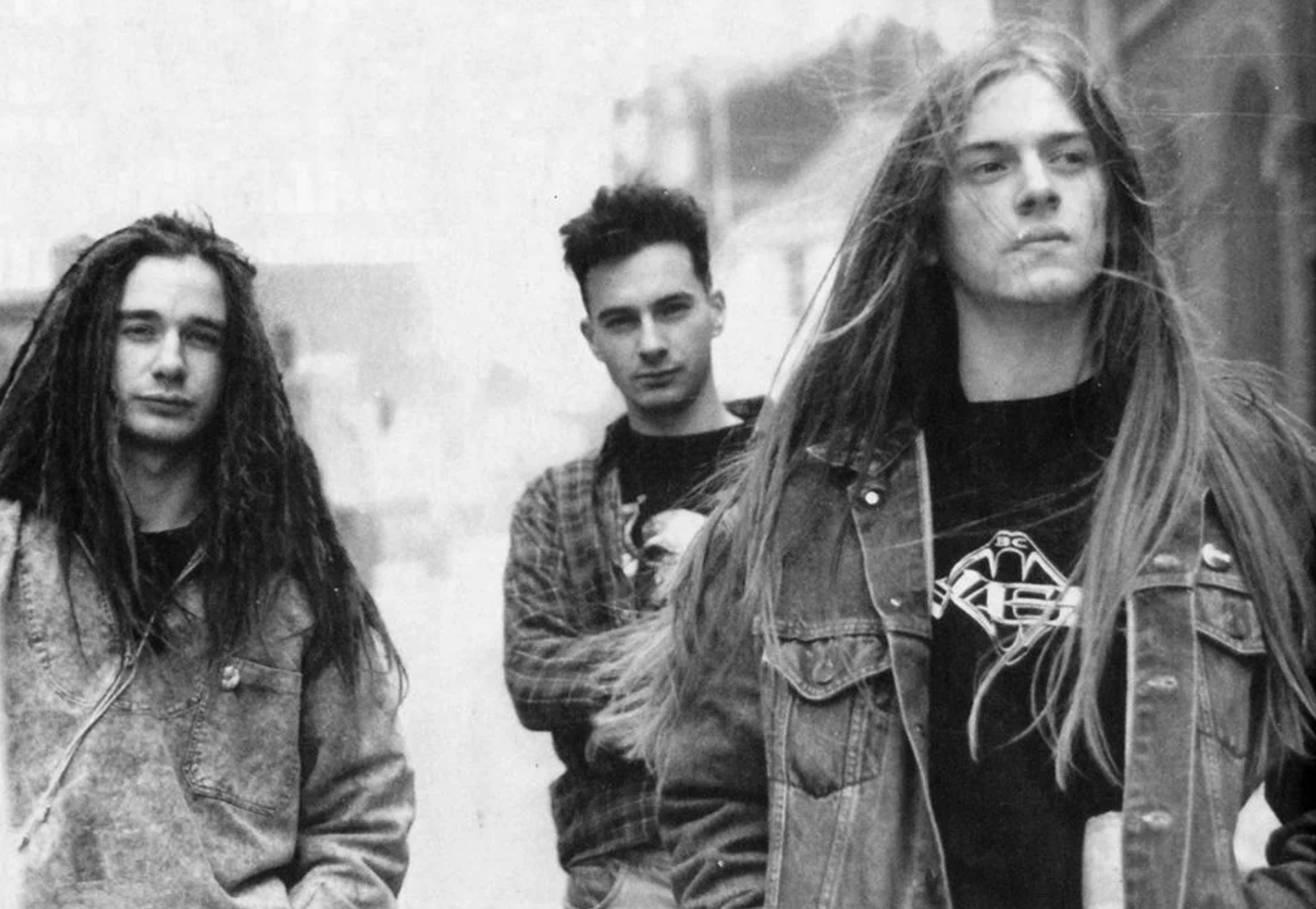
Jeff Walker, Bill Steer and Ken Owen never meant to record muddled nightmare music, they just has limited studio time and a not-so-good studio engineer who "ruined" the tracks according to Steer. The guys were all eighteen and nineteen then and played fast and hard, but not particularly well. Carcass had close ties to grindcore pioneers Napalm Death (Steer played for them) and shared some of their ideas about playing out of control. These factoids are important, they would become the ethos of goregrind. Little did they know, Carcass' debut record Reek of Putrefaction would go on and become a classic of extreme music.
Reek of Putrefaction also introduced two ideas that ended up mattering far more than the actual music. The first was vocal in a way that barely felt vocal at all: mostly standard grindcore growls, but occasionally dragged downward and pitch-shifted into something that sounded less like a person and more like a toilet monster coming to life. Used sparingly, those moments didn’t dominate the record so much as contaminate it, reinforcing the sense that something inhuman was pressing up against the songs from the inside.
The second idea was thematic, and even more telling. Carcass fixated on medico-legal horror not out of calculated shock value, but because one of them had access to his sister’s nursing school manuals, which treated the human body with a level of clinical indifference that felt obscene once translated into art. Diseased organs, autopsy language, pathology as vocabulary, this wasn’t Satanism or rebellion in any familiar sense. It was bureaucracy applied to flesh. Together, these two accidents — the voice slipping below the human register and the body reduced to instructional material — ended up defining goregrind far more than tempo, riffs or technique ever could.
Goregrind took some time to properly seep into metal culture and even now it’s unclear what the second goregrind record is supposed to be. Horrified by Repulsion and Impetigo’s Ultimo Mondo Cannibale both have legitimate claims, depending on whether you think goregrind is primarily about extremity or about attitude. I lean toward the latter. Horrified feels like a horror-themed grindcore record pushed to its limit, whereas Ultimo Mondo Cannibale already has the brutish, almost playful primitiveness that would come to define the genre.
It sounds like the logical mutation of Reek of Putrefaction: guitars made fat and overblown on purpose, horror filtered through humor and provocation rather than dread, and an overall sense that the ugliness is part of the joke. The pitch-shifted vocals aren’t there yet, but the groundwork is obvious. The systematic abuse of the human voice would come later, once the idea had fully rotted into place.
The foundational ideas were out there, though: simple music on purpose, played absurdly hard or, just as often, dragged into a lurching mid-tempo that made it feel heavier than speed ever could. Lyrics ceased to matter as communication and became competitive disgust instead, a kind of nuclear arms race to see who could describe the most vile, unnecessary shit imaginable.
Pitch-shifted vocals completed the transformation, not as a gimmick but as a signal flare: this was music abandoning human emotion altogether. What makes goregrind fun (against all reason) is that it’s monster music. A grotesque carnival where you’re briefly allowed to drop the burden of being a person and just revel in the noise of something proudly inhuman.
This leads us to The Beatles of goregrind. The band that would eventually define the genre.
Soundscapes From The End Of The World
Oddly enough, the band that would go on to define goregrind wasn’t really influenced by Carcass at all.
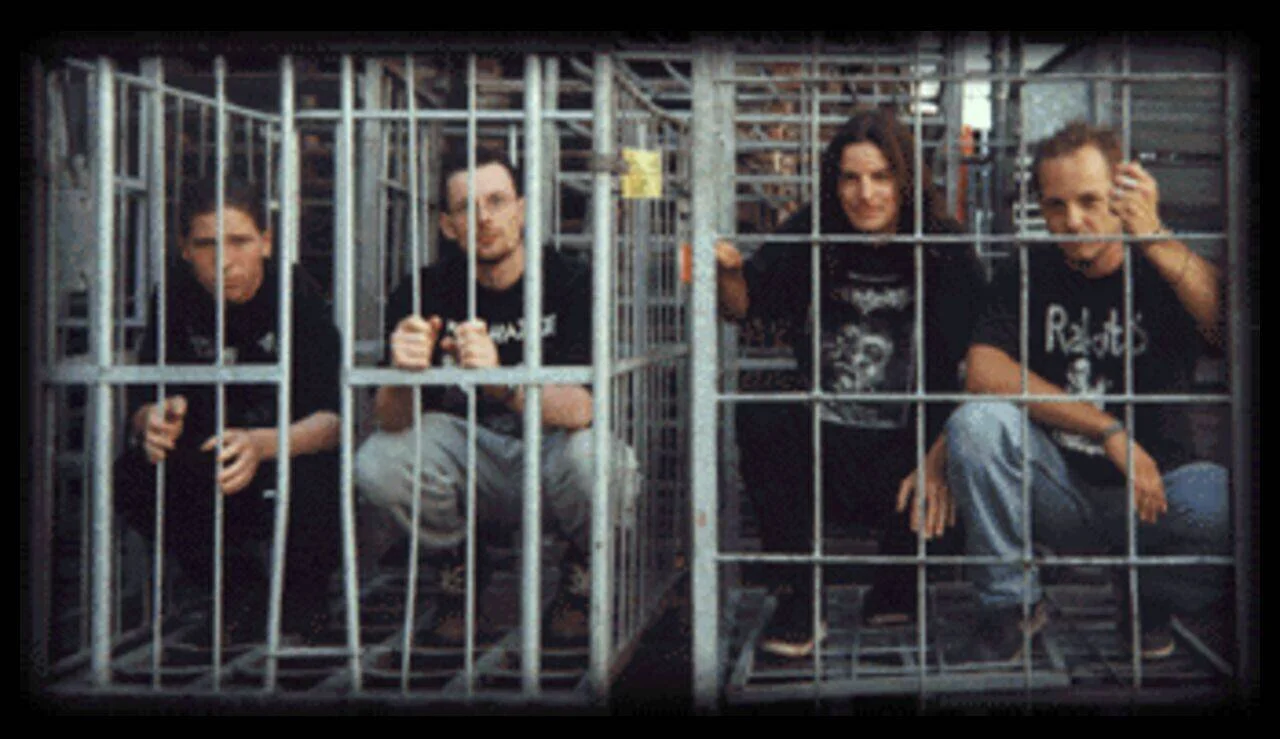
That fact only makes sense once you understand how little music had to do with their origin. I interviewed Last Days of Humanity’s original singer Hans Smits, which gave me a clearer picture than most of how something this horrific could emerge without any grand artistic intention. The band effectively began on December 30, 1989, when Smits and his friend Erwin de Wit organized a show for Agathocles and Drudge in the small town of Volkel.
To warm up the room, they grabbed microphones and started screaming and growling at the audience. There were no riffs, no songs, and no plan. They didn’t even know anyone who played instruments. What they had, unintentionally, was the purest expression of goregrind’s core idea: abandon first, structure later. They were mischievous teenagers who didn't give a fuck with energy to spare. Therein lies the magic of goregrind.
Last Days of Humanity released their first demo in 1992, and calling it "music" still feels generous. At that point they were aiming squarely at noisecore, operating in the same hostile zone as Anal Cunt and 7 Minutes of Nausea, where structure was optional and endurance was the real test. Not gonna lie, I kind of dig it the way I dig my nightmares when I wake up. It took years before anything resembling conventional musicianship even became a concern.
Their second demo, Human Atrocity, is still a strange and compelling artifact, not because it clarifies anything, but because it documents a band slowly discovering what it might be capable of sounding like. It isn’t until their first album in 1998 — remarkably late for a band that’s now nearly forty years old and has only released four full-lengths — that shapes vaguely reminiscent of Carcass begin to surface. By then, the chaos had coagulated into something recognizable. The ideas had taken physical form. Last Days of Humanity finally sounded like a band, which meant they were ready to do what they’d been circling all along: terrify the world.
Now, Last Days of Humanity were largely their own thing. An experience in extreme amusicality with no real equivalent, except maybe Anal Cunt at their most willfully anti-social. Other voices were emerging at the same time, but most of them were still tethered to death metal, either by technique, groove or the lingering belief that riffs should exist for a reason. Lymphatic Phlegm in Brazil pushed goregrind toward total abstraction, stripping the music down to texture and pitch-shifted inhumanity. General Surgery in Sweden represented the opposite impulse, grounding goregrind in old-school death metal muscle while embracing its pathology and filth. Japan’s Catasexual Urge Motivation belong in this conversation too, if only because they treated extremity as a performance art problem rather than a musical one.
I’d also add early Haemorrhage, who codified the medico-legal obsession into something almost scholarly, and the grimy, filthy Dead Infection from Poland, whose mid-tempo rot did more to define goregrind’s feel than its speed. None of these bands sound like Last Days of Humanity, but all of them helped outline the negative space around what LDoH would become. They proved that goregrind could bend, mutate and absorb influences without ever losing sight of its core idea: this isn’t music for humans so much as music about what’s left once humanity steps aside.
The Real Maniacs Out There
Goregrind has remained too rare and too socially inconvenient to ever solidify into a proper scene. It exists less like a movement and more like those guys you vaguely know who own too many knives and show up once or twice a year, unannounced, for a long and irresponsible drinking session before disappearing again.
Bands surface sporadically, usually folded into broader festival lineups rather than headlining their own ecosystems and this happens far more often in Europe, where the sound is generally tolerated, if not fully understood. In America, goregrind remains an acquired taste that most people wisely never acquire. As a result, much of the genre’s collective memory now lives online, filtered through shaky live footage from places like the Obscene Extreme Festival in Czechia, which has quietly become the closest thing goregrind has to a recurring physical homeland. It’s fitting: a genre that never wanted permanence now mostly survives as evidence that it happened at all.
Goregrind was never supposed to produce stars. It’s a genre designed to remain aggressively underground, structurally unprofitable and socially inconvenient. And yet, against its own logic, it somehow managed to generate two "superstar" bands: Rompeprop and Gutalax. Superstar here is a relative term. It means they show up at a festival and a critical mass of people go, “Oh yeah, them,” followed immediately by, “What are they called again?”
Rompeprop earned their strange notoriety almost by accident, about twenty years ago, when they opened a split with Spain’s Tu Carne Just a Matter of Splatter with a goregrind children’s lullaby. It wasn’t clever in a wink-wink way so much as disarming, the kind of move that made goregrind briefly legible to people who didn’t actually want to understand it. That intro spread faster than the band itself, turning Rompeprop into a reference point rather than a household name, which is probably the most fame goregrind can metabolize without collapsing.
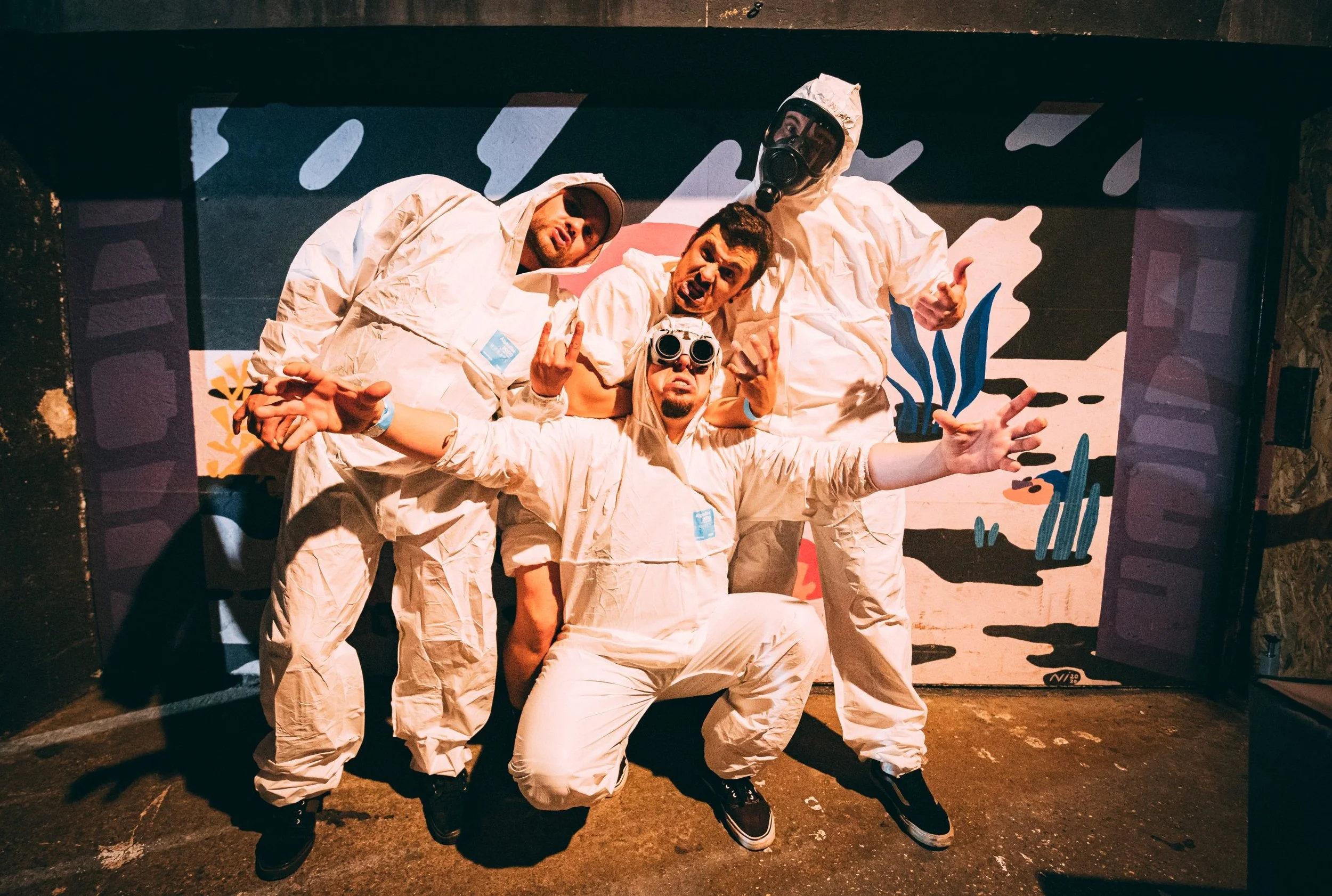
Gutalax are a different phenomenon entirely. Hailing from Czechia, they’re arguably the most popular goregrind band right now, which mostly means they’ve figured out how to lean into spectacle without pretending they’re doing anything else. Their poop-themed absurdity rubs purists the wrong way, largely because it makes explicit the humor that was always inherent to the Carcass branch of the genre. There’s no subtext left to excavate. The joke is the point. Personally, I find their pig-oink vocals weirdly soothing, like ASMR for people whose nervous systems were rewired by extreme music at a young age. I’d genuinely listen to an a cappella version of their songs, if only to confirm that goregrind finally achieved its purest form: music that sounds best once you remove the instruments entirely.
What Rompeprop and Gutalax ultimately prove is that even a genre built on deliberate ugliness can’t fully escape recognizability. Goregrind may reject success, but it still occasionally trips over it, stares at it in confusion, and then wanders off again before anyone can ask it to explain itself.
There are also the serious ones. Or at least the bands that present as serious, which in a genre like this is already a complicated claim. It’s hard to believe anyone is fully committed to the lyrical content on a literal level, but Pharmacist clearly approach goregrind with a kind of discipline and intent that feels almost scholarly. Dead Infection have been refining their version of pathological heaviness for decades now, and the aforementioned Tu Carne benefit enormously from the fact that I don’t speak Spanish, which allows the titles to exist as pure texture. GUT and Haemorrhage belong here too, if only because they’ve been doing this since 1991 and never felt the need to apologize for it.
On top of that, I’d add General Surgery again in this context, because their longevity and consistency have effectively turned them into accidental archivists of the genre’s Carcass wing. Lymphatic Phlegm also fit this "serious" bracket, not because they sound disciplined, but because they commit so fully to abstraction that it stops feeling jokey altogether.
The American side is worth pausing on as well. The groovy Oakland boys Haggus have become an unlikely gateway band, proving that you can make goregrind that actually moves without sanding off the ugliness. Miasmatic Necrosis push the modern end of the sound into grotesque overdrive, Fluids sit in their own sewer where goregrind, sludge, and noise blur together, and Lipoma remain one of the strangest U.S. projects around: a New York–based experiment that somehow fuses goregrind with melodic death metal in a way that shouldn’t work, but does just enough of the time to stay fascinating.
If anything, this spread of approaches underlines the weird truth about modern goregrind: once the foundational ideas were established, the genre stopped needing unity. Some bands chase precision, some chase stupidity, some chase atmosphere, and some just chase endurance. They don’t agree on much, except for the core principle that sounding human is optional at best.
Here are 5 songs to help you make sense of goregrind
Carcass - Pyosisfied (Rotten to the Gore) : Nasty and genuinely putrid, this track lurches between mid-tempo grooves and absurd bursts of speed like it can’t decide whether it wants to stalk you or sprint at you. It’s also possibly the earliest use of the vocal pitch shifter in extreme metal, which is crucial because it doesn’t just make the vocals heavier; it makes them less human. This doesn’t sound like a band playing a song so much as evidence recovered from a serial killer’s house and reluctantly catalogued as music.
Hemorrhage - Anatomized : Although Haemorrhage formed after Last Days of Humanity, they arrived at a full-length vision of goregrind several years earlier, locking the genre into a raw, filthy, mid-tempo menace that still feels definitive. They are quite influential. If Carcass provided the accident and LDH provided the extremity, Haemorrhage provided the template.
Last Days of Humanity - A Divine Proclamation of Finishing the Present Existence : The kings. Just watch them play and the usual questions stop making sense. Do you know what’s happening, or have you simply surrendered to the punishing density of it all? The sound doesn’t move forward so much as collapse inward, a sustained act of violence where structure is present only in theory. Music can be more abstract than this, sure, but it can’t be more extreme. This is goregrind stripped of every remaining courtesy, existing purely to overwhelm and erase the listener in the process.
Gutalax - Assmeralda : An oddly groovy, almost danceable take on goregrind, “Assmeralda” is simple, energetic, and weirdly festive, which is pretty much Gutalax’s entire philosophy in miniature. The riffs bounce, the rhythms invite movement, and everything about it feels designed for communal stupidity rather than private endurance. The real focus, though, is on those horrifyingly smooth vocals. I genuinely don’t know how Martin Matoušek is doing it, but it doesn’t even sound like he’s forming words so much as channeling a bodily function directly into a microphone. It’s grotesque, catchy, and impossible to mistake for anything else.
Haggus - As the Hammer Drops : Another fun band with energy to spare, Haggus lean into what they call mincecore, though in practice the label barely matters anymore. The track is a constant blur of shifting tempos, jagged riff attacks, and sudden dynamic pivots — sometimes within the same measure — so that the music feels like it’s teetering on the edge of collapse the entire time.
It’s precise chaos: riffs are scrappy but intentional, drums skitter between blast and groove, and the vocals act less like narrative and more like another percussive element. By the time the hammer drops, you’ve barely caught your breath, and the track is already dragging you toward the next collision. Haggus thrive in that liminal zone between grind, gore, and outright mischief, proving that goregrind can still evolve without abandoning its absurd core.
* Follow me on Instagram , Bluesky and Substack to keep up with new posts *