Movie Review : Civil War (2024)
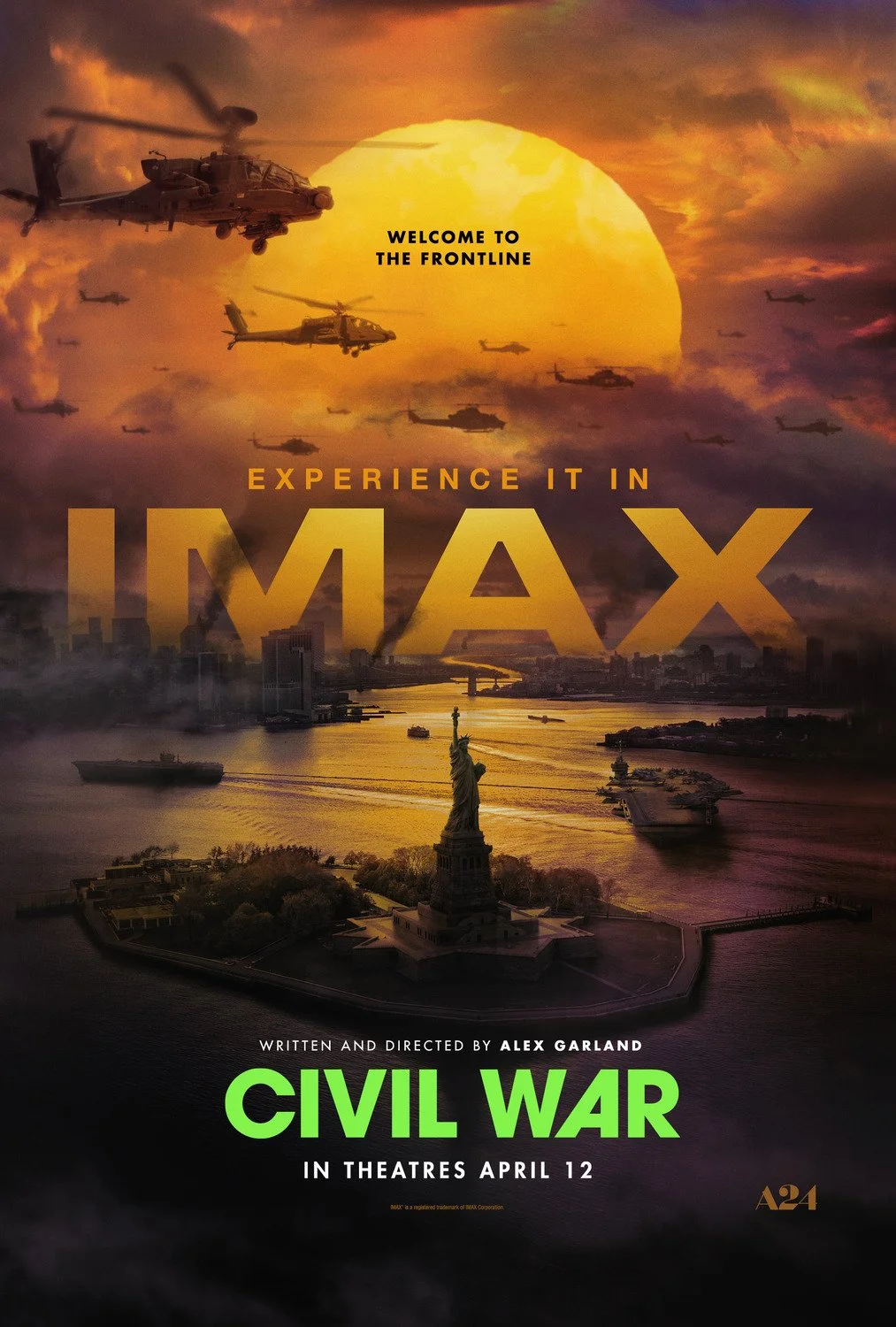
The career of British storyteller Alex Garland is nothing short of inspiring. He's written novels, screenplays, designed a video game, and now he’s making movies exclusively on his own terms. His most impressive feat is that he doesn't seem to miss. He's one of these creators who would rather keep his mouth shut forever than make something he didn't feel he absolutely had to. Audiences responded accordingly for the most part, except perhaps for his 2024 movie Civil War.
I’ve heard everything about this film: plotless, pointless, ideologically muddled — enough to keep me from watching the thing for almost two years. Well, I’m here to announce that Civil War is the antithesis of a coworker movie. If someone ever tells you they hated it, drop whatever you do and watch it. Then proceed to never talk about movies with this person again.
Civil War follows Lee (Kirsten Dunst) and Joel (Wagner Moura), journalists moving through an American civil war set just far enough in the future to feel plausible and close enough to feel rude. On the road, they pick up Jessie (Cailee Spaeny), an aspiring photojournalist who wants to document the inevitable fall of Washington and treats the frontlines like a calling rather than a warning.
As the three of them push deeper into the conflict, traditional moral categories collapse. There’s no ideology left to debate only survival. The violence becomes constant, exhausting and finally personal, especially for Lee, who begins to see Jessie not as a colleague in training but as someone she might not be able to protect.
Remapping The Meaning of War
Most war movies are extremely popular because they do the moral math for you. They tell you who deserves your empathy, who earned their violence, and why the suffering you’re about to witness is necessary, justified, or at the very least meaningful. Even the bleak ones tend to arrange the chaos into something legible: a wrong committed, a response provoked, a line crossed.
Civil War doesn’t do that. By the time the movie begins, the war is already winding down. There are three factions, but what any of them actually want is never explained, and it never feels like it’s missing. The conflict doesn’t need a thesis to feel urgent. It’s immediate, dangerous and terminal in the way real violence often is: stripped of ideology, emptied of purpose and reduced to a series of visceral, terrifying moments where survival is the only remaining logic.
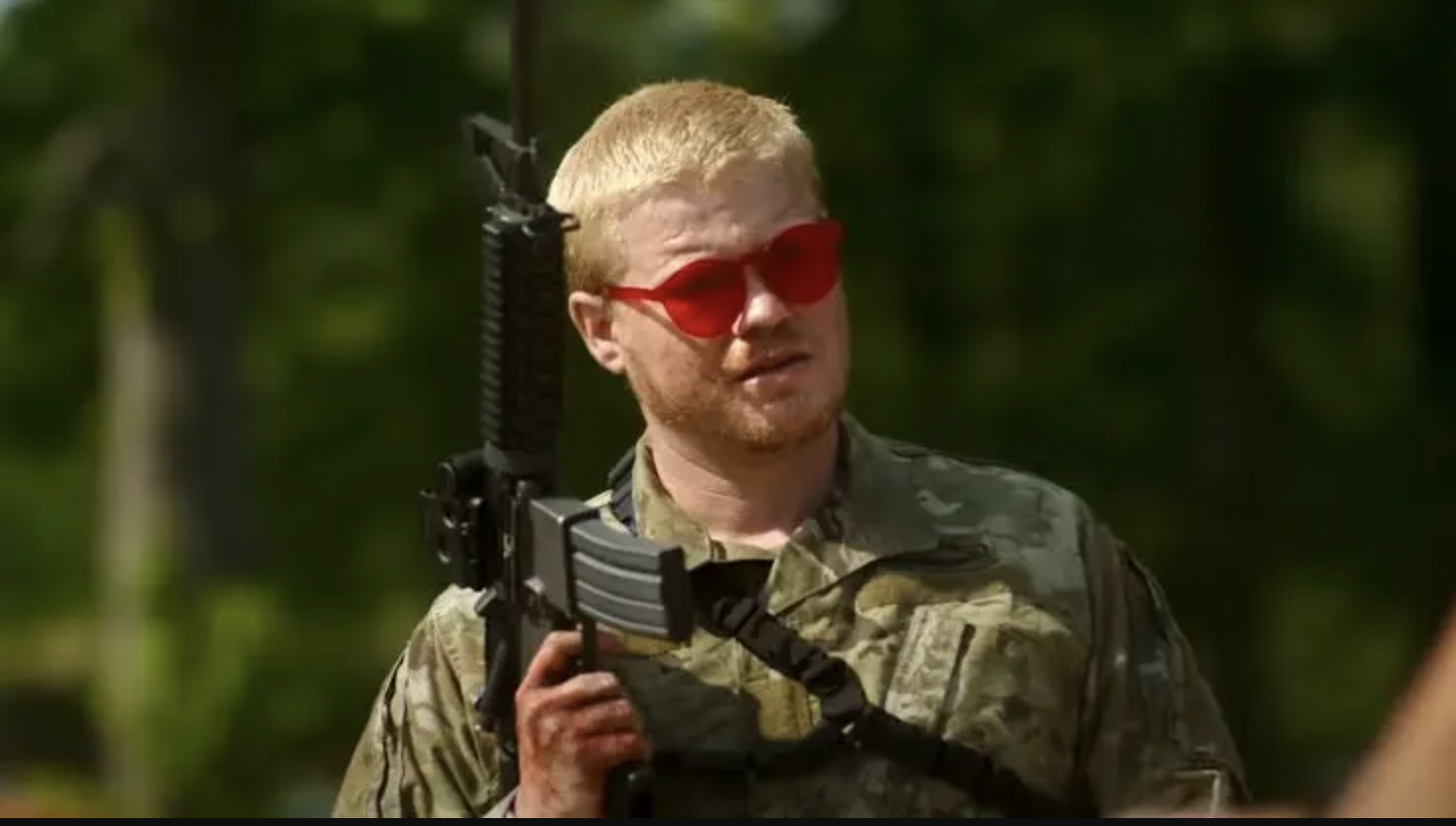
There’s a scene where the journalist squad is forced to take cover from sniper fire. Joel stumbles onto a counter-sniper team already pinned to the ground, men who systematically refuse to identify themselves, explain which faction they belong to, or clarify what the situation with the sniper actually is. Not because they’re being evasive, but because none of that information would help them survive the next ten minutes. Meaning is optional here, possibly even dangerous.
The scene feels lifeless and suffocating at the same time, built out of almost nothing but tension. It’s ninety-nine percent waiting and one percent action, which is exactly how it earns its power.
Most conventional war movies position the viewer on the winning side, or at least the morally superior one. Even when they’re bleak, they offer orientation. You know who you’re supposed to fear, who you’re supposed to root for and what victory is meant to look like. Civil War offers none of that. Garland doesn’t make you feel like a participant, he makes you feel like a civilian. Every faction is equally dangerous and your role isn’t to advance anything or take a stand. It’s to stay alive long enough to bear witness.
In that sense, Civil War plays less like a war movie than a horror film. It doesn’t generate courage or pride, it generates dread. The conflict isn’t something you engage with, it’s something that happens to you. And not participating isn’t framed as cowardice or moral failure, but as the only position that makes any sense at all.
The Noise Hidden in Boredom, Silence and Desolation
Another crucial element of Civil War is its use of silence and stillness, which oscillates between hauntingly beautiful and deeply unsettling. Alex Garland’s vision of a war-torn United States is filled with images of death and devastation, but for most of the film, you don’t actually see that violence unfold in real time. Lee, Joel, Jessie, and Sammy (Stephen McKinley Henderson) move from one ruin to the next accompanied mostly by quiet, with distant gunfire and explosions serving as the only proof that a war is still actively happening somewhere nearby.
This uneasy coexistence (peaceful silence paired with unmistakable devastation) creates a liminal space between life and death that the journalists can’t fully inhabit. It mirrors Lee’s internal state: outwardly calm and reassuring, but internally frayed by prolonged exposure to catastrophe. In this world, the line between quiet and death can be crossed at any moment, turning stillness into something tense rather than comforting.
Once again, the group advances toward danger the way a victim does in a home-invasion horror film, drawn toward the noise without fully understanding why. Not quite self-aware, but operating on the instinct of a trapped animal searching for an exit. The silence and desolation flatten the landscape, but they also make the journey feel harrowing and inevitable, as if the violence is no longer something they might encounter, but something that has already claimed them in advance.
*
Civil War is going to become a personal litmus test for me, a quick way to figure out whether I’m talking to someone I can actually discuss movies with. You might find that pretentious, and you’re probably right. But this is a genuinely taut, uncomfortable film built around a hypothetical that feels less abstract with every passing day. It doesn’t reassure, it doesn’t clarify and it refuses to tell you where to stand. It just sits there and makes you deal with it. That's everything I want from a film.
I’ve always believed that good art should comfort the disturbed and disturb the comfortable, and Civil War operates squarely on that wavelength. It doesn’t reward certainty. It punishes complacency. So yes, I’ll be that pretentious moviegoer. I’m fine with it. If you think this movie sucked, we’re not having a disagreement. We’re just using cinema for entirely different purposes and I’m not particularly interested in negotiating that gap.
8.4/10
* Follow me on Instagram , Bluesky and Substack to keep up with new posts *