

Movie Review : If I Had Legs I'd Kick You (2025)
Some problems don’t have solutions. When someone you love disappears from your life without warning, there’s no clever emotional technology that makes it manageable. You don’t "move on." You just slowly rebuild your daily existence around the hole they left behind and try not to fall into it every morning. The worst part is that you usually end up doing this alone. Not because people are cruel, necessarily. Often, they’re decent. They care. They say the right things. But when they realize there’s nothing useful for them to do, they drift away. Their helplessness becomes your isolation.
Mary Bronstein’s If I Had Legs I’d Kick You is about that specific, violent kind of loneliness: the kind that comes from carrying a burden too heavy for one person, while everyone around you quietly decides they are not equipped to help you carry it.
If I Had Legs I’d Kick You follows Linda (Rose Byrne), a therapist left alone for eight weeks to care for her infant daughter, who suffers from a pediatric feeding disorder. When her apartment floods and the ceiling collapses, Linda and her child are forced into a motel, where work, caregiving, guilt, alcohol and loneliness begin grinding away at her sanity.
Not in some glamorous movie-madness way, either. More like the surreal, humiliating kind of breakdown that happens when life keeps asking you to be reasonable without ever providing you with reasonable circumstances.
Invisible Terror
A lot has already been said about Linda’s daughter being kept off screen for the entirety of If I Had Legs I’d Kick You and with reason. It’s the movie’s defining formal choice. She’s not treated like a monster to be defeated or even a problem to be solved. She becomes something stranger and more intimate: a voice inside her mother’s head. A living obligation. A set of invisible chains keeping Linda from connecting with anything or anyone that might rescue her from her own fundamental loneliness.
That’s what makes Linda both the protagonist and the antagonist of the movie. She’s not fighting her daughter. She’s fighting the version of herself that resents how impossible her life has become, then hates herself for feeling that resentment in the first place. The real horror of If I Had Legs I’d Kick You isn’t that Linda can’t manage life with a sick child. It’s that she knows an ideal mother would supposedly be able to and she can’t stop measuring herself against that imaginary woman.
Even when Linda loses contact with reality, If I Had Legs I’d Kick You never quite becomes horror. It’s a movie about terror. The existential terror of seeing yourself as an objectively bad person, and the much more practical terror of hurting someone who cannot survive without you. It does not elicit pleasant feelings, but it also never pretends that unpleasant feelings are problems cinema is obligated to solve.
Bronstein’s film is about naming a crisis that polite society prefers to mislabel as exhaustion, stress, motherhood, or "a rough patch." But there’s a difference between being tired and being trapped inside a life where every available emotion makes you feel guilty.
A Healthy Fear of Men
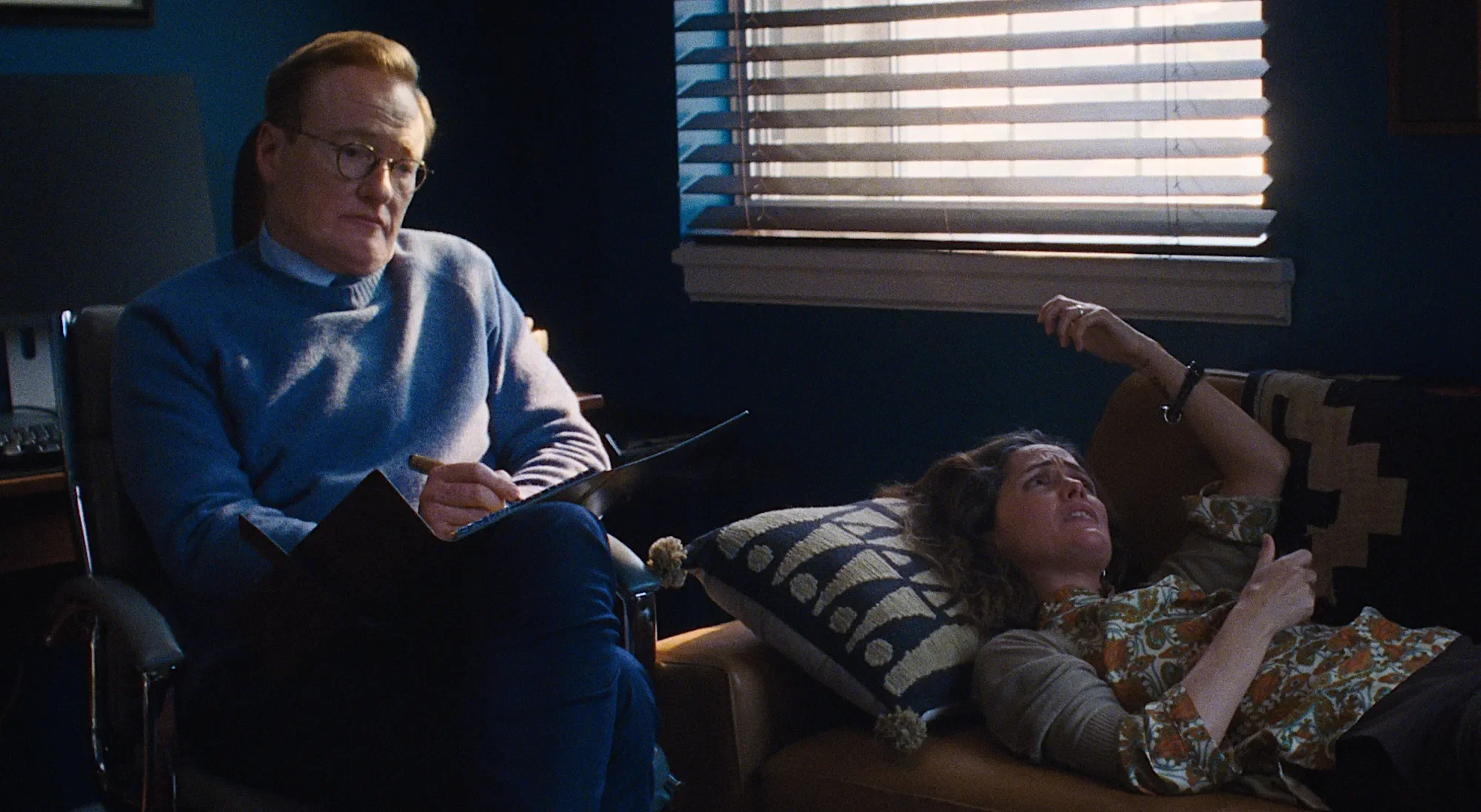
Linda’s plight is met with very little empathy throughout If I Had Legs I’d Kick You, but it does attract a certain uncomfortable interest from men. The most obvious example is her therapist, boss and potential lover, (Conan O’Brien), who treats her with a mixture of exhaustion and strange, slimy animal lust. He stays close enough to violate every sane professional boundary between them, but never close enough to actually help.
He is quietly, but unmistakably attracted to her. The attraction seems to be the only thing about Linda’s suffering that he can metabolize. Her panic, guilt, exhaustion and loneliness all pass through him as inconvenience. What remains is desire. Not romantic desire, exactly. More like the low-grade entitlement of a man who sees a woman falling apart and still manages to wonder what it might mean for him.
The other suspicious male presence in Linda’s life is James (A$AP Rocky), who seems attracted less to Linda herself than to the loneliness and vulnerability radiating off her. He teeters between pity and desire, performing a kind of wounded tenderness until it becomes clear that Linda doesn’t have much use for him. Then the softness curdles into hostility. Not explosive hostility, which would almost be easier to process. Just the familiar low-grade resentment of a man realizing that a woman’s pain was not actually an invitation.
I’ve rarely seen a movie understand the slimy persistence of male desire the way If I Had Legs I’d Kick You does. It’s not presented as a great villainous force or some dark organizing principle of the universe. It’s worse than that. It’s just always there, muttering to your worst self, hovering around the edges of every interaction, waiting to see if someone’s misery can be converted into access.
*
If I Had Legs I’d Kick You is unpleasant, borderline painful by design. It’s a poisoned fever dream about a woman fighting off her worst self, only to realize she might be losing the battle. There is nothing conventionally empowering about it, which is precisely why it feels powerful. Bronstein isn’t interested in making Linda’s suffering cathartic or instructive. She’s interested in making it recognizable to anyone who has ever been cornered by a life they were supposed to be grateful for.
It’s not a sweeping emotional journey, and it doesn’t need to be. Its power is in the little details: the exhaustion, the guilt, the humiliation of needing help, the horror of being offered every kind of attention except the one that might save you. I was expecting to be unsettled, and I was. This is the type of movie you walk away from feeling like you need a hot shower and a good night of sleep.
7.7/10
* Follow me on Instagram , Bluesky and Substack to keep up with new posts *