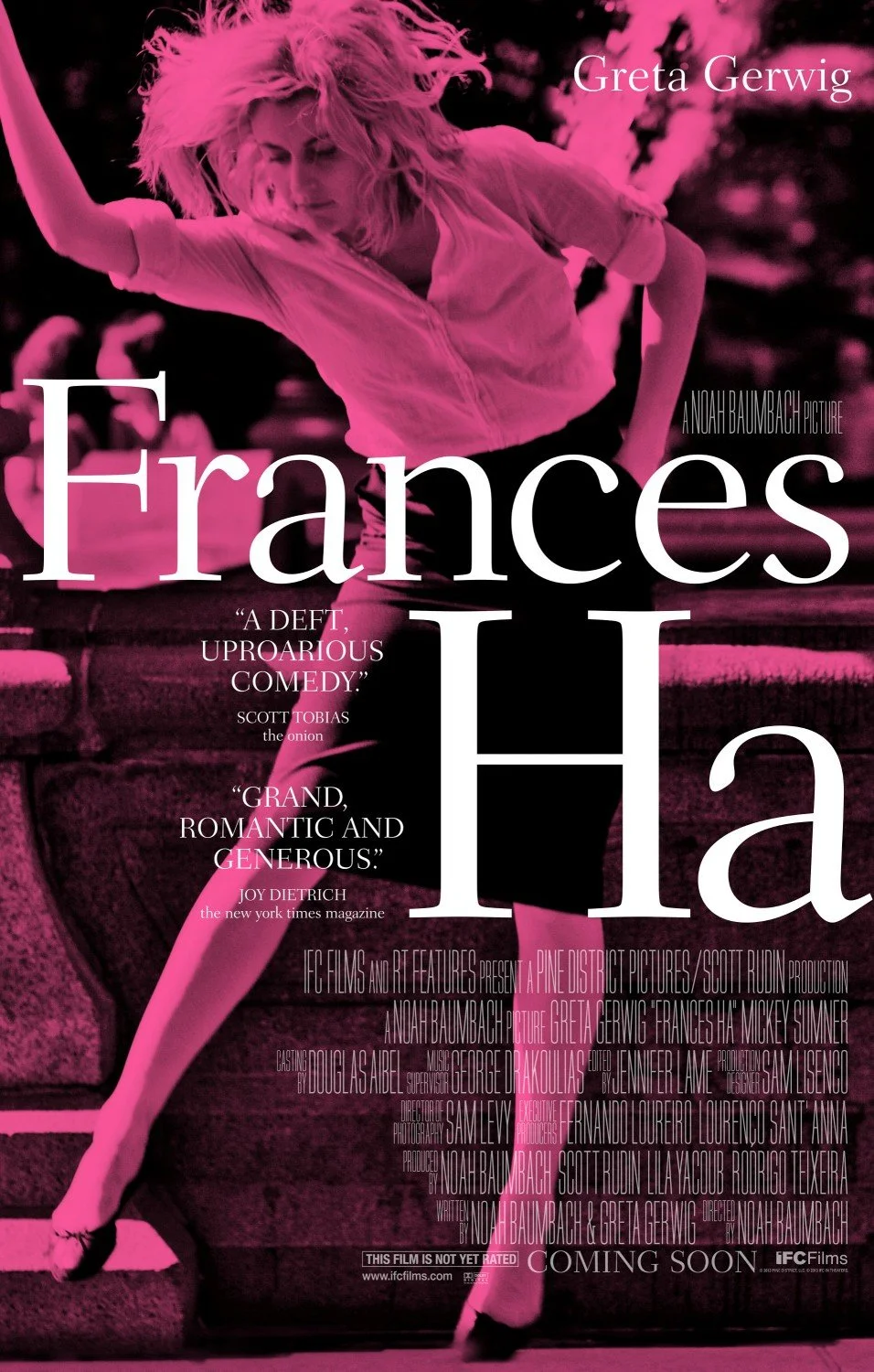
Movie Review : Frances Ha (2012)
Noah Baumbach makes what we have agreed to call serious movies, which mostly means movies where no one owns a gun, no building explodes and the central emergency is usually something like adulthood, divorce, professional disappointment or the slow moral suffocation of having too many opinions in New York. A less patient viewer might say Baumbach makes movies where nothing happens, and in the most literal sense, that person would not be insane.
Frances Ha, arguably his most iconic film, does not have much of a plot in the conventional sense. The movie’s central conflict is Frances herself, which is both the joke and the wound. It is one of those films where the protagonist and antagonist occupy the same body. Frances Ha is not about whether Frances will get what she wants. She doesn't know what she wants. Although she's still young, she's not young enough that the world bends over to give her opportunities because she's "full of potential".
Frances (Greta Gerwig, is an artistic twenty-something trying to work her way into a dance company and somehow make a living from the thing she loves, which is one of those dreams that sounds noble until rent becomes involved. She is not delusional exactly, but she is operating under the familiar young-person assumption that if you want something sincerely enough, the universe will eventually stop charging you for it.
Then her roommate and best friend Sophie decides to move out and into a more affluent part of New York. From there, Frances starts drifting from one apartment to another, trying to keep her dream alive.Every move makes her life feel a little smaller. Every decision, whether made by Frances or made for her by reality, pushes her closer to the terrifying possibility that being charming, talented and broke is not a temporary condition. It might just be who she is going forward.
The Romance Of Being Young
I might be too earnest a moviegoer to appreciate Frances Ha as a pure comedy of manners, but I found it discreetly heartbreaking. There is something almost cruel about being young after the structure of school disappears. For most of your life, ambition has been organized for you. There are semesters, grades, applications, teachers, stages of advancement. Even failure comes with paperwork. Then, suddenly, all of that vanishes and you are expected to become a person in the open market.
That is the quiet terror Frances is living through. Her plans are not destroyed in some dramatic, cinematic way. They simply become murkier. Ambition gets replaced by the more immediate problem of rent, student loans, professional usefulness and the fact that no one wants to hire you because you do not have experience, which is funny because experience is the thing you are supposedly trying to get by being hired. It is one of the more elegant scams adulthood plays on young people.
So you either find a function the world recognizes and pays for or you suffer the consequences of not being the person the world currently needs. This is what makes Frances Ha hurt. Frances is not talentless. She is not lazy. She is not even especially delusional. She is just trying to preserve a version of herself that reality has begun treating as non-essential. Frances gets dealt a particularly difficult hand as she's trying to find her way among the privileged upperclass for who her struggle doesn’t exist.

Being A Person in New York
Frances Ha is often described as a quintessential New York movie, and that is not just because it was shot in black and white and features attractive people having wounded conversations in apartments they probably should not be able to afford. New York is integral to how the movie works.
Frances does not undergo some enormous transformation. She does not collapse into a dramatic depression or experience the kind of personal crisis that announces itself with rain, cigarettes and a sad needle drop. Her decline is much more ordinary than that. She becomes frustrated, confused and impatient with the limited menu of choices adulthood keeps placing in front of her.
What changes is not Frances so much as the city around her. Or maybe more accurately, what changes is her ability to believe the city is on her side. As she moves through different apartments, neighborhoods and social classes, New York keeps revealing new versions of itself. There is the New York of artistic possibility, the New York of other people’s money, the New York of temporary couches, the New York of friendship as real estate and the New York where every block seems to ask whether you belong there or are just passing through with an overnight bag.
That is why the movie hurts in such a specific way. Frances is not lost in the abstract. She is lost in a city that sells the fantasy of reinvention while constantly reminding you that reinvention has a monthly payment.
*
Even though Noah Baumbach has the profile of a man I would challenge to a bar fight after two pints, I cannot seem to find his movies boring or even especially full of themselves. Frances Ha explores the quiet humiliation of having to reconcile your dreams with self-reliance, which is one of the central pains of adulthood and one of the least cinematic. No one wants to admit that growing up often means negotiating with the parts of yourself you used to think were non-negotiable.
That is why the movie feels so real despite being stylized within an inch of its life. It is not about catastrophe. It is about the smaller, meaner realization that the world does not hate your dreams. It simply does not care about them unless they become profitable to other people. Everyone not protected by old money eventually has to live through that moment, but almost no one has a name for it. Frances Ha does. That is why it feels more alive than most movies shot in actual colors.
7.6/10
* Follow me on Instagram , Bluesky and Substack to keep up with new posts *