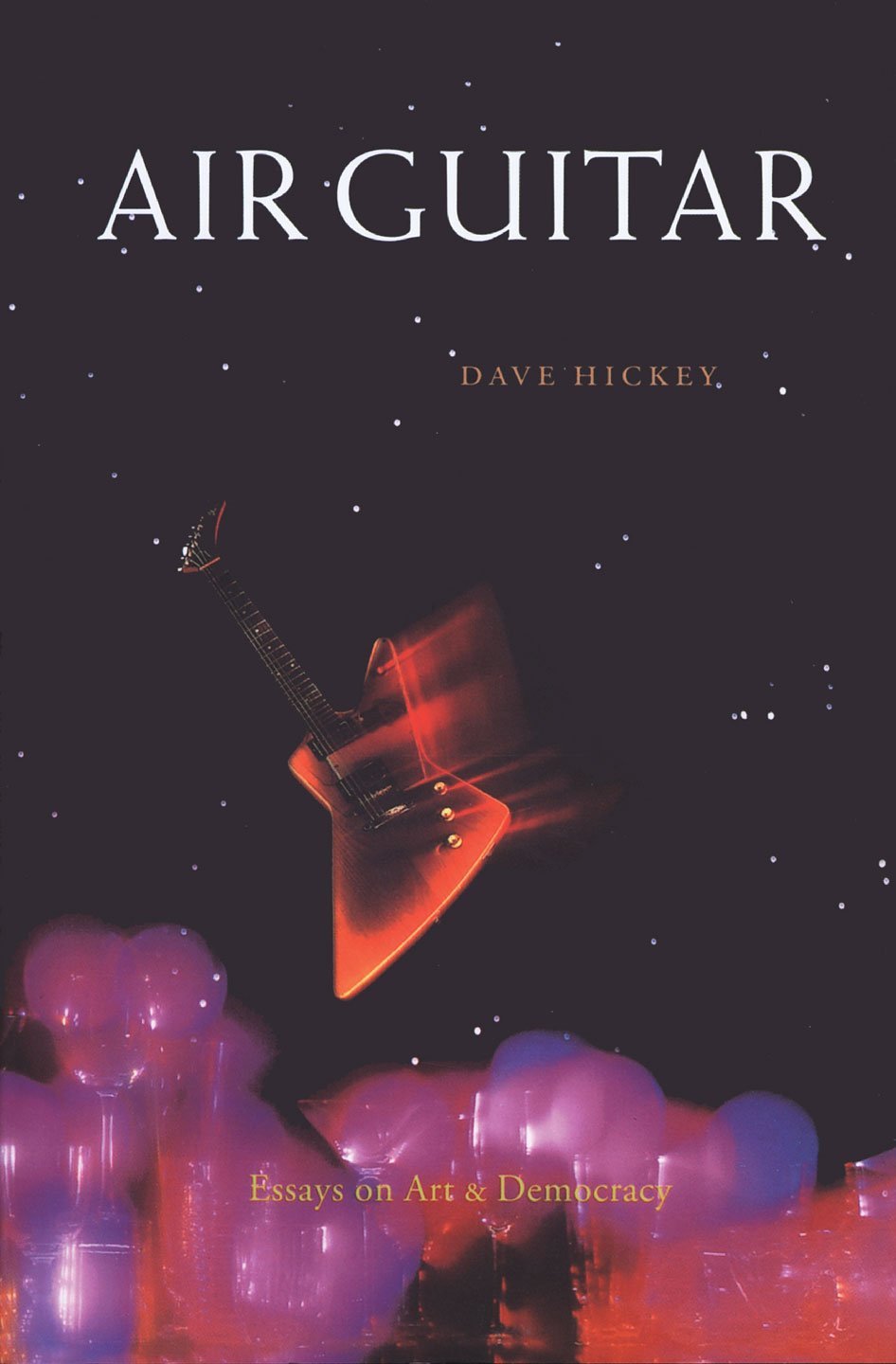
Book Review : Dave Hickey - Air Guitar: Essays on Art & Democracy (1997)
On any given topic, the boring take is rarely the correct one. This doesn’t mean the consensus is useless. Consensus tells you what everyone has agreed to stop questioning, which is often more revealing than the agreement itself. When everyone keeps making the same claim, the interesting question is not whether they’re right. It’s what they had to ignore in order to become so certain.
Art critic Dave Hickey wrote about the people, objects and cultural spaces that respectable opinion had either dismissed or deliberately trained itself not to see. In his 1997 collection Air Guitar: Essays on Art & Democracy, Hickey wanders beyond the fortified borders of so-called good taste, where beauty becomes suspicious, pleasure becomes intellectually embarrassing and ordinary people are somehow trusted to vote but not to know what they like.
Hickey understood beauty better than almost anyone, but beauty was never his final subject. What interested him was reality: who gets to define it, who gets excluded from it and why the things that feel most real are so often the ones intelligent people have been taught to distrust.
Air Guitar: Essays on Art & Democracy contains twenty-three essays about what people create in a free world. Hickey moves between deliberate art and intuitive expression, treating both as pyrecreativity. His interests range from the radical honesty of Las Vegas to the ways rock ’n’ roll and jazz defined the twentieth century, with detours through Norman Rockwell, Liberace, basketball and whatever else respectable culture had decided was too obvious, too commercial or too pleasurable to take seriously.
The book is largely a pre-internet artifact, written before taste became a public performance monitored by strangers. Yet its ideas have never stopped haunting the web. Hickey understood that democracy creates a permanent struggle over whose pleasures count as authentic, whose preferences require explanation and who gets to decide what everyone else should be embarrassed to enjoy.
Bad Taste is Real Taste
One of the central tensions in Air Guitar: Essays on Art & Democracy exists between who you are and the person your taste is trying to advertise. Interesting creation happens in the negative space between the two, where intention breaks down and something involuntarily honest leaks through. Bad taste, in Hickey’s world, is often just real taste without institutional permission.
One of the essays that expresses this idea most clearly is The Kids Are Alright, Hickey’s defence of Norman Rockwell. Rather than arguing for Rockwell’s technical importance or rescuing him through some elaborate intellectual loophole, Hickey miners his own memories for moments that feel Rockwellesque. He finds that Rockwell’s supposedly corny little scenes are everywhere: family rituals, childhood humiliations, public celebrations and those brief flashes of communal intimacy that seem insignificant until they disappear.
Rockwell is considered quaint because he painted experiences almost everyone recognizes but sophisticated people have been trained not to value. His paintings do not expose some hidden dimension of American life. They expose the embarrassing familiarity of the visible one. We dismiss Rockwell because admitting that he moves us would mean acknowledging that our inner lives are considerably less original than our taste profiles suggest.
Hickey attacks the consensus view of Rockwell by replacing it with something more uncomfortable and considerably more valuable. Rockwell is not simply painting an America that no longer exists. He is painting moments we continue to carry around inside us, where they mutate, acquire emotional weight and eventually become more real than the events themselves.
This leads to one of the collection’s most important ideas: your response to art becomes meaningful at the precise moment it escapes somebody else’s expectations. When you recognize yourself in something before you have consulted the cultural verdict, the experience belongs to you. It may be sentimental, unfashionable or completely indefensible at dinner parties, but it is honest in a way that approved taste rarely is.
Las Vegas, Liberace and America
The other foundational essay in this collection is, in my opinion The Ultimate Mirror, where Hickey argues that America is a poor lens through which to understand Las Vegas, but Las Vegas is an excellent lens through which to understand America. The essay functions as a Rosetta Stone for the way he thinks about art, pleasure and democracy. Vegas does not conceal its vulgarity behind civic virtue or respectable intentions. It tells you exactly what it wants, covers it in neon and charges admission.
In Las Vegas, everyone becomes the person they spend the rest of their lives pretending not to be. The cautious become gamblers. The modest become extravagant. People who would ordinarily judge a stranger’s lawn decorations spend three nights inside a fake pyramid drinking fluorescent cocktails. Nobody goes to Vegas to be a responsible citizen or a considerate neighbor. They go there to surrender to appetite without having to disguise it as self-improvement.
This is what makes Vegas so truthful for Hickey. It is not a place where people stop performing. It is a place where performance becomes honest. Everyone knows the fantasy is fake, which makes participating in it one of the few genuinely sincere things they do.
Hickey explores this paradox more deeply in A Rhinestone as Big as the Ritz, his essay on Liberace, a man whose authentic self could apparently be expressed only through the most elaborate artificial construction imaginable. Liberace may have been playing a character, but the character communicated something real that ordinary American life would not allow him to say directly. The costumes, chandeliers and impossible quantities of rhinestones were not distractions from his identity. They were its vocabulary.
This is what Hickey understands about performance: sometimes pretending is the only available form of honesty. Liberace could not simply announce himself to the world. He had to build an alternate universe in which being Liberace made sense, then sit behind a mirrored piano and invite everyone inside. And that universe could only exist in Las Vegas. Anywhere else, Liberace would have seemed excessive. In Vegas, excess was the local language. The city did not merely tolerate his performance. It supplied the conditions that allowed it to become truthful.
*
Air Guitar: Essays on Art & Democracy is a classic of contemporary criticism, blending personal history, genuine enthusiasm, high and low culture,and the kind of ruthless observation that makes conventional wisdom suddenly look like indoctrination Hickey could write about Norman Rockwell, Liberace, jazz, basketball and fine art without treating any of them as a guilty pleasure or an opportunity to demonstrate his superior intelligence. He understood that criticism was about sharing pleasure.
His work belongs in the same conversation as David Foster Wallace, Chuck Klosterman and the other writers who transformed pop culture criticism from the nineties onward, although Hickey often seems like the person who arrived early and left the door unlocked for everyone else. He wrote with the conviction that taste was inseparable from democracy: people reveal themselves through what they love, especially when nobody respectable has given them permission to love it.
Parts of Air Guitar have inevitably aged, but time has not contradicted its central argument. Almost thirty years later, we are more skilled than ever at mistaking conformity for sincerity. We carefully construct identities out of approved preferences, then congratulate ourselves for being authentic. Hickey understood the scam before the internet perfected it.
8.1/0
* Follow me on Instagram , Bluesky and Substack to keep up with new posts *