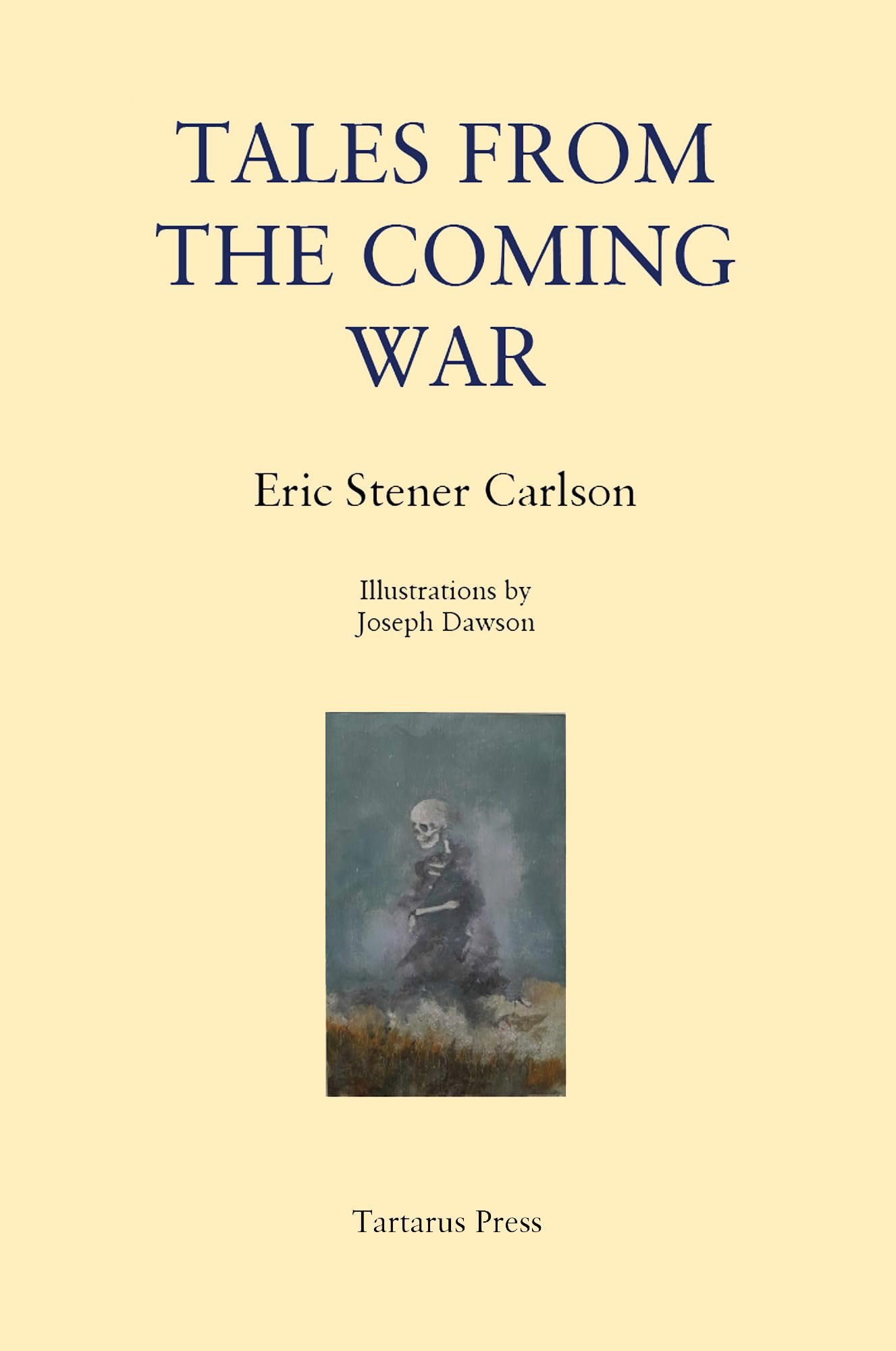
Book Review : Eric Stener Carlson - Tales from the Coming War (2025)
* a suggestion by Andrew Nolan *
There are basically three ways to experience war in the twenty-first century: you can engage in combat, suffer combat or you can watch terrifying fragments of combat unfold in real-time on social media. Most of us fall into that third category, while a much smaller number land in the first. But there’s a profound misunderstanding about the second. Being a civilian in a country at war is not primarily about dodging bombs. It’s about waiting for them and hoping they don’t land on your house or the people you love.
Eric Stener Carlson’s Tales from the Coming War lives inside that waiting. Sometimes consciously, sometimes not. These stories aren’t about combat as much as the psychological gravity field around it. The strange suspension of normal life that happens when violence becomes inevitable but hasn’t arrived yet.
The collection features thirteen stories about the atmosphere war creates. Not just the fear, but the strange emotional urgency that infiltrates everything around it. The hollow feeling of going about your daily business while knowing the entire structure of your life could disappear tomorrow. Carlson captures the psychological limbo of people who can’t imagine a future that isn’t shaped by conflict, along with subtler emotional distortions that are almost impossible to understand unless you’ve lived through them.
War is an abstraction until it isn’t in Tales from the Coming War. And sometimes, in Carlson’s stories or in real conflict, it manages to be both on the same day.
The spellbinding Desertscape follows a critically wounded man lying on a deserted highway, trying to make peace with the ghost of his father. Somewhere between life and death, his subconscious conjures the image of a man he both revered and resented, hoping that one last conversation might reveal something true about the life he’s about to lose. Their exchange is so intense and strangely tender that you almost forget young Faruk’s predicament. He’s trying to find peace while simultaneously trying to stay alive and the two goals slowly become the same thing.
In Christ, Mammoth, a researcher who has spent his life studying extinct animals slowly realizes he’s becoming one himself. Professor Radcliffe knows his best days — professionally and socially — are behind him,and the world now values speed and immediacy over the slow accumulation of knowledge he represents. He’s bitter about it, but painfully self-aware. Radcliffe understands that he has outlived his usefulness in a world that no longer has patience for men like him. The result is a character who is frequently unpleasant but strangely impossible to hate, because his resentment is rooted in a realization most of us quietly fear.
Two other standout stories push this idea in different directions. Cruel & Unusual is the collection’s most direct confrontation with war, set on a military base where an enemy soldier is held captive and the logic of permanent conflict has slowly eroded everyone’s sense of what normal life used to be. It’s a world where the war has lasted so long that the people fighting it no longer remember who they were before it started.
In The Zig-Zag Line, the stakes are quieter but just as revealing. The protagonist reduces the meaning of his life to a single achievable goal: seeing Machu Picchu before he dies. The characters in Carlson’s stories are often defined by very simple needs, but those needs exist inside situations so complicated that even the smallest aspiration begins to feel monumental.
One thing that might have intensified the collection would have been placing all these stories within the same global conflict. Carlson instead treats war as an idea rather than a defined event. We experience the stories entirely through the limited perspective of characters who don’t know the larger geopolitical picture and the conflicts themselves seem scattered across time and space. That approach feels realistic and relatable, but it also dilutes the sense of a single looming catastrophe.
Had all these lives been orbiting the same war, the cumulative dread might have been even more oppressive. It's a case of hindsight is always 20/20, but Tales from the Coming War pulsates with the potential to be more than what it already is.
*
While I can’t honestly recommend that reading war fiction will do anyone much good in 2026, Tales from the Coming War will at least make you feel something real. Many of these stories read like the most harrowing year in World Press Photo suddenly coming to life. There’s no intrigue, no patriotic heroism,just people trying to hold on to some fragile version of themselves while the world around them collapses.
By the end, you might find yourself thinking about your brother, your best friend, or maybe even recognizing a piece of your own life in these characters.
7.8/10
* Follow me on Instagram , Bluesky and Substack to keep up with new posts *