Classic Movie Review : Days of Thunder (1990)
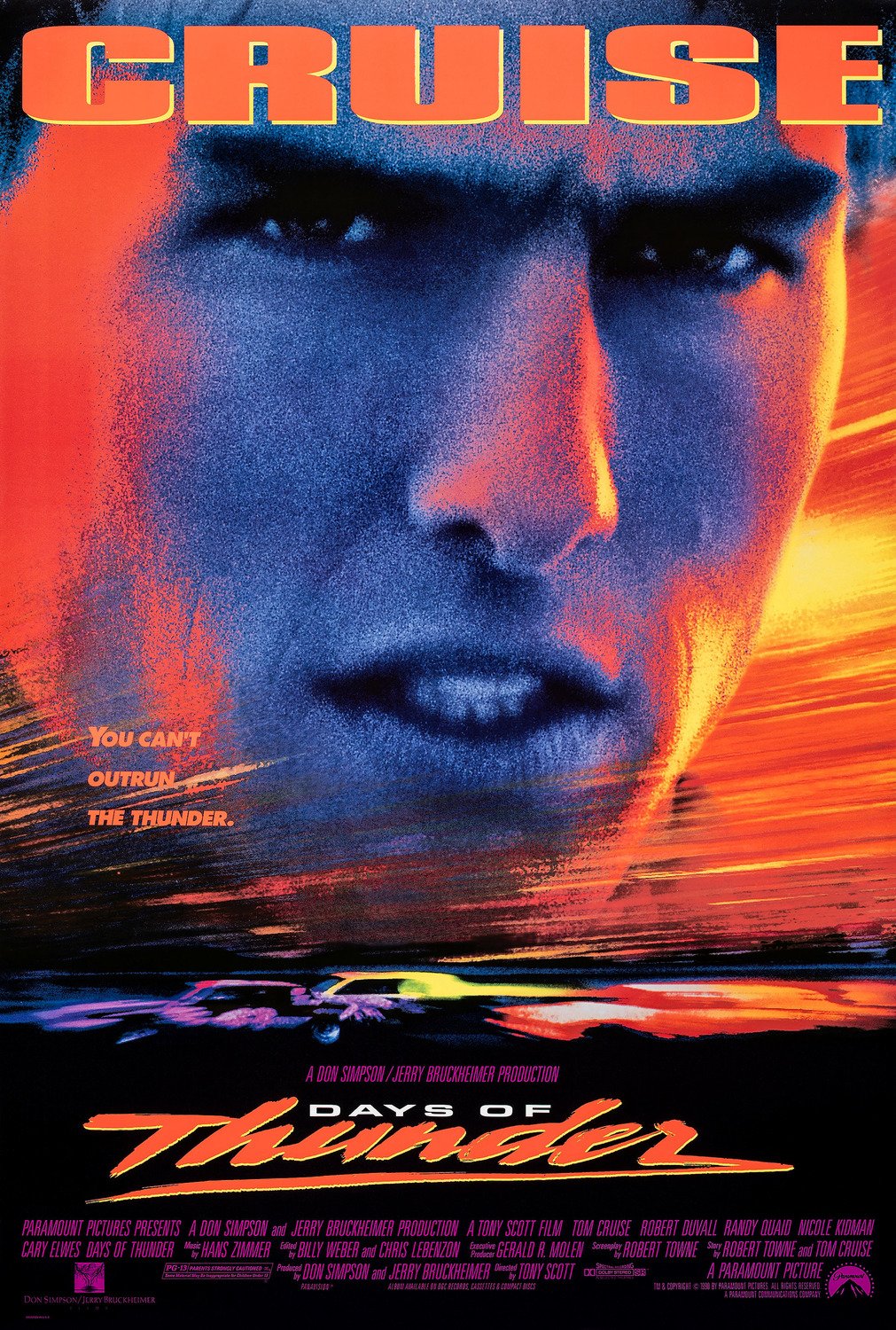
In 1990, any idiot could have come up with the idea of putting Tom Cruise in a stock car. This was still the pre-internet era, when America had to decide what it believed about things in real time, and "Tom Cruise learns NASCAR" was about as idiot-proof as commercial filmmaking could get. Take the most immaculate movie star in the country, drop him into one of its loudest and most regional subcultures and let people surrender their money on instinct.
The strange thing is that Tom Cruise winning the Daytona 500 is maybe the least interesting thing happening in Days of Thunder. It is the reason the movie exists, but not the reason it still works. Thirty-five years later, what makes it so obscenely watchable is that it’s not really a racing movie. The cars go fast, people say things about tires and Robert Duvall treats automotive maintenance like biblical scholarship. But the real topic is not racing, it’s the American fantasy of the self-made man.
Days of Thunder tells the story of a scrappy little NASCAR startup that takes a flyer on young hotshot driver Cole Trickle (Cruise) and asks him to lead them into glory. Except it doesn’t work. Trickle drives too fast, too recklessly, and keeps beating the pieces off his own car. When his rivalry with Winston Cup leader Rowdy Burns (Michael Rooker) ends in a life-altering crash, Trickle starts realizing he might not be the best advocate for his own success. Confidence, he discovers, is not the same thing as knowing how anything works.
Deconstructing Speed
Cole Trickle is obsessed with speed. He knows he’s the fastest, and he dismisses anything or anyone unwilling to support his quest to go faster and faster as a complete waste of oxygen. Although it’s never fully explained in Days of Thunder, he behaves like he’s overqualified to drive a stock car, to the point where he becomes dangerous to everyone’s health, including his own.
It’s not until he collides with Rowdy on the speedway that he realizes he can’t keep doing this forever. His talent is real, but it has no language until Harry Hogge (a low-key iconic Robert Duvall) teaches him how to translate it into something useful. That realization unlocks the movie’s counterintuitive truth: if Cole slows down and lets his team help him, he’ll actually become faster.
Days of Thunder is not a conveniently deep movie, but it quietly explores a fascinating idea: control. Cole Trickle becomes the fastest man on the speedway by trying to put distance between himself and every variable he can’t control. Other drivers, bad advice, mechanical limits, fear, pain, the basic reality of other people. His solution to everything is speed. But as he pushes that logic as far as it can go, he loses control of the very machine that was supposed to set him free.
That’s the strange little paradox at the center of the movie. In order to control the car, Cole has to stop trying to control everything around it. He has to listen to Harry. He has to trust his crew. He has to accept that being a great driver is not the same thing as being a self-contained human missile with excellent hair.
What’s fascinating is that Days of Thunder never expresses this in a Disney, let’s-learn-how-to-work-together sort of way. It’s much more perverse than that. Almost psychosexual. Cole drives himself into a dead end and realizes that what he really needs to surrender is not speed, or ambition, or even ego exactly. He has to surrender the idea of himself that made him feel untouchable. He gets metaphorically destroyed so he can be rebuilt into someone who understands that control is not domination. Sometimes control is trust.
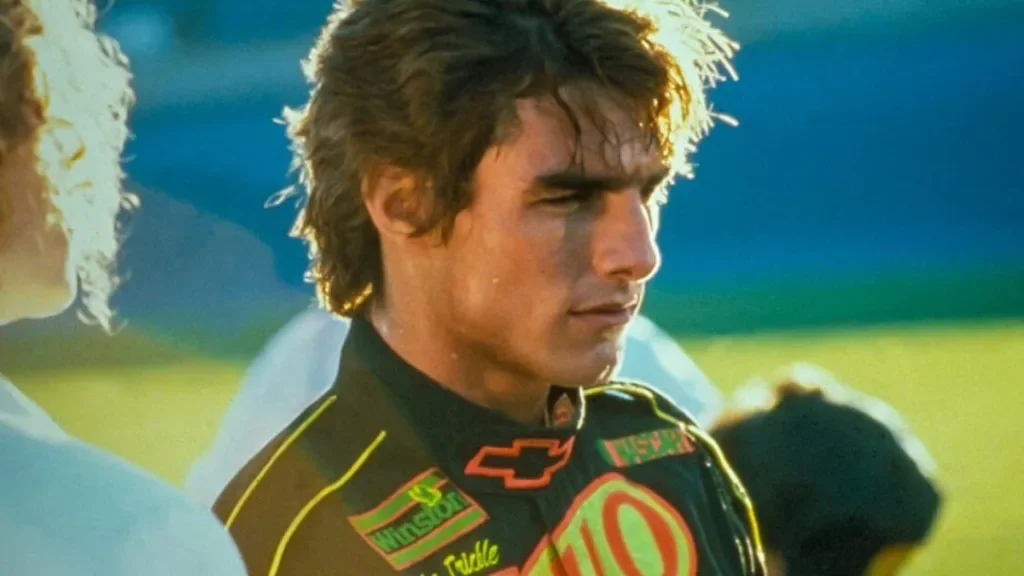
Tom Cruise is Weird, But The Idea of Tom Cruise is Weirder
I don’t think Days of Thunder would have worked, at this exact moment in movie history, with anyone other than Tom Cruise in the lead role. By 1990, Cruise was already transcending his profession, but he was also transcending his own personal brand. Tom Cruise was more than Tom Cruise. He was a set of parameters that calibrated the expectations of whatever movie he appeared in. Seeing him on screen immediately suggested a battle of egos, the improbable conquest of a woman and eventually, a whole lot of running.
That made him perfect to embody a character who is basically American exceptionalism in human form: irrational self-confidence powered by the unwavering belief that the universe is moral, legible and secretly arranged around you. Cole Trickle arrives as a pre-packaged idea on a motorcycle, wearing shades through a cloud of heat and exhaust fumes. He leaves as a composite of everyone who helped him survive his own limitations.
That’s what makes the Daytona 500 ending sneakier than it looks. Cole doesn’t win by proving he was right all along. He wins by letting another car stay in front of him for a moment. He wins by trusting Harry, by understanding Rowdy, by accepting that patience can be more efficient than speed. By the end, he’s not just himself anymore. He’s not even just Tom Cruise. He’s the delivery system for everyone else’s competence.
*
Days of Thunder holds up amazingly well, even though it comes from what now feels like a different civilization. Part of that is because it’s so easy to understand. It has a weird, winding trial-and-error structure, but its emotional logic is primal: a man thinks going faster will solve everything until speed starts taking things away from him.
It also helps that this is a movie made by Tom Cruise, Tony Scott and Jerry Bruckheimer, three men who understood the nuances between stereotype and archetype better than almost anyone. They are not subtle men, but they can make you feel things. Days of Thunder is filled with cartoonish people doing cartoonish things, but none of them feel disposable. They feel like movie gods drawn with crayons and lit by gasoline.
That’s why the movie still works. It’s about winning races, obviously, but it treats failure as a necessary part of Cole Trickle’s professional and emotional evolution. He learns from wreckage, fear, humiliation, injury and all the people he originally mistook for obstacles. Few movies have ever depicted failure with this much ridiculous sincerity: not as something to blast through on the way to victory, but as one of the materials victory is made from.
8.2/10
* Follow me on Instagram , Bluesky and Substack to keep up with new posts *