Movie Review : Lurker (2025)
There’s an old saying that you should never meet your heroes. It’s mostly true, but not because they’re jerks or secret lizard people. It’s because, when you like someone for what they do, they’re not really a person. They’re more of a mirror reflecting whatever you need them to reflect. They become a you-shaped fantasy in a them-shaped container. And reality, unfortunately, doesn’t have that kind of range.
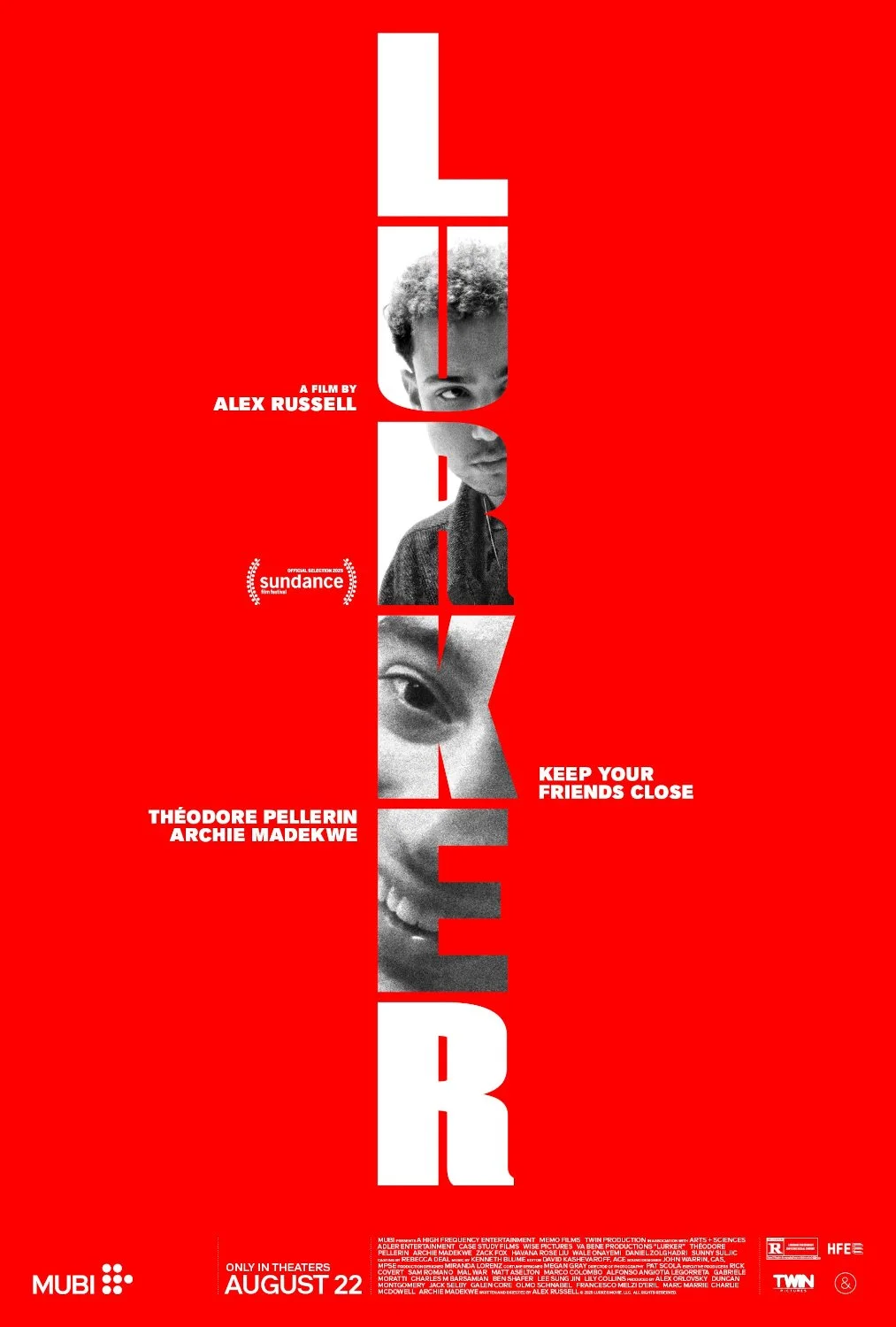
Alex Russell’s debut feature film Lurker plays in that uncomfortable space, where admiration curdles into possession and disappointment turns radioactive. It’s about a young R&B singer named Oliver who isn’t the person an obsessive fan imagined him to be and that fan not taking the real Oliver for an answer, because the real Oliver wasn’t part of the fantasy.
It reminded me of one of these horrible 90s obsession movies like Single White Female or Sleeping With The Enemy, except with iPhones and emotional cruelty instead of landlines and murder.
Lurker tells the story of Matthew (French Canadian haunted cherub, Theodore Pellerin), an anonymous retail worker who obsesses over up-and-coming R&B singer Oliver (Archie Madekwe). When the aforementioned Oliver shows up at his store, he manages to impress him and work his way into his inner circle as a videographer. Being close isn’t enough. Being useful isn’t enough. Matthew doesn’t just want proximity, he wants to be essential and he will NOT let himself be discarded.
The Nuances Of Love, Courage And Obsession
In a standard-issue obsession thriller, Matthew would be the villain. A hollowed-out creep with a God-shaped hole in his chest and a pathological need to turn a human being into a mirror. But Lurker doesn’t play it that straight. Writer-director Alex Russell sketches a messier, more interesting picture, because Matthew isn’t the only one living in a fantasy. Oliver’s doing his own kind of myth-making.
He’s charming, curated, and casually transactional, orbiting through hangers-on and collaborators like a guy who’s used to being the main character in every room. What he doesn’t expect is to become a supporting role in someone else’s story.
Oliver isn’t just the object of Matthew’s desire, he becomes the object of his becoming (if that makes sense). In Matthew’s mind, Oliver isn’t just a person, he’s a portal: to meaning, to self-worth, to being seen in a world that otherwise doesn’t look back. It’s a quietly devastating idea. One that pokes a hole in the neat moral binaries of our Judeo-Christian hangover: that obsession doesn’t start with malice or manipulation, it starts with love.
With the feeling that someone out there gets it, and that maybe, by getting closer to them, you can finally get closer to yourself. And yeah, that fucks Oliver up because he’s not the self-assured visionary he projects to be. He’s very much a work in progress himself, like any young person who wasn't Kanye West in 2004. Doubts and roadblocks are part of the game.
This is where Lurker really thrives: in the tension between two kinds of creators. Oliver, who builds a world around himself: curated, aspirational, vaguely sacred. Matthew doesn’t want to live in it. He wants to remake it, so it matches the version that’s already playing in his head.
The film isn’t driven by physical violence, it’s built on coercion, soft power, and the dark art of image control. Every interaction is a negotiation over who gets to shape the narrative. It’s unsettling in the best way, like being back in high school, except now you understand the rules of the game, and it still makes your stomach turn.

Where You Gotta Look For What Isn’t There
So how does this game actually play out, if it’s not violent in the way we usually recognize? That’s where Lurker becomes something of an acquired taste. Broadly speaking, there are two kinds of moviegoers: the ones who crave action, and the ones who feed on tension. Lurker is firmly in the second camp. It doesn’t deliver catharsis through chase scenes or bloodshed, it delivers it through awkward silences, misread intentions, and the psychic warfare of one person slowly encroaching on another’s sense of self.
The film (mostly) unfolds in microaggressions and boundary tests, in long glances that feel like judgment and conversations that feel like chess matches. It’s not loud, but it’s never not loud, especially if you’ve ever felt invisible, or obsessed, or just profoundly unsure where you stand in someone else’s life.
One scene in particular crystallizes the film’s unnerving quality : a quietly tense exchange between Matthew and Shai (played with eerie precision by Havana Rose Liu). She’s standing guard outside Oliver’s hous. She’s doing her job, playing gatekeeper to the kingdom. And yet, after a few tense back-and-forths, she folds. Not because Matthew threatens her directly, but because there’s something unspoken and unmistakable beneath the surface, a kind of emotional gravity that makes resistance feel exhausting
That moment says it all: to Shai (and most people in Oliver’s inner circle), he’s either a paycheck or a platform. To Matthew, he’s something else entirely. Something sacred. That imbalance is where the danger lives.
*
Lurker is smart, taut, and quietly venomous. It’s also refreshingly contemporary. Not in a hashtag-chasing way, but in how it dissects the invisible scaffolding of modern celebrity without pretending it’s some timeless, mythic tragedy. It doesn’t aim to be a four-quadrant emotional rollercoaster your mom will cry over on a plane. It’s not built for legacy; it’s built for right here and now and it works.
Theodore Pellerin is exceptional here, pulling off the kind of performance that might (and should) sneak into award conversations come fall. The film hits U.S. theaters August 22 and Canada on August 29, and honestly? We need more movies like this. Tight, stylish, and willing to get weird about the way we need to be seen.
7.8/10
* Follow me on Instagram and Bluesky to keep up with new posts *