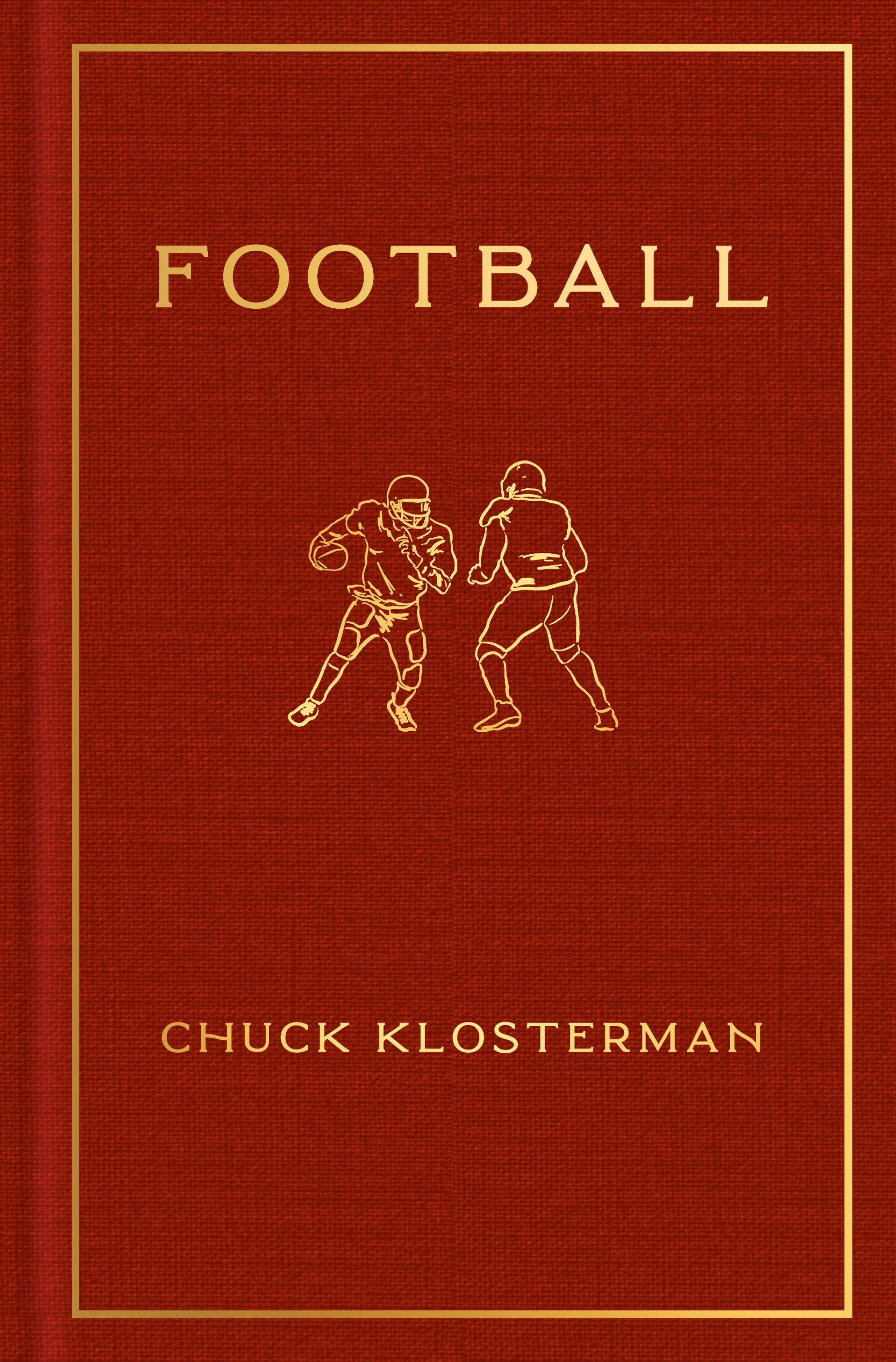
Book Review : Chuck Klosterman - Football (2026)
This will not be a "love letter to the game." Because that shit is for babies. I love football, but I don’t want to take it to prom. I don’t care how it feels about me. I am not Eric Clapton, football is not George Harrison’s wife, and this is not Layla.
Some of you already know this, but I have a long-standing, unequivocal, and slightly embarrassing relationship with the writing of Chuck Klosterman — and, to a lesser extent, with Chuck Klosterman as a person who exists in the world. Dead End Follies is influenced by him in ways that are probably obvious and I became a journalist in part because he showed me that this kind of writing was even possible. He’s the closest thing I have to a model, though I hesitate to use that word because I feel too old and too self-aware to refer to any living person as "my model."
In simpler terms: I really like the guy.
I would never have read a book about American football if it had been written by anyone else. But when Klosterman writes about something, it’s never only about the thing itself. Football is about football, obviously, but it’s also about the culture that turned it into an obsession and about how that same culture will eventually redirect that obsessive energy toward something else. That has always been Klosterman’s real playing field: not the artifact, but the cultural space it lives and dies in.
One of my longstanding pet peeves in sportswriting is the play-by-play recreation of games I did not watch and do not emotionally need to relive and Football does include a few of those moments, but very few. Most of the essays (or chapters; with Klosterman the distinction feels more negotiable than ever) that deal directly with the sport itself are clustered in the first half of the book. What actually drives Football is a simpler and more personal question: why does America love football so much — or, more precisely, why does Chuck Klosterman himself love football so much?
A normal fan is like a person who listens to Beethoven’s Symphony No. 5 and thinks, "This music is beautiful." A gambler is like a person who listens to Symphony No. 5 and thinks, "I don’t trust the motives of the bassoonist."
The challenge with any Chuck Klosterman book has never been quantifying my enjoyment. That part is automatic. The real challenge is qualifying it. Of course I enjoyed the hell out of Football. That was never a concern. The more interesting question is why.
Football did not make me a football fan. But as Klosterman himself once wrote a long time ago, "In and of itself, nothing really matters. What matters is that nothing is ever in and of itself." That line could double as this book’s operating system. The appeal of Football isn’t the game so much as everything that drifts into its orbit: video games, fantasy sports, etymology, soccer, courage, family, masculinity, patriarchy, national identity, subconscious desire, along with a dozen other ideas that keep circling the field, occasionally colliding, and never quite settling into place.
At its core, Football is a book about a national obsession with simulated warfare. And as is always the case with Klosterman, he never places himself above or outside the phenomenon he’s examining. He writes from inside it, from a position of genuine affection. But it’s a strange thing to love. Football is dangerous and violent in a way few non-combat sports are, outside of maybe rugby and it’s deeply insular to American sensibility. Learning to enjoy it can feel like learning Greek just to follow Greek protest slogans: an enormous investment of time and attention poured into something highly specific.
In that regard, the most revealing essay is Allegory of the Cave, from the Perspective of the Shadows, where Klosterman explores several ways football intertwines with American life. Most notably, he frames football as a simulation of warfare. Plenty of sports were conceived as symbolic stand-ins for combat, but few are as convincing as football. Klosterman astutely notes that the sport’s inherent danger is precisely what makes it so compelling to audiences.
It feels real. And because it feels real, moments of individual brilliance register as something more than athletic excellence, they resemble courage under fire. Football becomes a proving ground, a place where young Americans are asked to demonstrate who they are under tangible pressure and that feels good to people. Most notably to men.
"I gave up, but he did not. And that’s why he is who he is, and that’s why I am who I am."
- Chuck Klosterman’s dad William
I want to talk about the eleventh and final essay in the book, A Rose By Any Other Name Would Not Impact the Rose Bowl, because Klosterman has a habit of placing his most personal writing at the end, where it quietly clarifies the intent of everything that came before it. In this essay, there’s a moment where he admits that before going to bed, he eats a bowl of cereal and invents fictional football scenarios, sometimes against his will. It’s the adult version of a fantasy he’s carried with him his entire life.
That passage stopped me cold, because I do the same thing. For me, it’s basketball, hockey, or the other kind of football and it usually takes the form of fictional conversations — often between me and a podcaster who doesn’t exist. I’m not kidding. These scenarios help me fall asleep and I’m convinced they’re the Rosetta Stone for understanding Football. Klosterman follows with the admission that sports occupy far too much space in his life, but also the recognition that this is probably exactly what he wants, even if he never consciously chose it.
I can’t stop thinking about that ending. It reminded me of something author Harry Crews once said: "Sports are just about as close to what one would call the truth as it is possible to get in this world." You can either bench press 450 pounds or you can’t. You either beat the team in front of you or you don’t. Champions are decided objectively. I think that’s why sports matter so deeply to Chuck Klosterman, to me and to a surprising number of intellectually inclined people around the world. They offer a way to situate yourself in absolute terms: there is a winner and there is a loser.
Ultimately, that’s why we watch sports: to borrow absolutes and resolutions that aren’t available in everyday life. At least, that’s how it feels to me. The stories we tell ourselves around these games aren’t a distraction from meaning, they’re one of the few places where meaning is clear.
*
My opinion on American football hasn’t changed, but my opinion about almost everything else has. Football offers a panoramic view of why sports matter to a culture by zooming in on one person’s intellectual obsession with the sport. Reading it felt like catching up with that friend you used to only see at the bar — the one who somehow ends up offering clarity about your own life by explaining how he’s managed to find in his.
The only real downside to reading Football is knowing I’ll have to wait a few years for another Chuck Klosterman book. But if I had to bet, I’d say the next one will probably be about television.
8.3/10
* Follow me on Instagram , Bluesky and Substack to keep up with new posts *