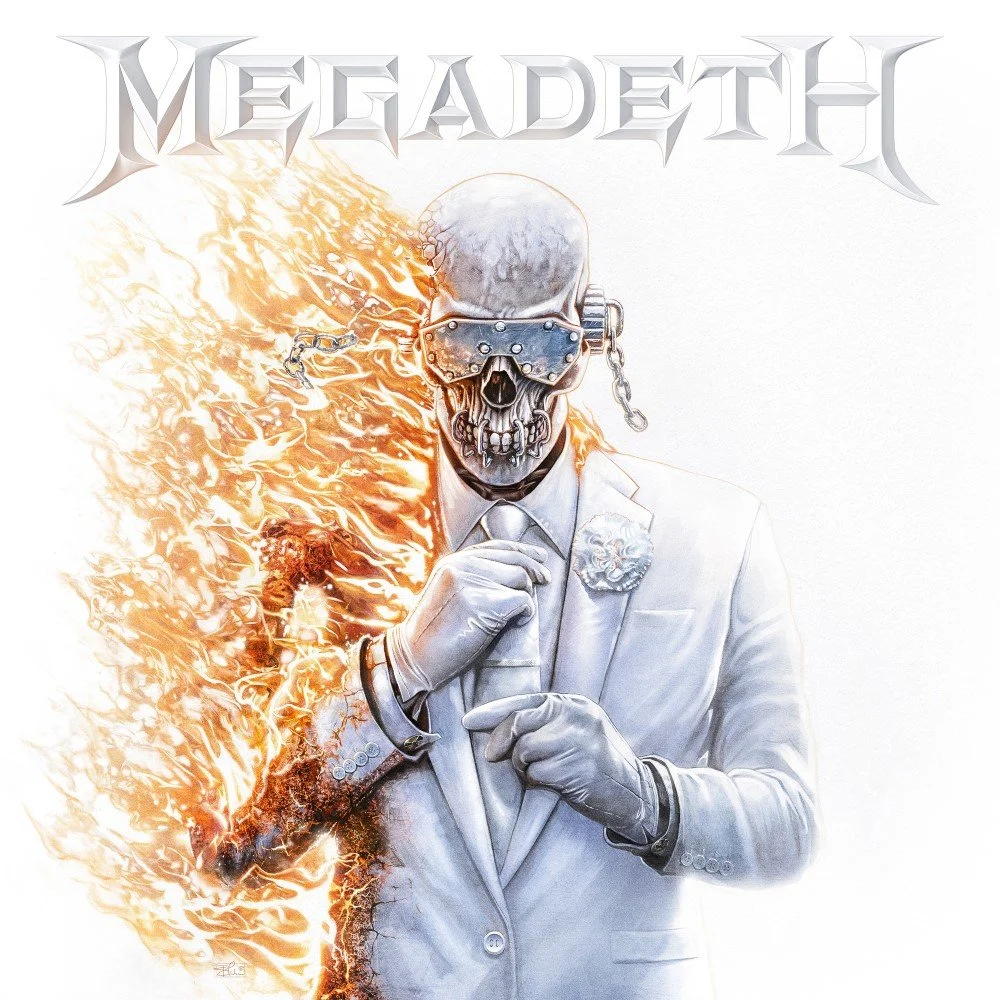
Album Review : Megadeth (2026)
Whenever Megadeth comes up among metalheads, the music itself rarely feels like the point. The band is more often discussed as a personality disorder, a grievance machine or a decades-long case study in professional resentment. Which is strange, because if Megadeth were judged purely on the quality of their output, they’d be far less divisive and probably far less interesting to argue about. They’ve been consistently good for four decades. That sounds like a provocation only because consistency is boring unless it’s attached to a volatile human being.
Dave Mustaine’s real achievement isn’t reinvention, but endurance. Anger and bitterness have functioned as renewable resources, keeping Megadeth locked into the same original impetus that made them dangerous in a pre-internet world, when rage wasn’t a brand strategy or a trauma response, but a practical engine. Mustaine never outgrew that energy; he just learned how to refine it. Megadeth has never been about personal growth so much as emotional efficiency.
Which is why Mustaine calling it a career feels both earned and incomprehensible. He’s in his sixties and touring is brutal, but Megadeth was never just a job, it was a coping mechanism. This self-titled record sounds like someone who still knows exactly who he is, but also understands that sustaining that identity indefinitely may finally cost more than it gives back. If this really is the end, it doesn’t feel like burnout. It feels like a rare, almost alien kind of self-awareness that prevents one.
Megadeth delivers ten songs and forty-one minutes of thrash metal that stubbornly refuses to deviate from the band’s established DNA. This album will not disorient you the way Countdown to Extinction once did or confuse you the way Risk tried to. Mustaine is focused on sticking the landing, not discovering new terrain. The songs lean on big, memorable choruses and familiar melodrama and while it’s far from the most intense album he’s ever made, that restraint feels intentional. He’s not trying to prove that Megadeth still matters; he’s operating from the assumption that it already does.
That’s what makes this feel like a sendoff gift — an album that’s unmistakably personal, yet written almost entirely for the people who have been paying attention all along. That’s comforting and a little limiting. It offers closure without surprise, satisfaction without revelation, and in doing so accepts the trade-off that endings, by definition, rarely change your mind.
So, Megadeth is fine and in this context, fine isn’t dismissive so much as it is clear. It’s nowhere near as ferocious as Endgame or as intoxicating as Dystopia and it lands a notch below The Sick, the Dying… and the Dead! in terms of sheer momentum. But it’s not a weak record, either. The riffs still gallop with purpose, the choruses are engineered to lodge themselves in your head, and Mustaine’s lyrics remain inspired, cartoonish, and occasionally disarming. Songs like Hey God?! and Another Bad Day flirt with a kind of vulnerability Megadeth usually keeps at arm’s length.
This is a middle-of-the-road Megadeth album in the best possible sense: a handful of genuine bangers surrounded by a surplus of catchy, clever choruses that know exactly what they’re supposed to do. It doesn’t chase transcendence or relevance. It settles instead for competence, personality, and familiarity. Three qualities that, in this particular band’s case, have aged better than anyone had a right to expect.
It’s not without its lulls. It would be another modern classic otherwise. The chorus-driven, more melodic tracks start to blur together as the record goes on and while Megadeth has always known how to balance speed with melody, that equilibrium slips in the second half. Songs like Made to Kill and Obey the Call aren’t bad so much as they are sleepy, settling into patterns that feel overly familiar and monotonous.
The only true burst of high energy comes right out of the gate with Tipping Point, which sets tremendous expectations the album never fully revisits. The singles Let There Be Shred and I Don’t Care technically qualify as uptempo, but they lean so hard into self-awareness that they come off a little goofy and on the nose. It’s Megadeth winking at its own mythology, but they’re a fundamentally unself-aware band. Dave Mustaine is and has always been more interesting when he takes himself too seriously.
The decision to close the album with a cover of Metallica’s Ride the Lightning is harder to justify. It’s competently executed, sure, but it’s nowhere close to a definitive version, and it ends up reinforcing the very narrative it seems designed to challenge, that Mustaine was ultimately expendable , and that Metallica thrived without him. That’s an odd note to strike on what’s framed as a farewell, especially when Megadeth’s legacy doesn’t actually require validation from its most famous fork in the road.
Because while Metallica peaked higher with Master of Puppets, Megadeth built the more consistent and frankly, more principled career. They lost the popularity contest early and never stopped paying for it, but creatively, Mustaine’s band has been sharper, riskier, and more honest for four decades. Ending the record by reopening that old wound feels unnecessary. Megadeth’s real victory was never about beating Metallica, it was about outlasting them on its own terms.
I’ve spent most of this review circling around the idea that Megadeth is good-but-less-than, though that probably says more about my standards for the band than the album itself. Tracks like Tipping Point, Another Bad Day and the infectiously hooky Puppet Parade, which could have comfortably lived as a middle-of-the-road cut on Dystopia are easy to enjoy and hard to shake.
This is a friendlier, more accommodating take on the Megadeth sound, which feels fitting for a final record and yet strangely out of character. Historically, after all, Megadeth has done its best work when it sounded openly, almost comically hostile to the very idea of making friends.
*
The real question this review is trying to answer is whether Megadeth needed to exist at all. Should the band have called it quits after The Sick, the Dying… and the Dead!, a legitimately upper-tier entry in their catalog? I’m inclined to tentatively say yes. Megadeth is the album-before-the-album-that-shouldn’t-exist: the record where you can hear creative fatigue brushing up against muscle memory, passion and hard-earned mastery. It probably would have worked better as an EP.
But Dave Mustaine has always been the guy who schedules meetings that could’ve been emails, and somehow turns them into events anyway. That instinct — excessive, stubborn, deeply personal — is why Megadeth exists in the first place. If this really is the end, it feels fitting that it arrives not as a perfect full stop, but as one last, unnecessary conversation he couldn’t resist having.
6.8/10
* Follow me on Instagram , Bluesky and Substack to keep up with new posts *