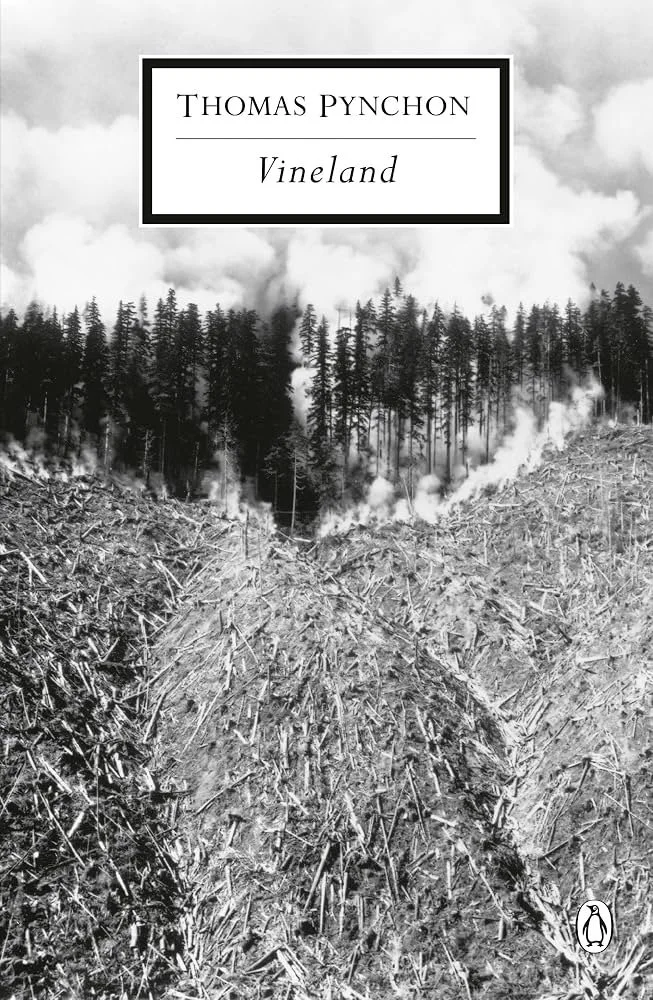
Book Review : Thomas Pynchon - Vineland (1990)
Thomas Pynchon is to literature what John Coltrane is to music: an unassailable signifier of good taste that is much easier to display than to meaningfully enjoy. People see them in your collection and nod with approval, partly because they respect the implication and partly because nobody wants to begin a conversation they cannot survive. This is probably unfair to both Pynchon and Coltrane, but it is also true.
Pynchon has been smuggled back into popular culture by Paul Thomas Anderson’s ongoing fascination with his work, which is how I found myself once again trying to understand this cryptic, paranoid, countercultural prophet of modern American life. Against my better judgment, I read Vineland, a novel that is supposedly connected to One Battle After Another but has almost nothing to do with the movie’s energy or appeal. It is stranger, softer, funnier and much sadder than the blockbuster film that led me to it.
Vineland tells the story of Zoyd Wheeler, an aging hippie burnout, part-time father and full-time survivor of the American counterculture’s long hangover. Zoyd lives with his teenage daughter, Prairie, who has grown up mostly estranged from her mother, Frenesi Gates, a former radical filmmaker whose life was derailed by her relationship with Brock Vond, a federal prosecutor dedicated to crushing left-wing movements with the patience of a bureaucrat and the appetite of a predator.
Vond is not simply after Zoyd and his old network of friends. He is after the entire world they once believed in. More disturbingly, he is after Frenesi in a way that feels both erotic and political. He does not just want to seduce her. He wants to convert her. To own her. To prove that her rebellion was always weaker than her desire to be dominated by power. That is why Prairie matters. She is not merely Frenesi’s daughter. She is the next generation, the living remainder of a counterculture he never fully killed.
The Revolution Never Happened
I’m not going to pretend I understood everything happening in Vineland, but one thing is obvious enough: the novel is set in the desolate aftermath of the 1960s, after the slogans have faded, the drugs have gotten worse, the revolutionaries have become parents and the state has learned how to absorb everyone’s weirdness into a file folder.
In the opening chapter, Zoyd Wheeler performs his annual act of ritualized defenestration, hurling himself through a window in order to prove he is still unstable enough to keep receiving government disability checks. It’s a perfect Pynchon joke because it is ridiculous, bureaucratic and spiritually bleak all at once. Zoyd is technically exploiting the system he once rebelled against, but this does not make him a winner. It makes him domesticated.
He is not an idealist anymore. He is not even really a rebel. He is a man who has converted his former outsider status into a survival strategy. The revolution, for Zoyd, has been reduced to an annual appointment with glass and gravity.
This failure of militant idealism haunts every page of Vineland. It begins with Zoyd, whose rebellion has curdled into a disability-check vaudeville routine, but it runs even deeper through Frenesi Gates, who allows desire to puncture the purity of her politics. Her betrayal is not just romantic or sexual. It is metaphysical. She chooses the man whose entire job is to destroy the world she claims to believe in.
What makes Frenesi so disturbing is not that she is weak, exactly. It is that her weakness is painfully relatable. She does not abandon the counterculture because Brock Vond proves her ideas are wrong. She abandons it because power gets close enough to touch her, and once it does, abstraction loses. The collective future cannot compete with the immediate thrill of being wanted, controlled and consumed by someone who represents everything she should hate.
That is the bleakest thing about Vineland: the enemy does not always defeat you by force. Sometimes it wins because it understands the private self better than your principles do.
Family As A Measuring Unit For Evolution
The idea of family tend to be heavily romanticized in fiction, which is something Vineland takes a nasty pleasure in in dragging it behind the shed. In most stories, family is where characters return when the world has failed them. It is the sacred unit, the final refuge, the thing that saves you after ideology, ambition and pleasure have all revealed themselves to be scams. In Vineland, family is not redemption. It is inheritance. It is the thing you cannot escape, and worse, the thing you cannot stop wanting even after you have accumulated enough evidence to know better.
Prairie has never known a functional family unit with two loving, stable parents, but her life is arguably easier before the idea of family starts hunting her down like game. Frenesi’s absence hurts, but it also creates distance. Once Prairie begins moving toward her mother’s story, she is not merely discovering where she came from. She is being pulled into the wreckage her parents left behind, forced to understand that family does not always explain you. Sometimes it recruits you into a disaster that started before you were born.
Pynchon represents family, and to a certain extent patriarchy, as a social system obsessed with its own survival. It does not need to be functional in order to perpetuate itself. It does not need to make anyone happy. It only needs to keep reproducing its own logic: parents create children, children inherit damage, damage becomes identity and everyone calls this continuity.
What family struggles against in Vineland is harder to name, because most of it is abstract and much of it sounds pretty good in theory. Freedom. Communal living. Political solidarity. Friendship. The possibility that a person might be defined by something other than blood, property, authority or obligation. The novel is full of these alternative arrangements, but Pynchon is too honest, or too depressed, to pretend they are automatically better. They are fragile. They are easily corrupted. They require people to be less selfish than people usually are.
That leaves Prairie in a strange position. She is the final hope of a failed generation, the child of burnouts, radicals, fugitives and informants, and everyone wants to claim her as proof that something survived. Brock Vond wants her because control always wants a future. Zoyd wants her because love is the last principle he has not completely compromised. Frenesi wants her, or wants to want her, because motherhood offers the fantasy that betrayal can still be forgiven.
This is why Vineland is such a dark and depressing novel beneath all the jokes, digressions and cartoon noise. It is not just about the death of the sixties. It is about the horrifying possibility that nothing really dies. Failed ideas become family stories. Political defeats become personal trauma. The past does not disappear. It raises children.
*
I have now talked an awful lot about a novel I do not pretend to fully understand, which feels appropriate, because any review of Vineland should probably be a little sprawling, a little paranoid and at least partially unsure of itself. I’m certain I missed some crucial point Pynchon was trying to make. I’m also not entirely convinced that missing the point is separate from the experience of reading him.
Pynchon does not really write straightforward narratives. He writes systems of disappearance. His novels make you search for something that may not be there: a conspiracy, a revolution, a moral center, a future that might still be available if everyone would stop selling each other out for five minutes. The joke, if it is a joke, is that the act of searching becomes the story.
That is why Vineland feels so sad beneath all its absurdity. It is not especially interested in showing what the future looks like, because the future is busy fighting for its life.
7.3/10
* Follow me on Instagram , Bluesky and Substack to keep up with new posts *