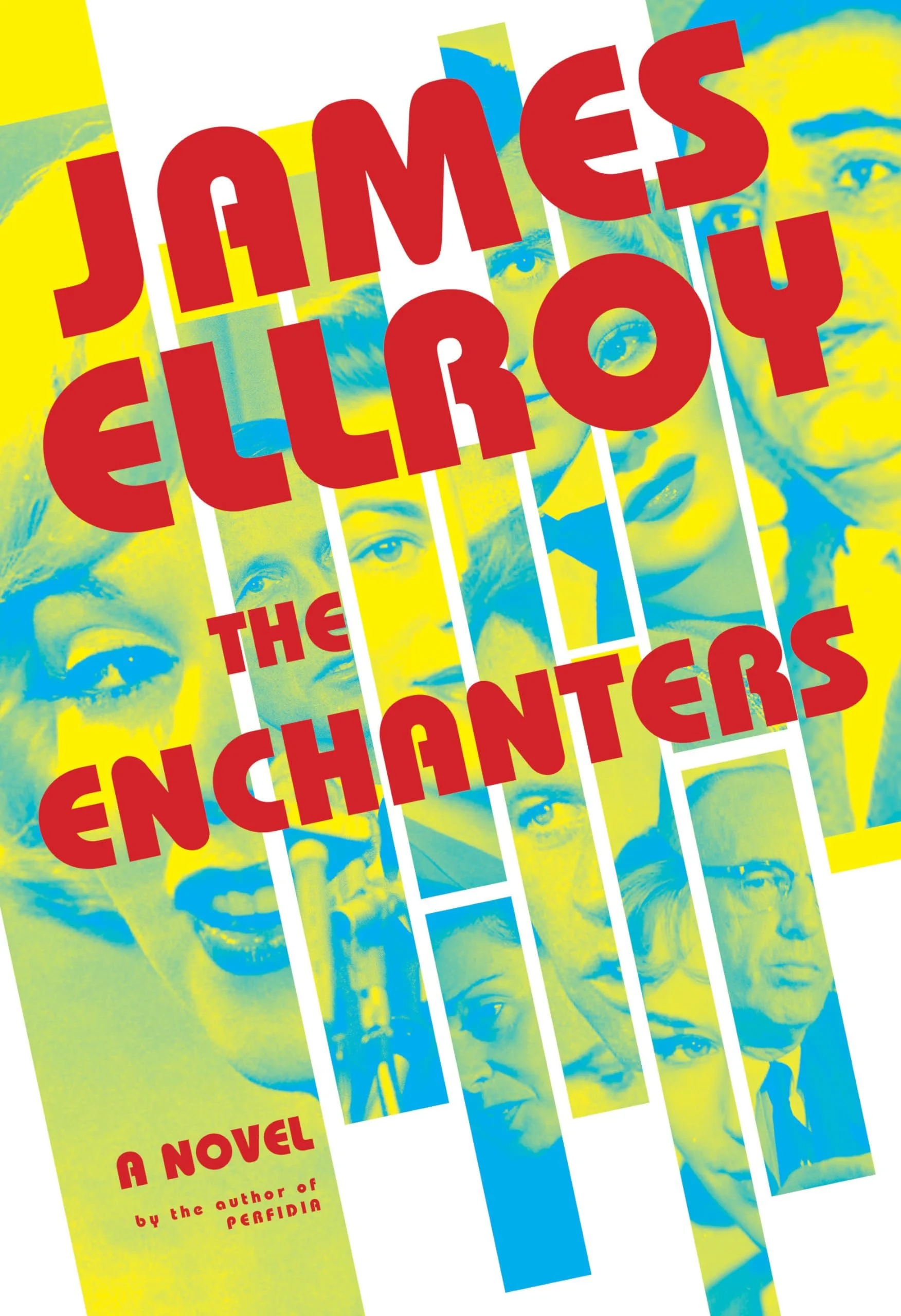
Book Review : James Ellroy - The Enchanters (2023)
Here's a chicken-or-the-egg question for you: how do you know when you’ve outgrown an author, and how do you know when that author has slowly turned into a tribute band for himself? I I used to be a full-on James Ellroy guy. The lack of decorum of his revisionist history and the way he blurred the line between tough guy and terrible person entertained the hell out of me. But it stopped being fun somewhere between the Underworld USA trilogy and the second L.A Quartet — now the L.A Quintet.
The tricks are still there, the bile still flowing, but the thrill ss gone. What once felt dangerous began to feel rehearsed. The Enchanters should’ve been catnip to me: Hollywood mythmaking, political paranoia, sexual pathology, the whole American nightmare pressed into a single doomed icon. Instead, I found myself asking an uncomfortable question. Did I become an elitist asshole who can no longer enjoy this kind of literary blunt force trauma or did Ellroy develop the literary yips?
Part of me still thinks I’m the problem. And that might just be me becoming a parody of own self.
The Enchanters revisits the final months of Marilyn Monroe’s life, filtering them through the bleary, self-mythologizing voice of ex-cop Freddy Otash, an operator so morally compromised he feels less like a narrator than a symptom of the ongoing moral decay. Pulled into a sprawling conspiracy involving John and Bobby Kennedy, Otash becomes our guide through a Los Angeles where politics, celebrity, and organized depravity operate as a single ecosystem.
Ellroy peels back the glow of mid-century American glamour to reveal something far less romantic: a savage, transactional Eldorado powered by leverage, surveillance, and appetites that never shut off. This isn’t a world designed for justice or redemption. It’s a place where survival is the highest achievable ambition, and a man like Otash doesn’t climb the ladder so much as cling to it, knuckles bleeding, hoping not to be crushed by the machinery he helps keep running.
Welcome to HollywoodWorld
Here’s one thing you need to understand about James Ellroy: he’s 77 years old. Which means he experienced the sixties not as a historical concept or a Pinterest aesthetic, but in real time, from roughly age eleven to twenty-one. Those are formative years, the stretch when the world quietly teaches you what is normal, what is tolerated, and what is rewarded. Ellroy’s version of the decade matters because it’s remembered, not reconstructed.
He remembers how people talked. He remembers middle-aged men being openly racist and casually sexist, while also treating strangers with more courtesy than their own wives. That contradiction, public civility masking private brutality, is the moral ecosystem Ellroy has always been best at dramatizing. His books are fun because they feel informed, not enlightened. There’s a stripped-down authenticity to them, a refusal to complicate behavior that was never complicated in the first place.
Ellroy’s characters are powerful — lawfully or otherwise — and that power frees them from the obligation to perform decency for anyone else. They don’t posture. They don’t apologize. They don’t narrate their trauma in the language of self-awareness. They are bleak, but bleak in a way that feels earned. Not symbolic bleakness. Not metaphorical corruption. Just people doing terrible things in systems designed to reward exactly that kind of behavior.
Where The Enchanters starts to go off the rails is in its obsession with knowledge that now feels distressingly cheap. This isn’t Ellroy excavating shadowy power dynamics he actually understands, it’s Ellroy wading into conspiracy logic that any sufficiently motivated guy online with a caffeine problem could assemble after a long weekend. We’re no longer watching damaged men navigate a corrupt system, we’re theorizing about Marilyn Monroe’s death, and that shift drains the story of its intimacy.
Ellroy lived through the announcement of Marilyn Monroe’s death, sure. But he never convinces me that he remembers what it felt like. The book doesn’t carry the emotional temperature of the sixties so much as it performs a remix of its mythology. There’s a looseness to it, a sense that the material is being toyed with rather than confronted.
For the first time, Ellroy’s voice feels playful in a way that borders on charlatanism. Not dangerous. Not severe. Not grounded in that stern, unblinking authenticity that once made his books feel like forbidden documents. Instead of moral rot remembered, we get paranoia reenacted and that difference matters more than it probably should.
Pretending Not To Know How To Write
Another thing about The Enchanters that kept nagging at me is how far Ellroy pushes his telegraphic writing schtick. Short, declarative sentences are one of his great weapons when the stakes are too heavy to be processed in real time. The understatement creates a private tension, an unspoken understanding between the book and the reader that something awful is happening just off the page.
Here, that discipline collapses into something closer to filature scrawlings: clipped fragments, informational drive-bys, entire emotional beats fast-forwarded past as if atmosphere were a luxury item. Moments that should breathe are reduced to data points. The style stops creating tension and starts withholding context.
At times, it feels like the only person who’s truly meant to understand what’s happening is Freddy Otash himself. The prose no longer invites the reader in; it assumes complicity without second guessing itself. What once felt like precision now reads like shorthand, Ellroy writing for an audience that already agrees with him, already knows the moves, already speaks the language. And when that happens, the voice that once felt brutal and clarifying starts to feel insular.
It’s a shame, because this story would have absolutely shined in the hands of 1990s Ellroy. That version of the writer would have lingered on Freddy Otash and given the reader just enough context to lock into his rhythm. The madness would still be there, but it would feel calibrated, designed to be entered and not merely observed from the outside. It’s not uncommon for aging writers to stop giving a fuck and start writing exclusively for the crowd that’s already onboard. There’s a confidence in that move, even a kind of honesty.
But in The Enchanters, that circle feels smaller than it used to be. Even for longtime Ellroy readers, the margins are wearing thin and that’s a bummer.
*
So I’m left circling the same question I started with: am I getting uppity, or does James Ellroy simply not care anymore? The Enchanters doesn’t feel like a novel written by someone interested in characters or even in recreating the midcentury atmospheres that once made his work feel so volatile and alive. The questions of that era still clearly obsess him (and there are a lot of them) but the act of building a world around those questions feels secondary now, almost optional.
Maybe that’s inevitable. Maybe at seventy-seven you stop worrying about creation and focus exclusively on fixation. Maybe I’ll be the same way if I make it that far, barking my pet theories at whoever’s still listening. Who knows. Until then, I guess this is what it looks like when a former Ellroy hardliner realizes the hardest part of fandom isn’t turning on an artist, it’s admitting you might no longer be who the work is written for.
6.4/10
* Follow me on Instagram , Bluesky and Substack to keep up with new posts *