The Existential Mythology Of Vermis
I retired from playing video games ten years ago or so. It’s not that I didn’t like it anymore. On the contrary, I always liked video games way more than they liked me and it was becoming a problem. The Ancient Gods of Playstation are hungry for time and money and when you’re over thirty, you either indulge them or start choosing your battles. Endless FIFA campaigns and irresponsible microtransactions started interfering with my plans of being a creative person.
Yeah, I know what you’re thinking: "here we go, another millennial whining about being robbed of his soul by capitalism". Fair. But unlike the beanie-wearing guys in your MFA program, I didn’t just tweet about it, I actually quit. Cold turkey and I've never went back. I probably would be writing essays if I was still spending my hard earned bucks to make it out of Bundesliga 2 as a second-rate defensive midfielder.
But the itch never really leaves. I still love games. And thanks to YouTube, I don’t even have to play them anymore. I outsource the obsession. I get the 50-hour epic mainlined into me in a single 90-minute YouTube video while I fold laundry (or eat dino nuggies, but I'm 42 years old, so don't say it out loud).
I follow a couple video game YouTuber, but my favorite is by far is an Irish dude named John Walsh, better known as Super Eyepatch Wolf. This guy is like that sweet and awesomely nerdy friend who’s so enthusiastic about stuff you know nothing about that he gets you into it somehow. Japanese pro wrestling? John’s got you covered. The unspoken weirdness of Jake Paul being a boxer now and constantly winning? He knows a thing or two about it. Fake martial arts? Absolutely. Fake video games?
Wait, fake video games? What the hell, is this even a thing?
Turns out, it’s a thing: entire games that exist only as concept art, fake trailers, lore bibles, user manuals. Nothing you can actually play, just scaffolding for your imagination. I know it sounds like weird, slightly uncomfortable DeviantArt fanfic, but it's not. Imagine: no code, no bugs, no clueless marketing department telling you what your childhood dreams should look like. Just raw possibility.
And that’s how I ended up purchasing Vermis.
Absence as a Kaleidoscope
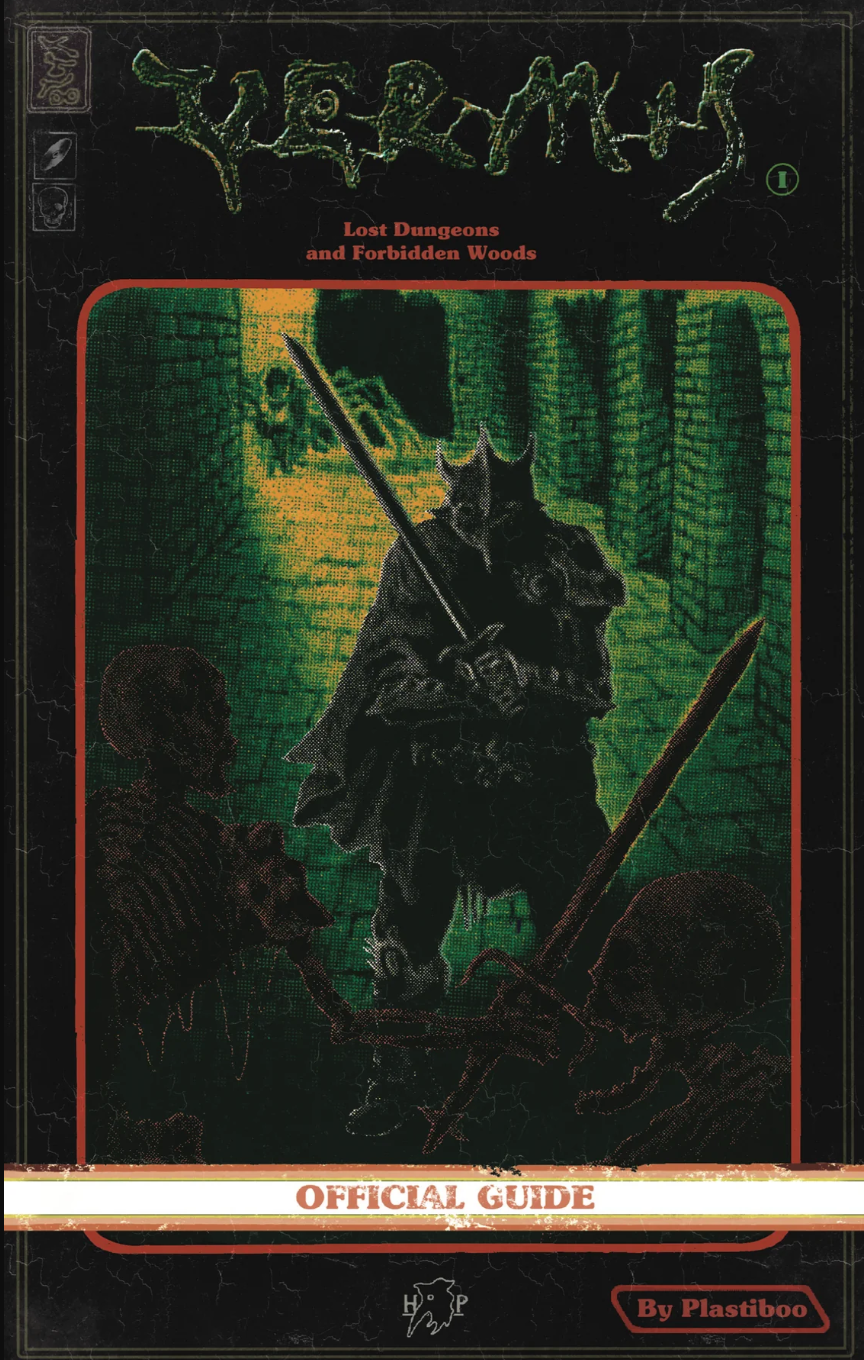
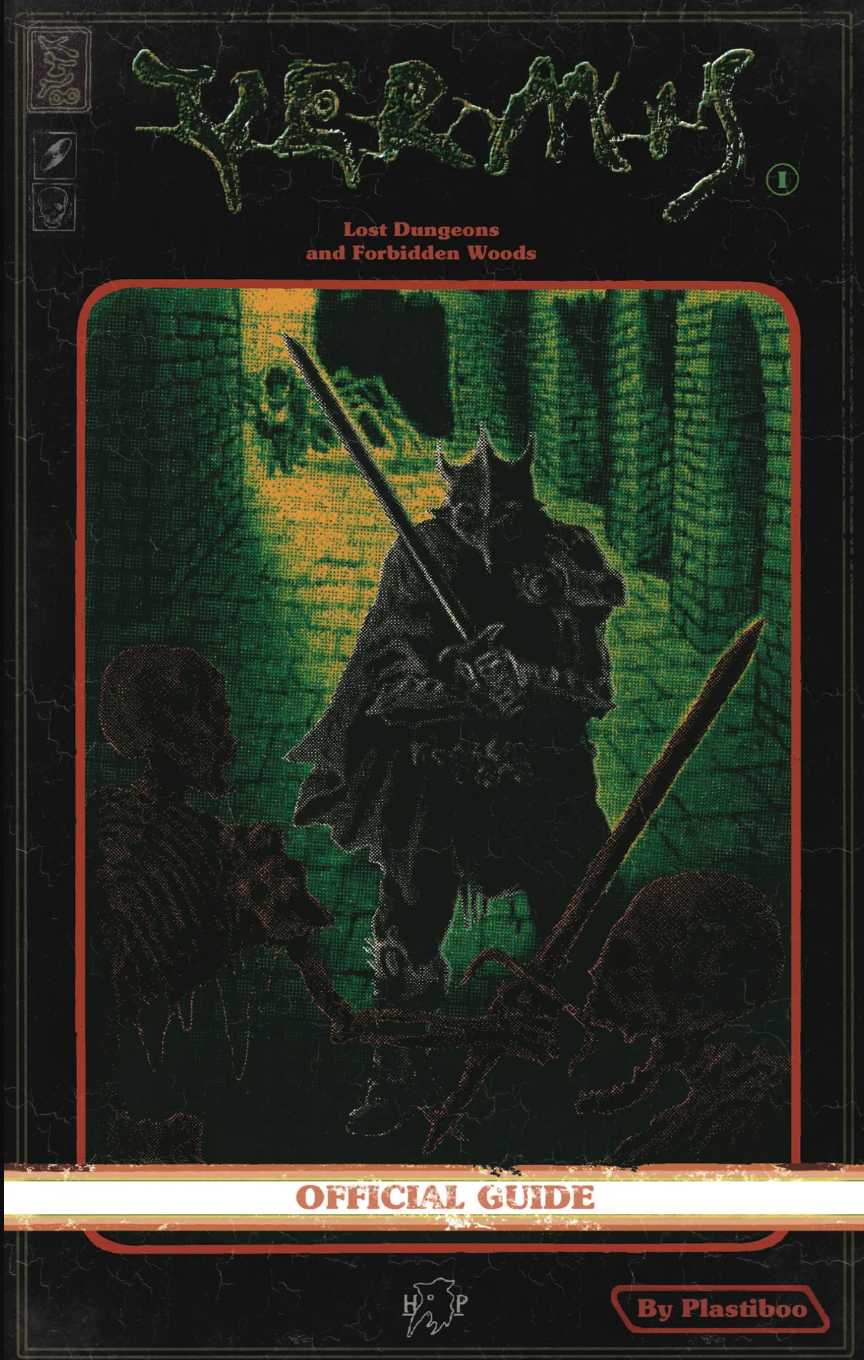
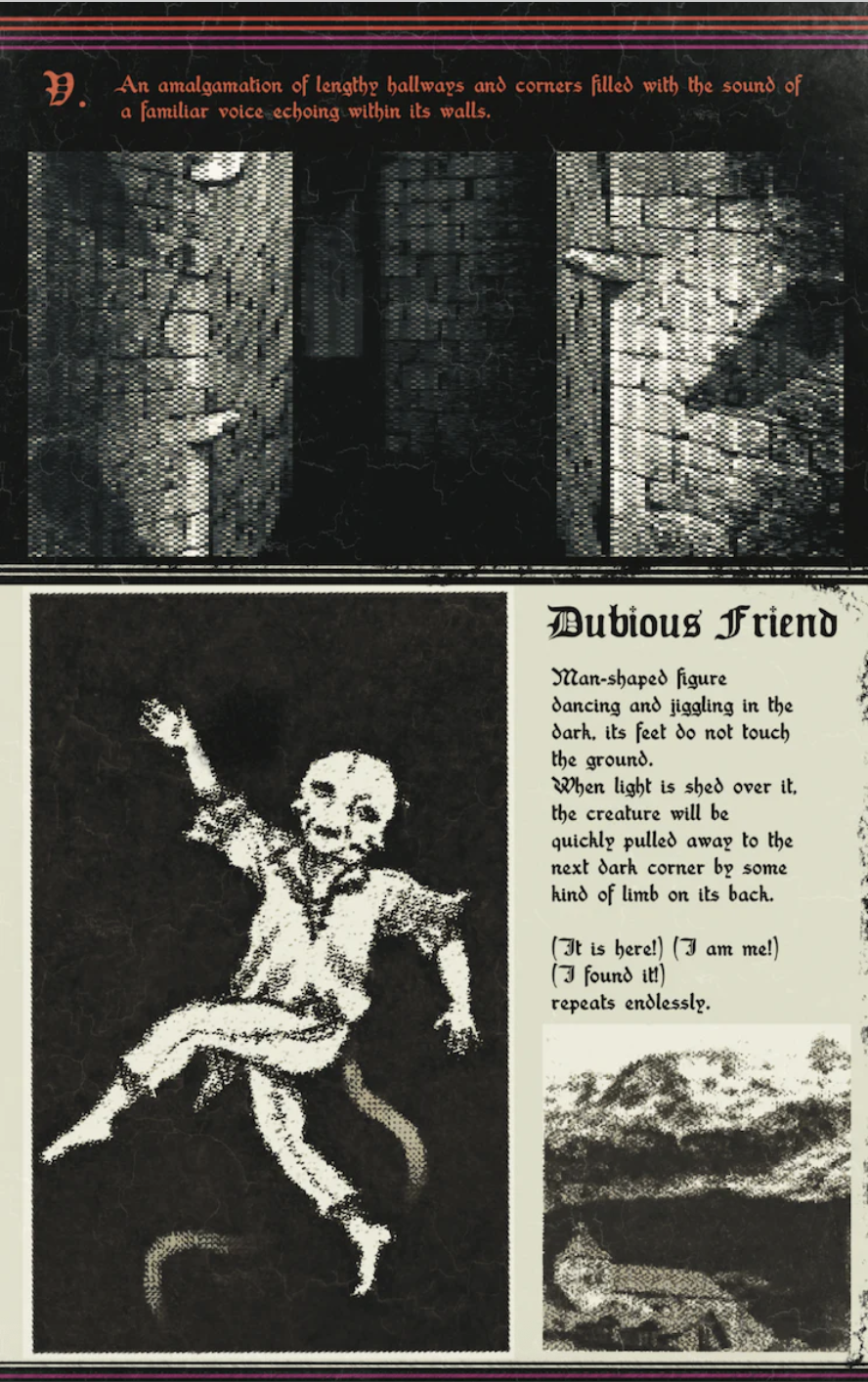
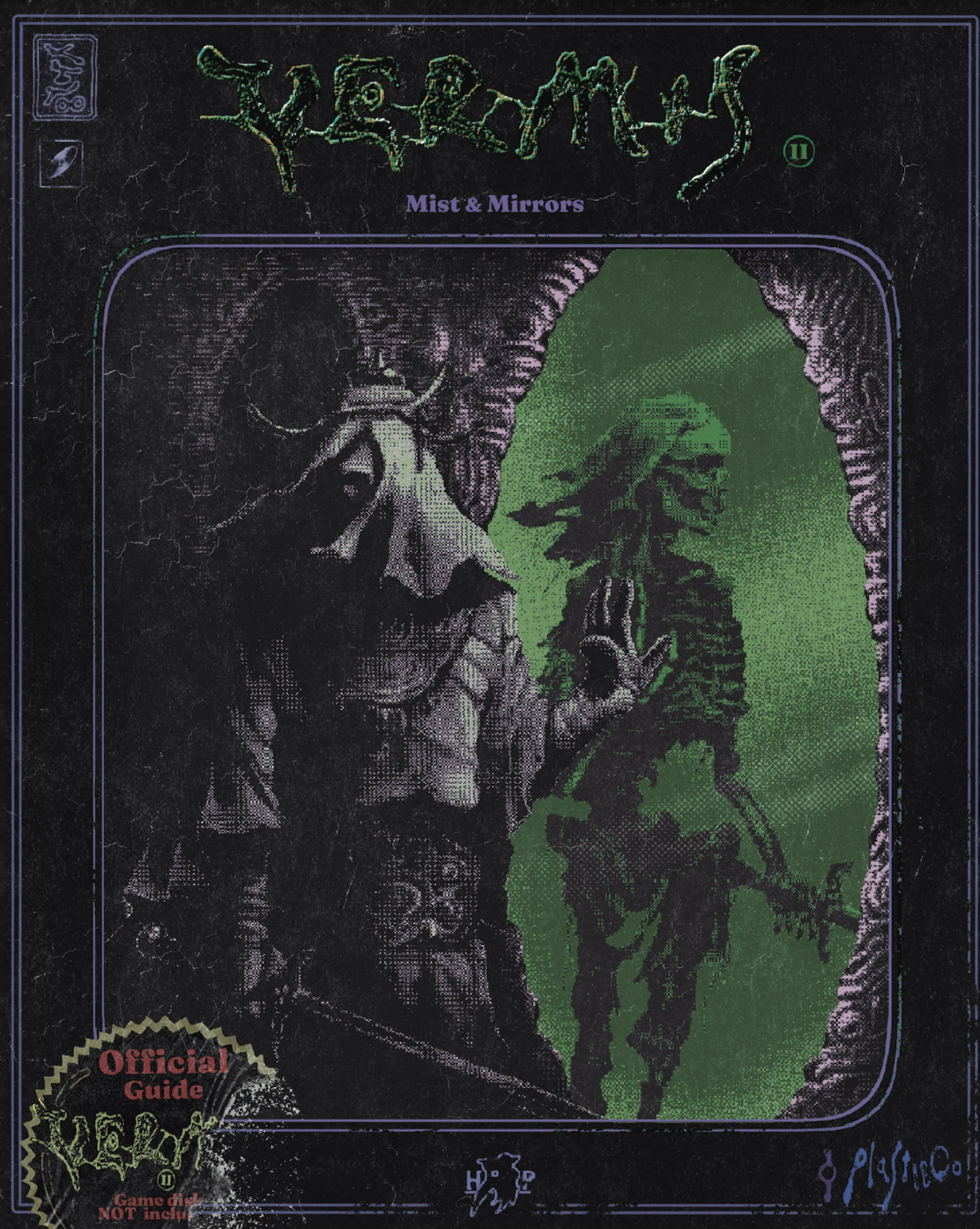
Vermis is two books: Lost Dungeons & Forbidden Woods and Mist & Mirrors, video game manuals for a game that never existed. They look old, beaten, smuggled from some late eighties, early nineties MS-DOS timeline we never lived in. Written and drawn by a mysterious artist named Plastiboo, they drop you into the middle of a dark-fantasy campaign with no map, no princess, no kingdom. Just armored strangers trudging toward some inevitable revelation.
Here’s the kicker: the books barely tell a story.
I don’t know about you, but the fun of playing a video game for me has always been to leave my body for a couple hours and become someone with skills and a purpose that I don’t have. I don’t care about the characters, I care about becoming the character and it’s not exactly what happened when I read Vermis. I became the character, but he also became me. That's when it clicked and the magic happened: Vermis isn’t a game. It’s mythology for people who lie awake at night asking themselves if the health app on their iPhone is secretly draining their soul.
The point of Vermis is not to kill monsters and gather wealth, it’s to question the meaning of what’s happening to you and whether or not the people you meet and things you find along the way will either save you or kill you. As it is the custom for video game guides, Vermis makes it very clear what items are good for you and what items are bad, but it makes you ask the question: What in my life is a healing potion? What’s a cursed item?
That cabin by the lake where I read the book? Blessed, restorative, +10 to tranquility. My laptop? A double-edged sword that either creates or destroys depending on the day. Alcohol? A quick buff with poison damage over time. And that fucking Health app? A cursed relic that punishes me for not worshiping at the altar of 10,000 steps.
That’s the genius of Vermis. The encounters and items on the page are just placeholders for the ones in your life. The gaps in the story (and there are purposefully are gaps you fill with your own anxieties, addictions, questions. It’s less like reading a book and more like staring into a mirror made of fog.
Same goes for the encounters. In ordinary life, you figure that most people are either uninterested with you or inherently benevolent because they’re primarily motivated by a desire to be liked. But in the world of Vermis, the isolation and complete lack of social baseline for what to expect forces you to ask yourself questions you wouldn’t ask in other circumstances: does this person have stakes in my involvement in their lives? Is she protecting something I either don’t see or don’t understand? Do I need to transact with her for my own sake? These are questions you'll never ask yourself outside of a mythological framework.
That’s what’s so fabulously mind-bending about Vermis. The story it tells is very straightforward and non-eventful, but it is so full of holes that your imagination has to feel that it forces you to fill the gaps with your own and see yourself through the tools it provides you. You have to be open to it, but I believe being open to it is the whole fucking point of this particular creative process. You can read it as a straightforward art project, but it would be like reading the back of a cereal box without eating the actual cereals inside.
Mythologizing the self as a hobby
Now, Plastiboo didn’t invent the reverse-engineering of mythology.
I’m going to say something alarming, but bear with me: incels’ superdaddy Jordan Peterson has been doing it FOR YEARS. He’s built his entire career on interpreting the Bible and other foundational myth as a moral and psychological tool to navigate contemporary life.
I’ve been vocal about this in the past. It’s a dangerous and potentially noxious process that Peterson became famous for. Because if you take foundational myths to face value (which is what he claims helped society remain constructive for thousands of years), well you’ll always find a dragon to slay. If the story has a built-in bad guy, you’re going to look for it in your own life and you’re going to live through your entire life fighting people you could’ve forged alliance with because not everything is a matter of life and death like it once was. Not every quarrel can be solved by the death of one of its participants anymore.
Sometimes your WiFi acting up is just your WiFi acting up. Not a technocratic conspiracy to shut you up.
I’ve never interviewed Plastiboo so this is pure conjecture on my part, but he (or she/they) doesn’t fall into that trap because he (or she/they) created a myth from what is essentially going through ordinary life. That’s why it’s so easy to superimpose your own life. The events of Vermis are metaphors for daily struggles. In the Silver Swamp, the Lonely Knight is facing his own inner demons which show up in the form of a dream, shaking him from an invisible curse that drains his energy. In the Pauper’s Catacomb, he faces the Frightened Frog Knight, an embodiment of his own anxiety. A vision of a noble warrior giving in to his own cowardice.
There’s a lot of that stuff in Mist & Mirrors too, but it is mainly focused on wounds, inflicting damage to others and protecting yourself even up to a point where it’s not necessary to your survival, but it’s deeply encoded into your DNA.
In Vermis, 2000 years old myths don’t interpret contemporary life. Contemporary life is filtered through the life & death logic of dark fantasy and what emerges is that our quests are barren, haunted and filled with questions we can’t possibly make sense of and it shouldn’t be a bother anyway because all of our quests end up one of two ways: with either a new life or complete obliteration and in both cases, we should accept it and let go.
That’s what makes Vermis so rare. It doesn’t give you answers, it just hands you a sword and tells you to wander into the dark. The books are full of absences, cracks, ellipses and in those gaps, your own imagination ties all the loose ends between fiction and your life. It’s a looking glass for adults.
And yeah, it’s haunted. But in a good way. Like a mushroom trip where you finally see the invisible wiring of your life. The stuff between the stuff. The unspoken rules you’ve been living by without even noticing.
Art like this doesn’t come from committee meetings or quarterly earnings calls. It comes from an artist reckless enough to ignore commerce and just throw their weirdest, darkest vision out into the world. And we need that. Because sometimes the thing that wakes art up, the thing that moves culture forward, isn’t the next Marvel movie, it’s some anonymous, driven creator making fake video game manuals that fuck with your head.
Reading Vermis felt to me like stumbling onto a demo tape that invents a whole new genre of metal. You know it’s going to change something, even if nobody else notices yet.
And yeah, it’s niche. But that’s the point.
* Follow me on Instagram and Bluesky to keep up with new posts *