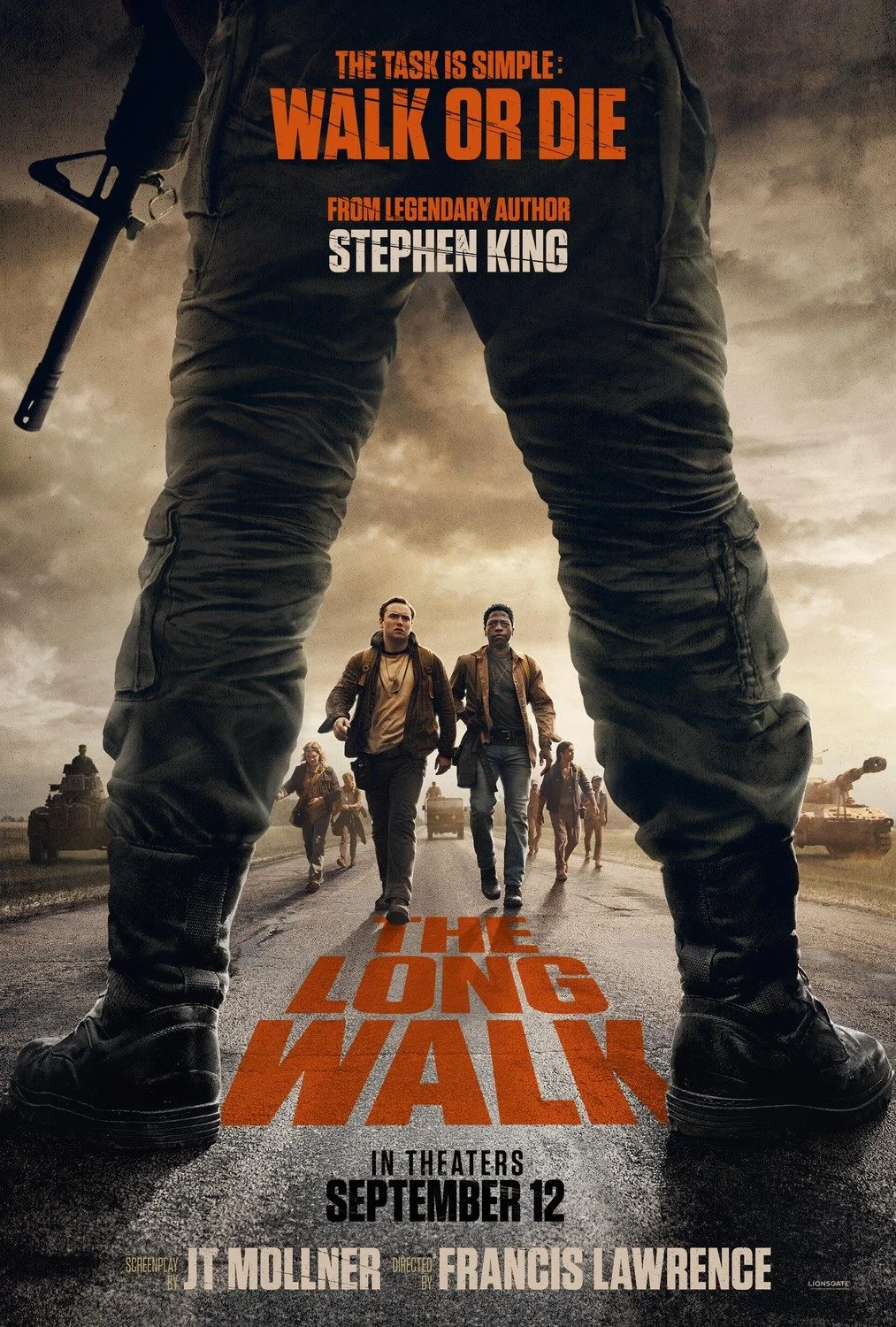
Movie Review : The Long Walk (2025)
* this review contains spoilers. They're even more aggravating if you’ve read the book *
When a celebrity dies, their legacy automatically takes on a different meaning. Concerns about authenticity fall away, because the celebrity can no longer contradict the version of themselves we’ve decided to believe in. What they leave behind starts to feel definitive, as though it were an earnest manifestation of who they really were. In that sense, death makes people easier to understand. It coexists with life in order to give meaning to human interaction. Because you won’t live forever, how you choose to carry yourself matters.
Teenage boys don’t understand this nuance. At that age, the world feels self-centered by default, which makes life-and-death situations especially revealing. In the film adaptation of Stephen King’s The Long Walk, screenwriter JT Mollner and director Francis Lawrence make a counterintuitive, but ballsy observation about this widely accepted truth: being a self-centered dick doesn’t necessarily make you a bad person. When there’s nothing left to gain, the mask you wear comes off and it can be both beautiful and tragic.
For the uninitiated, The Long Walk follows Ray Garraty, a teenage boy living in a dystopian, economically struggling America, who volunteers for the Long Walk—an annual event where one hundred young men walk until only one remains. Stop or slow down too often and you receive a warning. Three warnings earn you a bullet to the head. The winner gets unspeakable riches and one wish, but everyone involved intuitively understands that the real prize is the friends who die along the way.
On Death & Character
I’ve read Stephen King’s novel at least three times to my knowledge and I keep a great memory of it. The novel is almost aggressively minimal in terms of plot: roughly 370 pages of kids walking down empty roads and getting shot in the face. What it lacks in story mechanics, it makes up for in character. It’s essentially high school with life-or-death consequences. There’s the cool, self-reliant McVries (an excellent David Jonsson), the driven jock Stebbins (Garret Wareing), the loose cannon Barkovitch (Charlie Plummer) and then some.
You get the gist.
Under normal storytelling rules, you’d expect the righteous to endure and the assholes to get sorted out along the way. That’s not what happens here. The Long Walk punishes everyone equally, regardless of intent or temperament. Survival isn’t a moral reward system; it’s a process of exposure. The longer the walk goes on, the less anyone can hide.
Barkovitch is a good example. He provokes another participant into getting killed, yet recoils at the idea of being labeled a murderer. His cruelty doesn’t read as confidence so much as fear with nowhere to go. That fear becomes its own fuel. It drives him forward longer than most, even as it strips him down. The more ground he covers, the more obvious it becomes what’s actually been pushing him all along because the less distance there is left for him to walk. Besting people has been his way of dealing with existential terror.
McVries and Baker (played by Sudanese actor Tut Nyuot) function as the counterexample. One exists closer to death and meaninglessness than the others, the other closer to God, yet they arrive at the same place. When someone punches their ticket, both instinctively turn toward the group to offer comfort, to receive it, to make the moment survivable for whoever is still standing.
They understand death as a finality, not a spectacle, which makes care for the living feel urgent rather than performative. Neither of them hides behind hormonal machismo or competitive posturing. That absence matters. It quietly recalibrates the dynamic of the walk, softening what is supposed to be a contest into something closer to a shared vigil. That's a nuance JT Mollner reading of The Long Walk who completed mine. I become a boy again reading the novel, but Mollner’s sensibility is of a man.
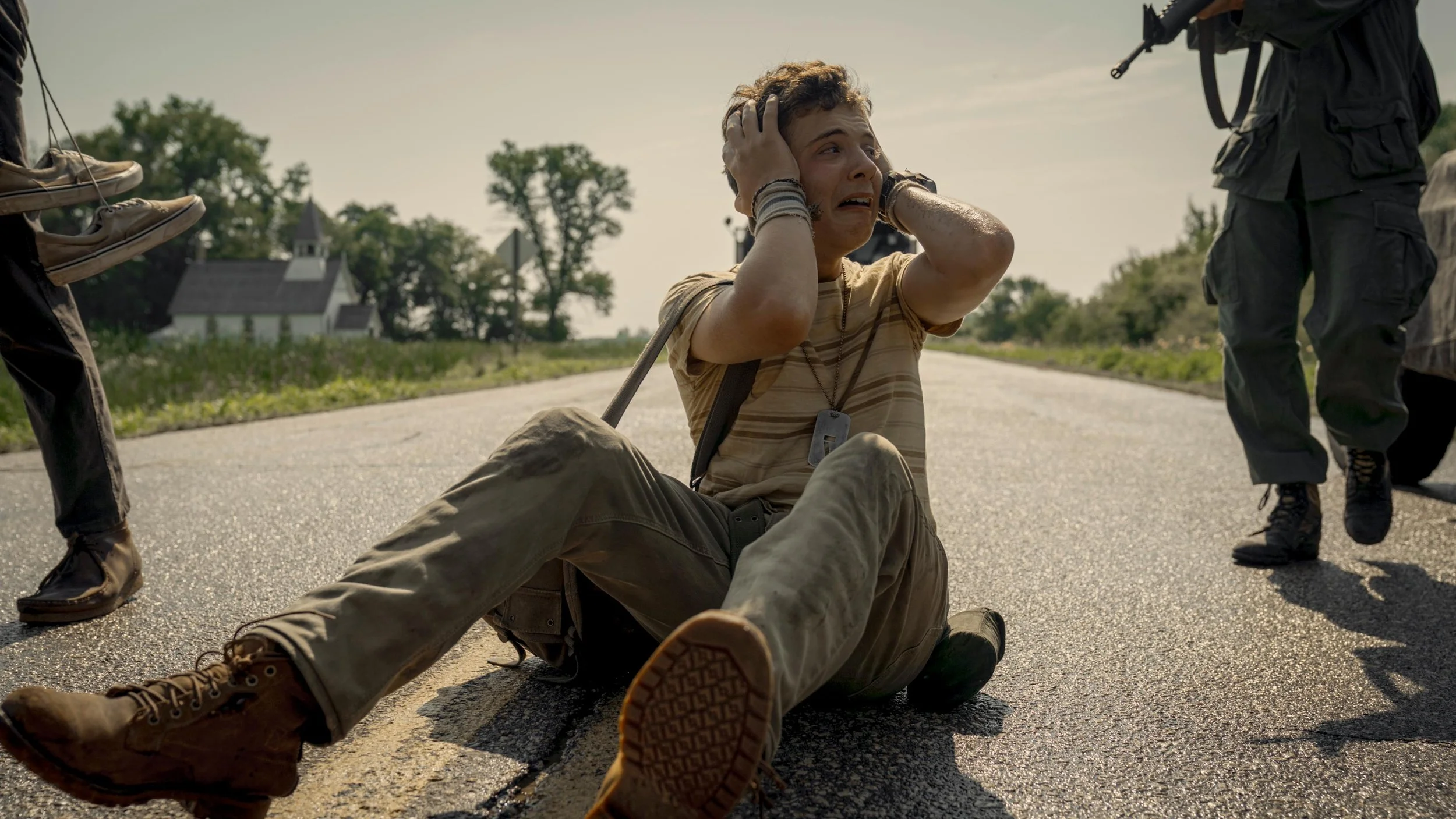
And then there’s Ray Garraty. He’s you, in the loosest possible sense. Not literally — you have to get past the fact that he’s played by an actor who looks about thirty trying to pass for a teenager (Cooper Hoffman is 22) — but conceptually. Garraty is a naïve blank slate, moving forward on instinct, his reasons half-formed and ready to be stress-tested by the walk itself. What makes the film, and the story, hit so hard is how those tests land. The moments that fracture Garraty’s understanding of the world don’t come from the system enforcing the rules, but from the people walking beside him. That’s where the damage happens. Not through oppression, but through proximity.
Garraty isn’t exemplary or symbolic in the way the others are. He doesn’t embody a position so much as an experience. He’s relatable not because he’s admirable, but because he’s unfinished.
The Quiet Charms of Personal Readings
Let’s address the elephant in the room: yes, the ending is different. Not philosophically, but narratively it veers sharply away from the novel’s final movement. That choice seems to stem from Francis Lawrence and JT Mollner’s reading of Peter McVries, which is markedly different from my own. I always read McVries (my favorite character) as kind, but aloof, self-contained and self-aware to the point of emotional distance. The kind of boy a teenager would idolize.
Lawrence and Mollner’s version is once again more mature: openly warm, actively loving, even in the face of violence and death.
I’ll admit I was initially irritated by what felt like a box-checking impulse in the castingevery major runner neatly representing a different ethnic or cultural background, while most of the semi-anonymous deaths belong to white kids — which becomes unintentionally funny the longer you sit with it. But McVries and Baker being Black isn’t incidental; it’s foundational to this adaptation.
As members of an oppressed community, they instinctively model the leadership, solidarity, and compassion required for this makeshift group of condemned boys to keep going. They lead by example, turning the walk from a competition into a community, one where risk and sacrifice are shared rather than hoarded. Seen that way, the altered ending makes sense. It’s there to support the symbol of hope the film has deliberately built toward, not to undercut it.
*
Not gonna lie: even though I saw it in early 2026, this is one of the best films of 2025—possibly the best. It’s poised, focused, and alive with steadily escalating emotional stakes. It’s also, quite simply, the strongest Stephen King adaptation south of The Shining I’ve ever seen.
The Long Walk is two hours of kids walking and talking, but it’s also two hours of teenagers living entire lives in fast-forward: becoming men, growing old, and dying terrible deaths right in front of us. It carries the emotional impact of the novel while firmly anchoring its heart in the present. The result isn’t comforting, but it’s galvanizing. It makes you want to keep moving, even when disaster feels inevitable, and I can’t think of a higher calling for entertainment than that.
8.4/10
* Follow me on Instagram , Bluesky and Substack to keep up with new posts *