
Movie Review : Demolition (2015)
Suffering through adulthood used to be a private ritual. You drank too much, bought things you didn’t need, maybe ruined a relationship or two and waited for the consequences to catch up. That was the Gen X model: silent decay via unchecked impulse. But millennials took it one step further. They branded it. They turned disaffection into a kind of lifestyle aesthetic. Sadness became marketable, even aspirational. Emotional dysfunction didn’t just happen, it meant something.
That right there is basically the drivign idea behind Demolition, the last feature film of the late Jean-Marc Vallée.
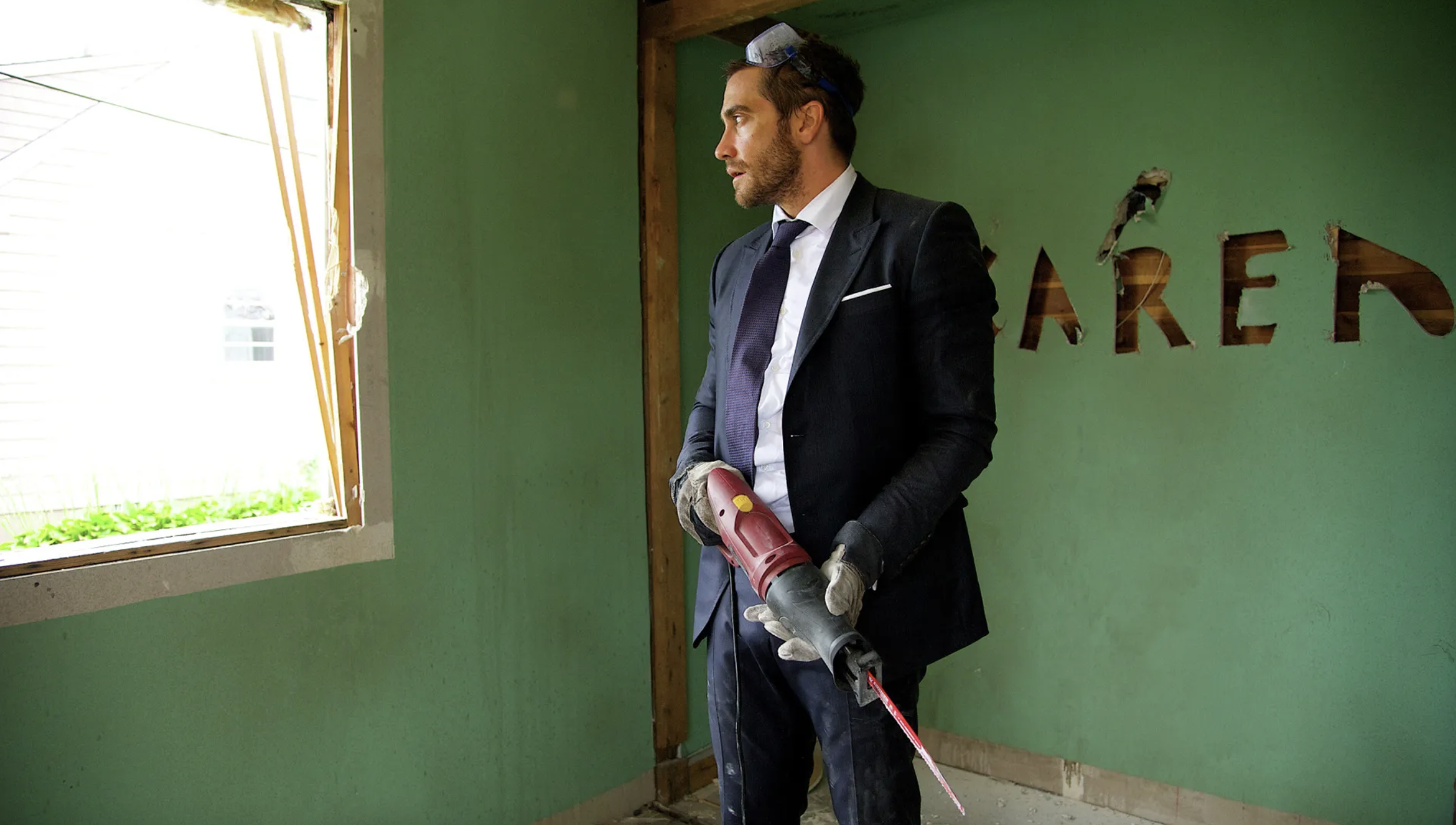
Demolition follows Davis Mitchell (Jake Gyllenhaal), a thirty-something late-blooming finance bro who becomes a widower in a car accident. As close to his emotions as a finance bro can be, Davis grieves by writing formal complaint letters to a vending machine company, destroying his own appliances with a disturbing lack of urgency, and sidestepping the first ever display of good faith from his father-in-law (Chris Cooper). Once the universe puts a crack in the identity he never asked for, Davis becomes obsessed with tearing it apart piece by piece.
Destroying yourself to become someone else
I wouldn’t call Demolition strange. We're not in David Lynch territory, there’s no backwards-talking little people or dream villains. But it’s atypical in a quieter, more frustrating way. It builds tension without offering the usual emotional payoff. There’s no triumphant breakthrough or cathartic collapse. Davis Mitchell doesn’t "learn to grieve," because Demolition isn’t about grief as a clean process. It’s about confusion. About disassembly. About realizing you’ve been living someone else’s idea of a life and deciding, almost arbitrarily, to burn it down.
Yes, Davis is mourning. But not his wife. He’s mourning a version of himself he never actually wanted to be.
The trick is that he didn’t know that until she was gone. When the illusion cracked, when the immaculate portrait of his life started to smudge, he could finally see the truth in it. And instead of repairing what was broken, he started tearing it apart. Not in rage, but with almost scientific detachment. Davis still doesn’t know who he is or what he wants. But he starts to figure it out by eliminating what he doesn’t want. That’s not exactly self-help canon, but it’s somewhere between Fight Club and Eat, Pray, Love, which is a sentence I never expected to write but feels weirdly accurate nonetheless.
The film never spoonfeeds him a revelation. There’s no big speech, no dramatic shift. But Davis does start orbiting around people who need something from him, specifically, his blankness. His honesty. His weird refusal to pretend. Emotional transparency becomes his only real currency. And even though he’s living through the fallout of a completely pre-scripted identity, he starts to become useful to other people by refusing to play along anymore.
There’s also this odd turn where the film hands him a symbolic wife and son, Karen (Naomi Watts), the customer service rep, and her troubled kid (Judah Lewis), who practically assigns Davis emotional homework. It shouldn’t work. It’s too neat. But somehow, because the film never pretends they’re literally his new family, the metaphor feels earned. They aren’t replacements. They’re co-conspirators in a world where nobody really knows how to feel anything real until something breaks.
The Subtle Art of Adulting
What makes Demolition so emotionally uncomfortable is that it flirts with a fantasy most adults have, whether they admit it or not: the fantasy of walking away from your own life. Moving away to Thailand and starting a deluxe sandwich shop for overfed, opulent tourists on the beach. Everyone’s imagined it. Few get the opportunity. Fewer still take it. Davis does. And not heroically, but because the scaffolding collapses underneath him and he decides not to rebuild it.
Jean-Marc Vallée and screenwriter Bryan Sipe dig into a kind of everyday determinism that rarely gets interrogated. The "go to school, get a job, get married" model. The path that isn’t quite mandatory, but is treated like gravity. Even in an era where social structures have allegedly evolved, most people still default to the script because it’s comforting. You assume that if enough people are doing it, there must be a payoff at the end. But Demolition suggests otherwise. Davis is like a gold miner who never finds gold, just endless dirt. And instead of quitting, he starts to enjoy the digging.
There’s freedom in the excavation itself, even if it doesn’t lead anywhere.
*
Demolition is the kind of movie that gets under your skin without quite telling you how or why. It’s so emotionally off-key in such an intentional way that I suspect a year from now I’ll wonder if I actually saw it or just dreamed it. It looks and feels like real life, but operates on the logic of a nervous breakdown, quiet, relentless, and weirdly coherent.
I wish the film asked better questions. I wish it didn’t treat family as the inevitable reward for personal growth. But then again, life bugs me that way too. Demolition doesn’t give answers. But it makes you feel the discomfort of living without them, which is a rare thing to find in a film. It’s frustrating and honest and, for two hours, it’s enough. Demolition might not be memorable, but it's very good and sometimes it's all a film needs to be.
7.8/10
* Follow me on Instagram and Bluesky to keep up with new posts *